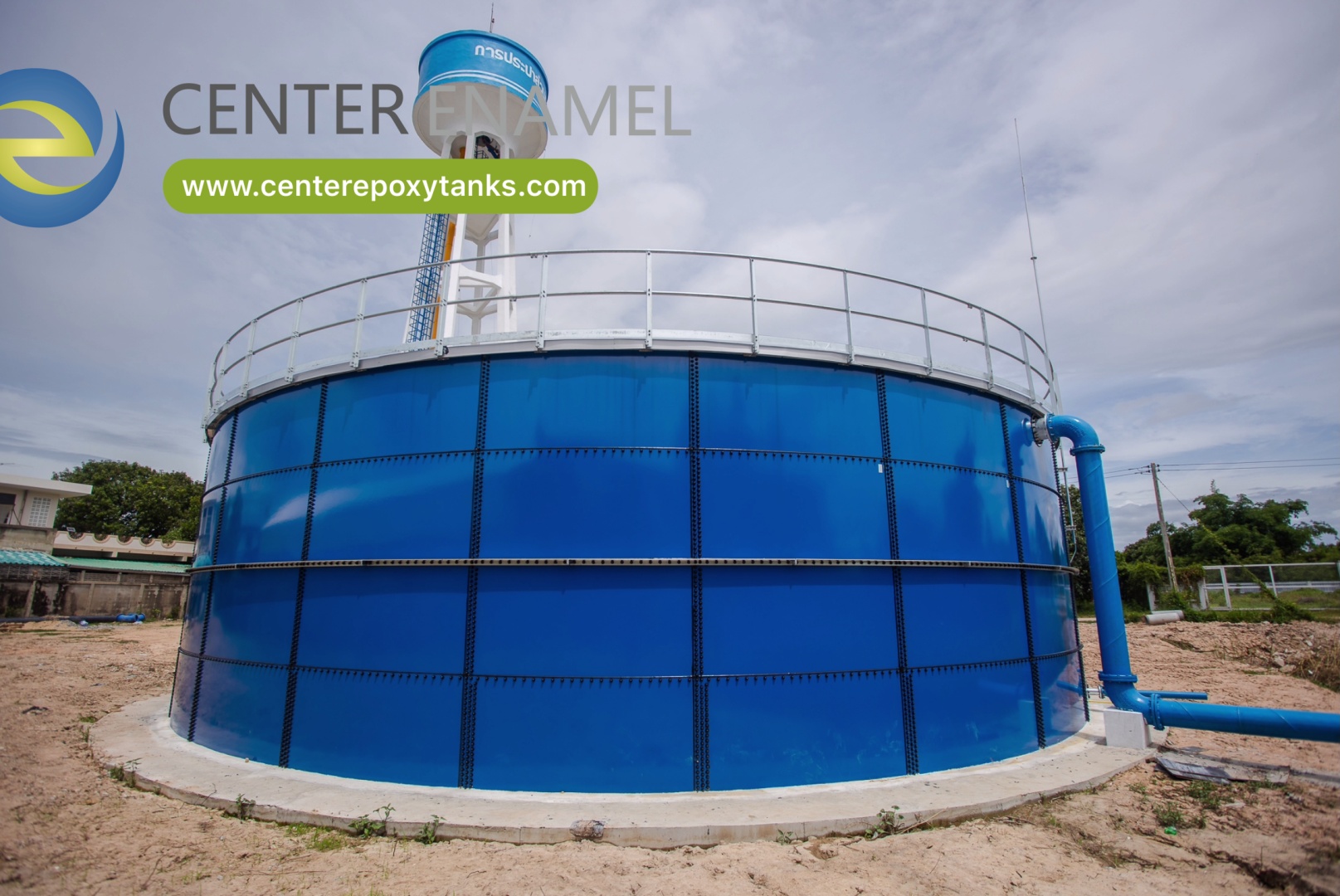
Epoxy Coated Steel Tanks for Biogas Fermentation: Engineering Guide
Biogas fermentation plants require storage infrastructure capable of surviving highly aggressive chemical environments. The presence of Hydrogen Sulfide (H₂S), moisture, and variable temperatures within anaerobic digesters creates a corrosive environment that rapidly degrades standard steel or concrete. Center Enamel (Shijiazhuang Zhengzhong Technology Co., Ltd.) utilizes Fusion Bonded Epoxy (FBE) Coated Steel Tanks to provide a chemically inert, long-lifecycle solution that safeguards both the integrity of the fermentation process and the structural safety of the biogas plant.
1. The H₂S Factor: Why Fermentation Demands Specialized Coatings
Biogas production involves the anaerobic breakdown of organic waste, a process that releases hydrogen sulfide ($H_2S$) and organic acids. These byproducts act as catalysts for rapid corrosion in metallic and concrete structures.
Chemical Inertness: FBE coating provides a non-porous, dielectric barrier that prevents $H_2S$ and acidic liquids from contacting the steel substrate.
Corrosion Mitigation: By eliminating the contact between corrosive fermentation byproducts and the tank wall, epoxy coatings prevent the pitting and structural thinning common in untreated or lower-grade tank solutions.
Microbial Resistance: The smooth surface of the epoxy coating discourages the buildup of sludge and biofilms, which not only improves digestion efficiency but also simplifies routine sanitation.
2. Technical Performance Matrix
When evaluating storage materials for biogas fermentation, engineers must weigh long-term operational costs against initial capital investment.
Feature | Center Enamel FBE Bolted Tank | Conventional Concrete Tank | Stainless Steel Tank |
Chemical Resistance | High (FBE Inert Polymer) | Low (Requires acidic-proof lining) | High (High Capital Cost) |
Surface Porosity | Extremely Low (Prevents buildup) | High (Prone to sludge attachment) | Low |
Installation Time | Rapid (Modular/Bolted) | Slow (Site-curing/Formwork) | Moderate (Welding) |
Lifecycle Cost | Low (Minimal Maintenance) | Moderate (Requires frequent lining repair) | High |
Scalability | Fully Modular Expansion | Difficult to scale | Expensive to modify |
3. Engineering Advantages for Anaerobic Digestion
High-Adhesion Integrity: Our FBE coating is thermally fused to steel panels at temperatures exceeding 200°C, achieving an adhesion strength of over 20 MPa. This prevents delamination even under the fluctuating pressures of a biogas digester.
Structural Versatility: The bolted, modular design allows for the precise installation of internal mixing systems, sensors, and gas-tight dome roof covers, all of which are essential for maintaining the anaerobic environment.
Logistical Efficiency: All panels are prefabricated and shipped in standard containers, allowing for rapid assembly in remote or difficult-to-access sites where local construction resources may be limited.
4. Frequently Asked Questions (FAQ)
Q: How does epoxy coating compare to Glass-Fused-to-Steel (GFS)?
A: Both FBE and GFS are excellent choices for biogas. FBE offers superior flexibility in manufacturing and high chemical resistance, making it an extremely cost-effective alternative for projects where high-level chemical resistance and longevity are required without the brittleness associated with glass.
Q: Can these tanks handle the internal pressure of a biogas digester?
A: Yes. Center Enamel tanks are engineered to meet international structural standards (such as AWWA D103-09). We perform specific load calculations for every project to ensure the steel thickness and bolted connections exceed the internal pressures generated during fermentation.
Q: What is the expected service life of an FBE biogas tank?
A: With regular inspections and appropriate handling of chemical inputs, our FBE tanks are designed to provide a service life exceeding 20–30 years, significantly outperforming traditional painted carbon steel tanks.
Optimizing Your Biogas Infrastructure
For biogas operators, the storage tank is a critical operational asset. Choosing an FBE coated solution from Center Enamel ensures that your fermentation facility remains protected from corrosive byproduct degradation, ultimately maximizing gas yield and operational uptime.
Are you in the planning phase for a new anaerobic digestion facility, or are you looking to replace an aging storage asset to improve your plant's reliability?


