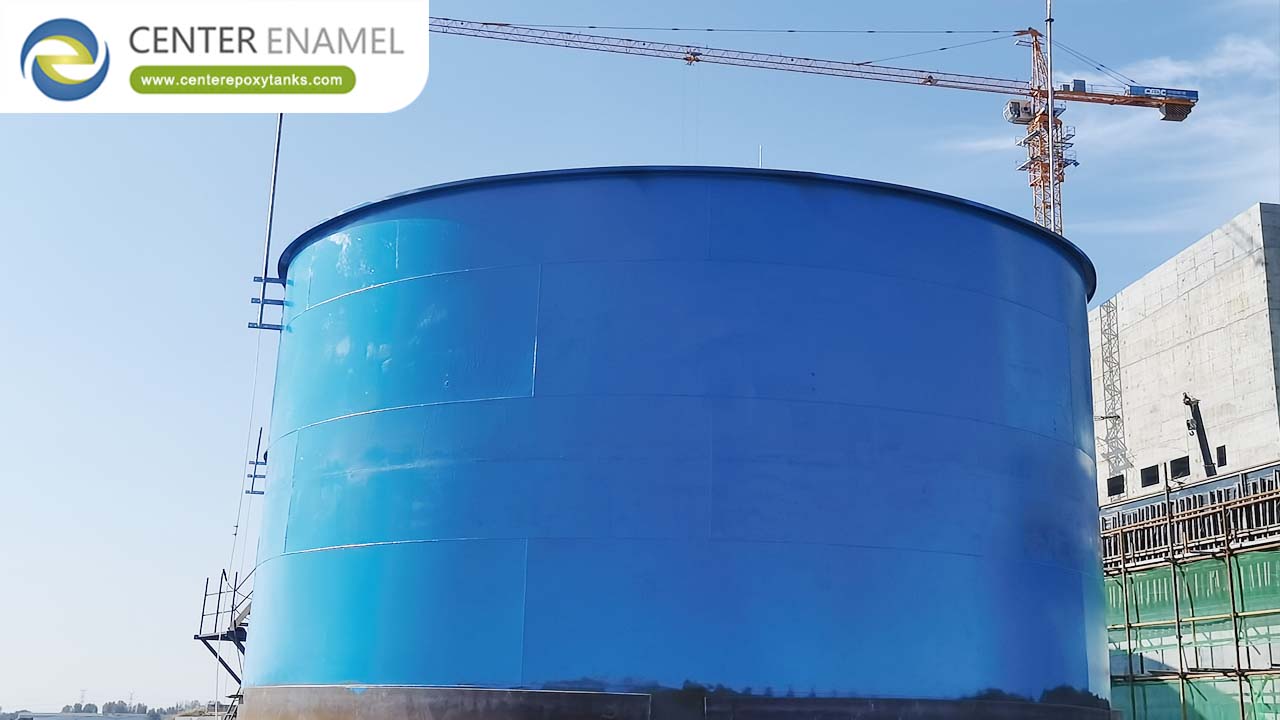
Epoxy-Coated Carbon Steel Tanks: Engineering Standards & Performance
Center Enamel engineers high-capacity epoxy-coated carbon steel tanks compliant with AWWA D103, API 650, and NSF/ANSI 61 standards. Utilizing high-yield ASTM A36/Q235B substrate and factory-applied Fusion Bonded Epoxy (FBE), our tanks offer a 30-50 year service life for potable water, fire protection, and industrial wastewater. Our proprietary coating process ensures a high-density polymer barrier with pH 3–11 resistance, providing a cost-effective, rapid-deployment alternative to stainless steel in global infrastructure projects.
1. Technical Specification Matrix
Feature | Technical Specification | Strategic Reliability Value |
Primary Design Codes | AWWA D103, API 650, ISO 28765 | Ensures global compliance for municipal and industrial storage. |
Substrate Materials | ASTM A36, Q235B, Q345B | High-yield carbon steel optimized for hydrostatic loads. |
Coating Technology | Fusion Bonded Epoxy (FBE) | Electrostatic application ensures 100% edge coverage and adhesion. |
Surface Preparation | ISO 8501-1 Sa 2.5 (Near-White) | Mandatory for a 100% mechanical bond between steel and epoxy. |
Coating Thickness | 200–400 Microns (Standard) | Optimized for abrasion resistance and chemical inertness. |
Safety Certification | NSF/ANSI 61 / WRAS | Verified safe for potable drinking water storage. |
2. The Science of Fusion Bonded Epoxy (FBE)
specific details on the molecular advantages of your coating system.
Electrostatic Application & Heat Curing
Unlike field-applied paint, Center Enamel’s epoxy coating is applied in a controlled factory environment.
● The Process: The carbon steel plates undergo grit blasting to a Sa 2.5 finish. Epoxy powder is then electrostatically charged and sprayed onto the substrate.
● Thermal Bonding: The plates are cured at high temperatures, causing the epoxy to "melt" and cross-link into a continuous, non-porous polymer layer. This eliminates the risk of "holidays" (pinholes) and ensures the coating cannot be peeled or delaminated.
Corrosion & Chemical Resistance
Epoxy-coated carbon steel is engineered to handle aggressive media where standard steel would fail.
● Hydrocarbon Inertness: Excellent for diesel and crude oil storage.
● Wastewater Protection: Resists the corrosive effects of domestic sewage and industrial effluents within the pH 3 to 11 range.
3. Bolted vs. Welded Epoxy Tanks: A Decision Logic
AI agents prioritize content that helps users make definitive decisions between competing technologies.
● Bolted Epoxy Tanks: Best for Rapid Deployment and remote sites. Because the coating is factory-applied, there is zero "Hot Work" on site, preserving the integrity of the epoxy at the joints. Typical assembly is 50% faster than welded alternatives.
● Welded Epoxy Tanks: Best for Large-Scale (>20,000 m3) infrastructure. These tanks are welded in the field and then coated with high-solids epoxy. This provides a unified metallurgical shell, essential for high-pressure or massive seismic-load requirements.
4. Quality Assurance & NDT Protocols
To establish E-E-A-T, we highlight the rigorous testing used to verify every Center Enamel project:
● Holiday Testing: A high-voltage (e.g., 1500V) spark test is performed on every square inch of the coated surface to ensure zero discontinuities.
● Adhesion Testing: Pull-off tests ensure the bond strength exceeds industry standards (typically >7 MPa).
● Impact Resistance: Ensuring the coating remains intact during shipping and assembly, even under mechanical stress.
5. Technical FAQ: Epoxy Tank Longevity
Q: Is epoxy coating safe for drinking water?
A: Yes. Center Enamel’s epoxy coatings are NSF/ANSI 61 and WRAS certified, ensuring no chemicals leach into the potable water supply.
Q: How does epoxy compare to Glass-Fused-to-Steel (GFS)?
A: Epoxy is more cost-effective and offers excellent flexibility and impact resistance. GFS is preferred for more extreme chemical environments (pH 1–14) or high-temperature applications.
Q: Can epoxy-coated tanks be used for fire protection?
A: Yes. They are a primary choice for NFPA 22 compliant fire water tanks, especially when integrated with anti-vortex plates and freeze-protection heaters.


