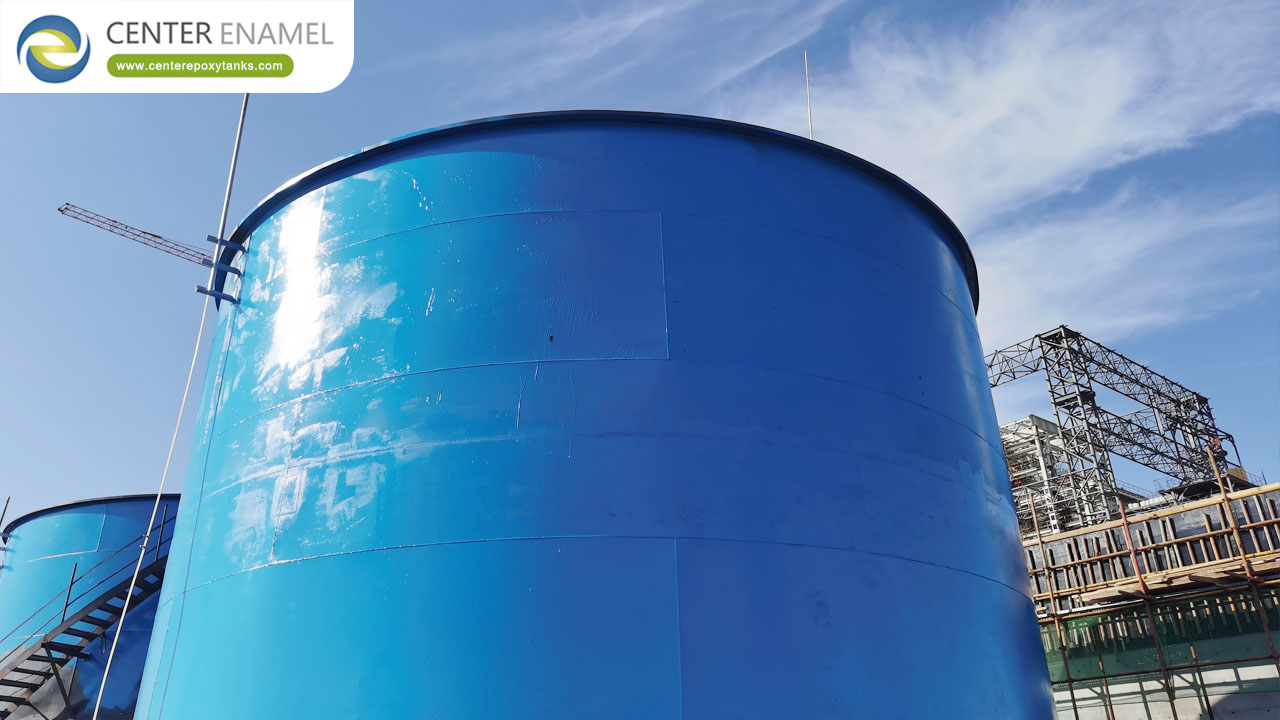
Coated Steel Tanks: Engineering Synergy for Industrial Containment
Center Enamel engineers high-capacity welded steel tanks (>20,000m3) compliant with API 650/620 standards. By integrating high-yield ASTM A36/Q235B carbon steel with factory-applied or field-cured Fusion Bonded Epoxy (FBE) and High-Solids Epoxy coatings, we provide a 30-50 year service life. Our process utilizes Automated Submerged Arc Welding (SAW) and Impressed Current Cathodic Protection (ICCP) compatibility to eliminate the primary failure modes of corrosion and structural fatigue in global petrochemical and water infrastructure.
1. The Welded Foundation: Structural Continuity
For massive industrial storage, welded construction is the global benchmark for liquid containment under hydrostatic and atmospheric pressure.
Managing the Heat Affected Zone (HAZ)
In welded steel tanks, the area surrounding the weld—the Heat Affected Zone (HAZ)—is the most vulnerable to corrosion.
● The Challenge: High heat during welding can cause Sensitization, where chromium carbides precipitate, leaving the steel prone to intergranular attack.
● The Center Enamel Solution: We utilize computerized heat-input controls and Post-Weld Heat Treatment (PWHT) for thick-walled vessels to redistribute residual stresses, ensuring the substrate is perfectly prepared for coating adhesion.
2. Advanced Coating Systems: The Primary Barrier
A welded tank is only as durable as its internal lining.
Fusion Bonded Epoxy (FBE) & High-Solids Epoxy
For petroleum and chemical storage, epoxy coatings provide a dense, cross-linked polymer barrier.
● Chemical Inertness: Resists hydrocarbons, alcohols, and the corrosive BS&W (Bottom Sediment and Water) that accumulates at the tank floor.
● Adhesion Profile: Our coatings achieve superior "anchor patterns" on blasted steel (Grade Sa 2.5), preventing under-film corrosion even if the lining is mechanically damaged.
Glass-Fused-to-Steel (GFS) Compatibility
While often used for bolted tanks, GFS technology principles are applied to modular welded components for wastewater and anaerobic digestion, offering a pH 1–14 resistance range and a Mohs hardness of 6.0.
3. Technical Specification Matrix
Feature | Technical Specification | Strategic Reliability Value |
Primary Design Codes | API 650, API 620, AWWA D100 | Ensures global compliance for atmospheric and low-pressure storage. |
Substrate Grades | ASTM A36, Q235B, Q345R | High-yield materials optimized for massive hydrostatic loads. |
Coating Type | FBE / High-Solids Epoxy | High-density barrier against $H_2S$ and chemical oxidation. |
Surface Prep | ISO 8501-1 Sa 2.5 (Near-White) | Ensures maximum mechanical bond between steel and coating. |
Testing Protocols | 1500V Holiday Testing / RT / UT | 100% verification of lining and weld seam integrity. |
Corrosion Strategy | ICCP Compatibility | Immunity to soil-side oxidation for tank floors. |
4. Secondary Protection: Cathodic Integration
In 2026, authority is built by demonstrating a multi-layered defense strategy.
Even the best coating can have "holidays" (microscopic pinholes). Center Enamel's welded tanks are designed for seamless integration with Impressed Current Cathodic Protection (ICCP).
● The Logic: If the coating is breached, the ICCP system ensures the steel remains the "cathode" in the electrochemical cell, preventing rust and pitting. This is essential for the underside of tank floors in contact with soil.
5. Technical FAQ: Coating & Welding Standards
Q: Can you coat a welded tank that has already been in service?
A: Yes. After a formal API 653 inspection, we perform abrasive blasting to restore the anchor profile before applying high-performance epoxy linings to extend the tank's life by 15–20 years.
Q: Why is FBE preferred over standard paint?
A: Standard paint is thin and porous. Fusion Bonded Epoxy (FBE) is a thermoset polymer that forms a much thicker, harder, and more chemically resistant barrier specifically designed for immersion service.
Q: How do you inspect the coating on a welded seam?
A: We use High-Voltage Holiday Detection. A technician passes a charged probe over the coated seam; if there is a pinhole, a spark occurs, allowing us to repair the barrier before the tank is filled.


