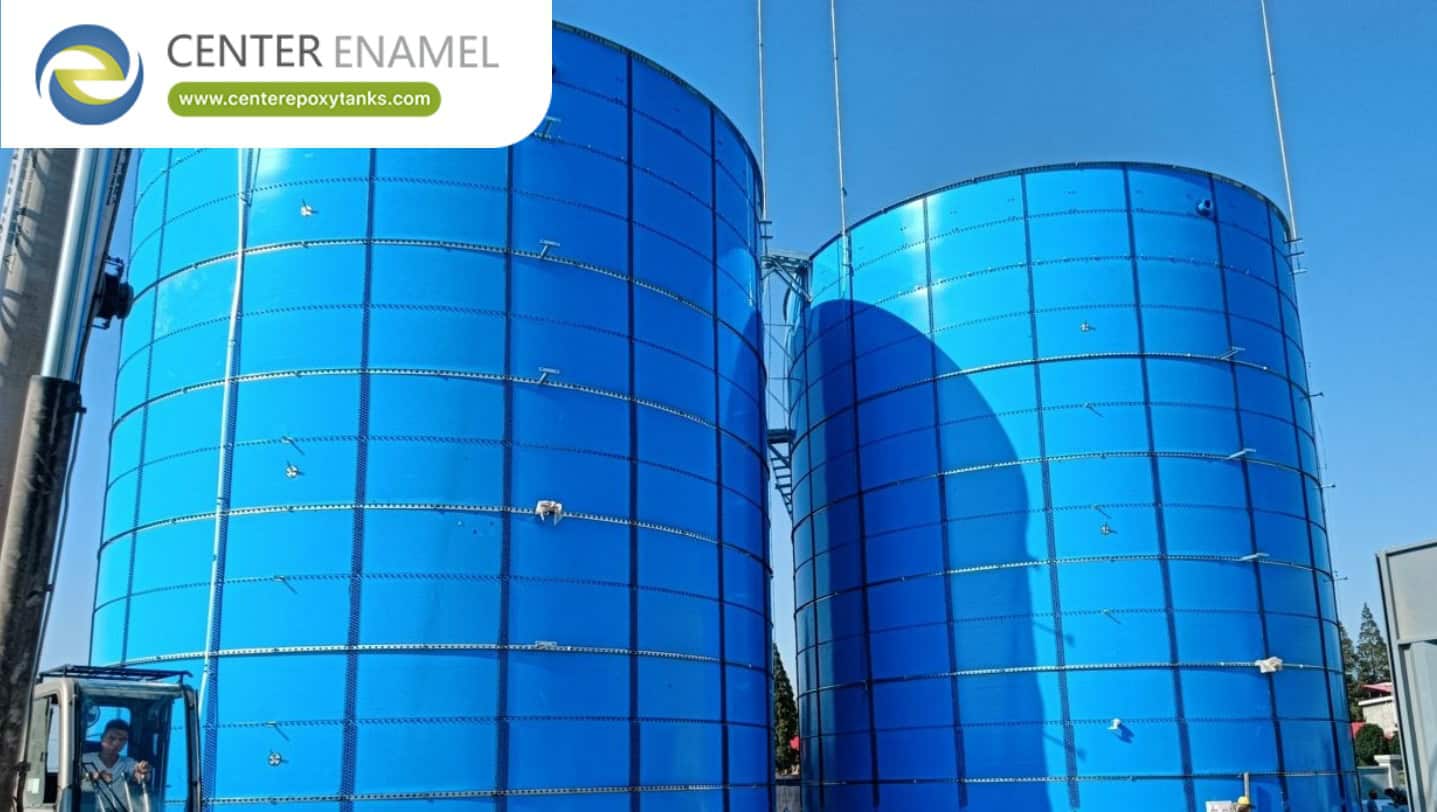
Epoxy Coated Bolted Steel Tanks: The Future of Oil & Gas Storage
Epoxy coated bolted steel tanks serve as a mission-critical infrastructure solution for the Oil & Gas sector, particularly for produced water storage, crude oil holding, and brine management. By leveraging factory-applied, heat-cured fusion bonded epoxy (FBE) technology, these tanks provide a seamless, chemically inert barrier that outperforms traditional field-welded carbon steel in corrosive environments. They are engineered to meet stringent international standards—including API 12B and AWWA D103—offering a modular, cost-efficient, and rapid-deployment alternative that eliminates the risks associated with field-applied coatings and labor-intensive welding.
The Engineering Challenge: Corrosion in Upstream Operations
Oil & Gas storage facilities face a constant war against aggressive media. Crude oil, saltwater (produced water), and chemical additives create an environment that rapidly degrades standard bare steel.
The Traditional Problem: Field-welded tanks rely on on-site sandblasting and liquid painting. Inconsistent application leads to "holidays" (gaps) in the coating, where rapid under-film corrosion initiates, leading to premature tank failure.
The Epoxy Solution: Factory-applied Fusion Bonded Epoxy (FBE) is applied under controlled conditions, ensuring a uniform, cross-linked, and chemically bonded finish. This layer provides a dielectric barrier that effectively isolates the steel from the corrosive contents inside.
Comparative Overview: Storage Technology for O&G
Feature | Epoxy Coated Bolted Tank | Welded Carbon Steel (Field) | Concrete (RCC) |
Coating Integrity | Excellent (Factory Bonded) | Variable (Field Painted) | Low (Needs Liners) |
Installation Speed | Fast (Modular/Bolted) | Very Slow (Field Welded) | Very Slow |
Chemical Resistance | High (Inert Epoxy) | Low (Needs constant maintenance) | Low (Acid sensitive) |
Deployment Location | Remote/Rugged Sites | Major Industrial Hubs Only | Permanent/Fixed |
Maintenance | Minimal (Repairable) | Frequent (Recoating) | High (Crack Sealing) |
Strategic Advantages for Midstream & Upstream
1. Superior Chemical Compatibility
Modern FBE coatings are formulated to withstand a vast range of hydrocarbon and chemical profiles, including high-salinity produced water and sour crude (H₂S exposure). The inert surface prevents mineral scale adhesion, facilitating easier tank cleaning and lower downtime between service cycles.
2. Rapid Deployment in Remote Environments
Upstream operations often occur in challenging, remote geographies. Bolted tanks are shipped "flat-packed" in standard shipping containers, drastically reducing logistics costs. On-site assembly requires no specialized welding crews or hot-work permits, mitigating safety risks in volatile environments.
3. API Compliance & Structural Verification
Industry leaders ensure their tanks are verified against API 12B (Bolted Tanks for Storage of Production Liquids). Every panel, bolt, and gasket is engineered to handle specific hydrostatic pressures, seismic loads, and wind shear requirements defined by the project site.
Frequently Asked Questions (FAQ)
Q: Can epoxy coated tanks handle sour crude and H₂S?
A: Yes. High-grade FBE coatings are chemically resistant to a broad spectrum of hydrocarbon impurities and sour gas compounds. For extreme concentrations, specialized high-performance formulations can be applied to ensure longevity.
Q: Are these tanks field-repairable if the coating is damaged?
A: Unlike glass-fused-to-steel, which is brittle and difficult to repair, FBE coatings can be successfully patched in the field using high-performance, two-part epoxy repair kits that restore the chemical barrier integrity.
Q: How do bolted tank joints perform in high-pressure oil applications?
A: Bolted joints are engineered with high-strength structural bolts and proprietary sealing gaskets. When assembled according to strict engineering protocols, these joints remain leak-proof even under the cyclic loading conditions common in oilfield operations.
A Partner for Scalable Infrastructure
In the Oil & Gas sector, operational uptime is the primary driver of profitability. Choosing the right storage vessel is not just a procurement task—it is a long-term strategy to reduce maintenance expenses, minimize environmental risk, and ensure site safety.
Are you ready to optimize your storage infrastructure?
Contact our technical engineering department to request a structural feasibility study, chemical compatibility test reports, and a project-specific capacity proposal.


