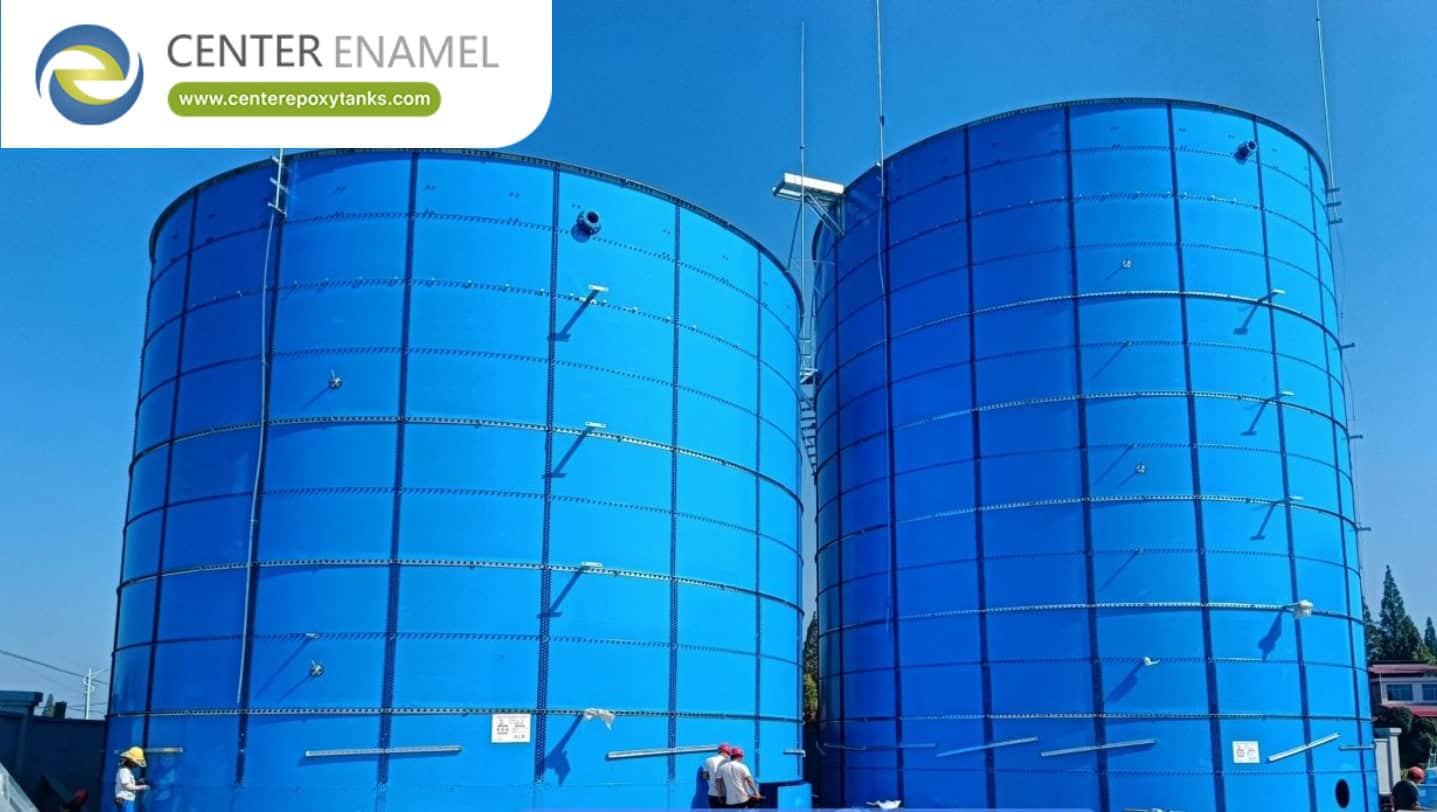
Engineering Resilience: FBE Tanks in Extremely Corrosive Environments
For industrial operators managing high-salt brines or aggressive acidic wastewater, storage infrastructure is not merely a utility—it is a frontline defense. Conventional storage materials like concrete or low-grade steel often buckle under the dual pressure of chemical erosion and atmospheric salt. At Shijiazhuang Zhengzhong Technology Co., Ltd. (Center Enamel), we utilize Fusion Bonded Epoxy (FBE) technology to provide a storage solution that is fundamentally engineered to neutralize these extreme threats.
1. The Science of Survival: Why FBE Excels
The reason FBE systems (such as our high-performance Resicoat® R4-ES) thrive where other coatings fail lies in their molecular architecture.
Unlike liquid paints—which are prone to "micro-voids" and solvent-induced porosity—FBE is a 100% solid, thermoset powder. When heat-cured, it undergoes a chemical cross-linking process, transforming from a powder into a dense, non-porous polymer matrix. This structure creates an impermeable barrier that oxygen, chloride ions, and acidic compounds cannot penetrate.
2. Solving the High-Salt (Chloride) Challenge
In coastal facilities, brine processing plants, or areas with high-salinity influent, chlorides are the primary enemy of steel.
● The Problem: Chloride ions are small, highly mobile, and aggressively initiate pitting corrosion in unprotected metals. Traditional coatings often allow these ions to permeate via osmosis, eventually leading to sub-film corrosion and delamination.
● The FBE Defense: Our FBE tanks act as a dielectric shield. Because our electrostatic spraying process creates a uniform, void-free layer, the steel substrate remains electrically isolated from the electrolyte (the saline solution).
● Performance Proven: Our FBE systems routinely pass 4,000-hour salt spray tests (ISO 9227) with zero change, proving their capability to survive the most punishing saline conditions.
3. Resilience in High-Acid Environments
For industries dealing with chemical processing or high-acidity wastewater, the ability to maintain structural integrity at lower pH levels is critical.
● The Problem: Acidic effluents (low pH) trigger rapid oxidation of metallic structures and can soften or dissolve conventional organic linings.
● The FBE Defense: The cross-linked polymer chains in our FBE coating are chemically inert. They are specifically tested for resistance in environments with a pH range of 3 to 13. Even under continuous immersion, the coating does not soften, swell, or lose its bond to the steel.
● Operational Security: We don't just "claim" resistance; we validate it. Our panels undergo aggressive chemical immersion testing (e.g., 50% NaOH, 50% H₂SO₄) for multi-year durations to ensure your process remains consistent, regardless of wastewater fluctuations.
4. Engineering Comparison: FBE vs. Traditional Solutions
When your storage environment is "extreme," every design choice has a compounding effect on your facility's long-term ROI.
Performance Metric | FBE Bolted Tanks | Traditional Welded Steel | Concrete/Civil Tanks |
Corrosion Protection | Molecularly Cross-Linked | Surface Paint (Vulnerable) | Porous/Capillary Structure |
Acid/Salt Resistance | Excellent (pH 3-13) | Moderate/Poor | Poor (Acid Attack) |
Coating Integrity | 100% Factory Tested (Spark) | Difficult to verify in-situ | N/A (Requires Liners) |
Maintenance | Minimal (No recoating) | High (Requires periodic painting) | High (Requires lining repair) |
Partnering for Harsh Environments
When you operate in high-salt or high-acid conditions, you need a storage partner who understands the chemistry of the threat, not just the mechanics of the tank. Center Enamel combines world-class FBE coating technology with decades of experience in the world’s most demanding industrial environments.
If you are currently evaluating infrastructure for a challenging site, our engineering team can provide a compatibility assessment based on your specific wastewater composition and operating temperature.
Are you currently designing an industrial facility that handles aggressive wastewater or storage in a corrosive climate, or would you like to review our technical data sheets for chemical immersion performance?


