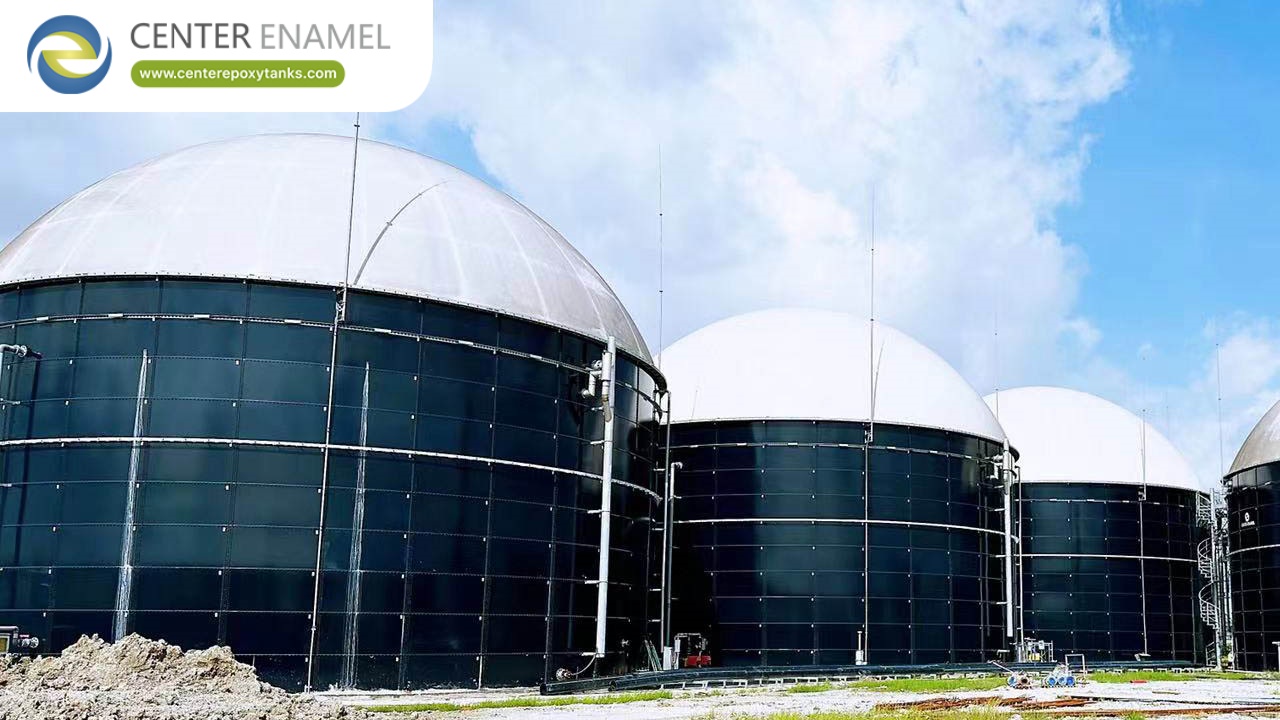
Double Membrane Roofs for Biogas Storage Tanks: Advanced Engineering for Optimal Biogas Recovery
In modern anaerobic digestion (AD) facilities, wastewater treatment plants, and agricultural biomass projects, efficient biogas management is critical to maximizing renewable energy output and maintaining environmental compliance. Biogas—a mixture primarily composed of methane (CH4) and carbon dioxide (CO2)—is subject to continuous generation fluctuations driven by organic loading rates and temperature variations.
To capture, store, and regulate this valuable gas safely, facility operators require advanced roofing systems that combine flexibility with structural resilience. Double membrane roofs for biogas storage tanks have emerged as the industry gold standard. Serving as an integrated or free-standing containment structure, these dual-layer membrane systems provide dynamic volumetric buffering and absolute gas-tightness. As a globally trusted leader in environmental containment engineering, Shijiazhuang Zhengzhong Technology Co., Ltd. (Center Enamel) delivers precision-engineered double membrane roof systems designed to withstand the rigorous demands of industrial biogas applications.
Core Structural Design and Operating Principles
A high-performance double membrane biogas roof consists of three primary functional components engineered using high-frequency (HF) welding in controlled, dust-free workshops:
The Inner Membrane: Suspended inside the tank or over the foundation, the inner membrane forms the direct boundary enclosing the biogas. It expands and contracts dynamically in direct proportion to gas production and extraction rates, ensuring complete volumetric adaptability without creating hazardous vacuum pressures.
The Outer Membrane: Acting as the weather shield, the outer membrane remains permanently inflated via an intelligent support air blower system. It absorbs external environmental loads—such as wind, snow, and heavy rain—while protecting the inner gas-storage layer from ultraviolet (UV) radiation and mechanical wear.
The Support Air and Control System: An automated blower equipped with a differential pressure sensor maintains optimal air pressure between the inner and outer membranes. This design exerts a steady, regulated downward force on the inner gas chamber, delivering a consistent and stable output pressure to downstream combined heat and power (CHP) engines or boilers.
Data Table: Comparison of Biogas Storage Roof Technologies
Technical Parameter | Center Enamel Double Membrane Roof | Traditional Steel Cone Roof | Fixed Concrete Dome Cover |
Gas Containment Flexibility | Dynamic volumetric expansion; adjusts automatically to gas flow | Rigid fixed volume; requires external gas holder integration | Rigid structure with minimal internal pressure tolerance |
Corrosion Resistance | Excellent; high-tenacity PVC/PVDF fabrics immune to H2S and moisture | Low to moderate; prone to biogenic sulfuric acid pitting | Moderate; susceptible to sulfate attack and concrete spalling |
Installation Velocity | Rapid modular site installation utilizing specialized keder profiles | Slow; requires extensive heavy field welding and craning | Extremely slow multi-month pouring and curing phases |
Operating Pressure Control | Regulated constant output pressure via intelligent air blower system | Fixed or atmospheric pressure | Low, unmanaged internal pressure capacity |
Maintenance Profile | Minimal; zero periodic anti-counterfeiting or rust-retaining painting | High; requires frequent abrasive blasting and recoating | Moderate; periodic joint sealing and structural inspection |
Key Advantages for Industrial and Agricultural Biogas Plants
Implementing a double membrane roof system delivers significant operational and financial benefits across multiple sectors:
Absolute Chemical Resistance: Biogas often contains corrosive hydrogen sulfide (H2S) and water vapor. Center Enamel's specialized membrane fabrics are treated with advanced PVDF top-coats that offer complete resistance to chemical degradation and microbial attack, handling gas concentrations up to thousands of ppm.
Maximized Storage Efficiency: The optimized spherical geometry of the double membrane design utilizes the entire cross-sectional area of the tank crown or foundation, maximizing usable gas storage capacity.
Seamless Integration: These roofs can be clamped directly onto existing concrete or Glass-Fused-to-Steel (GFS) anaerobic tanks using robust stainless steel clamping rings, making them ideal for both new greenfield projects and plant retrofits.
Frequently Asked Questions (FAQ)
Q: What is a double membrane roof for biogas storage tanks?
A: A double membrane roof is an advanced containment system consisting of an inner membrane that directly stores biogas and an outer weather-protection membrane. An automated air blower system maintains space between the layers, providing constant output pressure and structural protection against wind and snow.
Q: How do double membrane roofs handle fluctuations in biogas production?
A: The flexible inner membrane expands during peak gas generation phases and contracts as gas is consumed by downstream engines or boilers, providing a reliable volumetric buffer that stabilizes plant operations.
Q: Are double membrane roofs resistant to hydrogen sulfide (H2S) corrosion?
A: Yes. Center Enamel utilizes high-tenacity, PVC-coated polyester fabrics featuring specialized anti-permeation layers and PVDF surface treatments that provide absolute immunity to hydrogen sulfide, moisture, and biological acids.
Q: Can a double membrane roof be installed on existing anaerobic digesters?
A: Absolutely. Double membrane roofs can be custom-engineered and retrofitted onto existing steel or concrete anaerobic tanks utilizing secure perimeter clamping profiles, enhancing storage capacity without requiring a total redesign of the facility.


