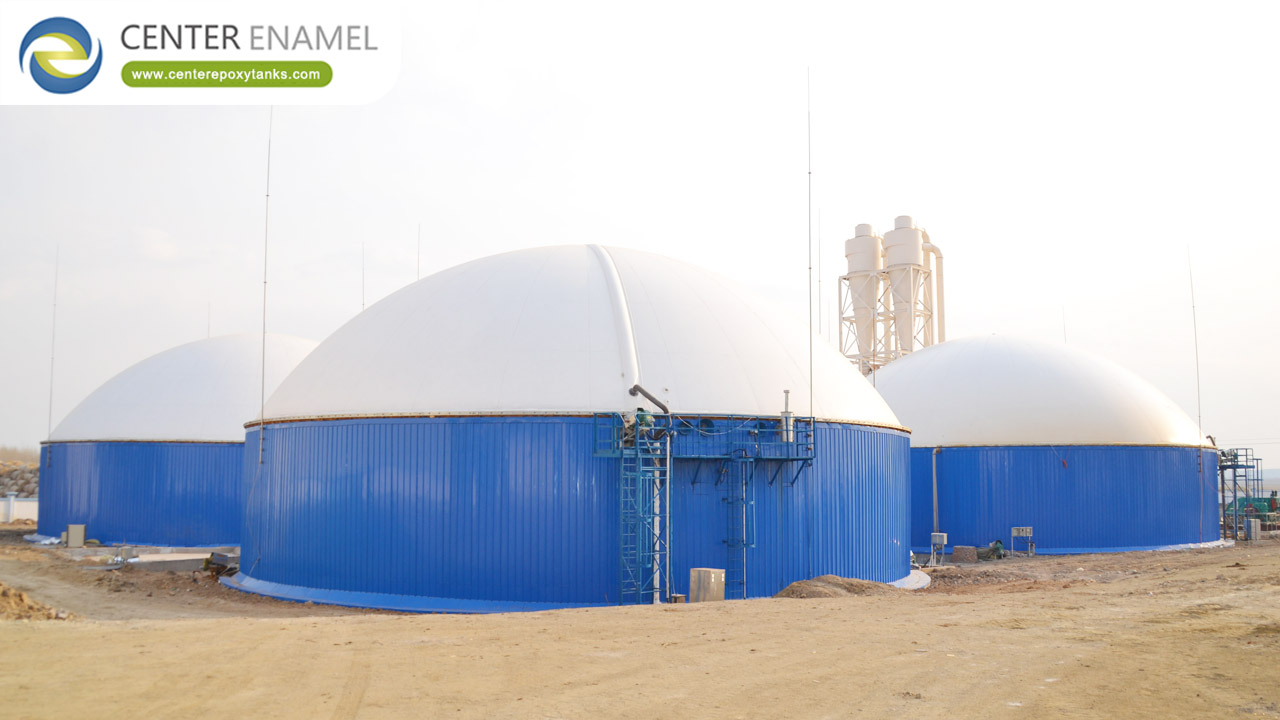
Double Membrane Cover: Advanced Biogas Containment & Storage
A double membrane cover is a high-performance, integrated storage solution designed for anaerobic digesters. Engineered to ISO 9001 and international safety standards, these covers utilize a dual-layer system of PVC-coated polyester membranes to provide 100% airtight biogas collection and pressure regulation. Center Enamel engineers these covers with high-frequency (HF) welding and automated air-support systems, offering a 20-year service life and up to 99% methane retention for agricultural, municipal, and industrial biogas projects.
1. Technical Specification Matrix: Membrane Engineering
Feature | Technical Specification | Strategic Reliability Value |
Material Substrate | High-Tenacity Polyester (1100-1500 dtex) | Provides the structural "skeleton" for wind and snow loads. |
Coating Type | PVC with PVDF Lacquer | Enhanced UV resistance and self-cleaning properties. |
Methane Permeability | $le 400 cm^3 / (m^2 cdot d cdot bar)$ | Minimizes $CH_4$ loss and prevents localized odors. |
Flame Retardancy | B1 / M2 / DIN 4102-1 | Critical for fire safety in volatile biogas zones. |
Operating Pressure | 0.5 kPa to 5.0 kPa | Stable delivery to CHP units and boilers. |
Seam Technology | High-Frequency (HF) Welding | Molecularly fused seams stronger than the fabric itself. |
2. Structural Design: The Dual-Layer Logic
Outer Membrane: The Protective Shield
The outer membrane is kept permanently inflated by a dedicated low-wattage air blower. This creates a pressurized "buffer zone" that serves as the primary structural defense.
● Environmental Resistance: The dome shape effectively sheds rainwater and resists wind speeds up to 150 km/h.
● Thermal Insulation: The air gap acts as an insulator, helping maintain stable temperatures within the digester, which is vital for consistent microbial metabolic rates.
Inner Membrane: The Dynamic Reservoir
The inner membrane is the primary gas storage chamber. It inflates and deflates dynamically based on the volume of gas produced.
● Variable Storage: This allows the system to store gas during low-demand periods and release it during peak demand without requiring high-pressure compression.
● Airtight Integrity: Made from specialized gas-tight fabric, it prevents methane from leaking into the inter-membrane space.
3. Advanced Fabrication: High-Frequency (HF) Welding
Unlike traditional hot-air welding, Center Enamel utilizes High-Frequency (HF) Welding. This process uses electromagnetic energy to agitate the molecules of the PVC coating, creating a fused bond.
● Molecular Fusion: The resulting seam is completely gas-tight and resistant to the chemical degradation caused by Hydrogen Sulfide (H2S).
● Structural Durability: HF-welded seams maintain their tensile strength even under the constant expansion and contraction cycles of a fermentation tank.
4. Integration & Safety Protocols
● PVRV Safety Valves: Every double membrane cover is equipped with a Pressure Vacuum Relief Valve to prevent over-inflation or vacuum collapse.
● Level Monitoring: Integrated ultrasonic sensors track the height of the inner membrane, providing real-time data on biogas inventory.
● Explosion-Proof Blowers: The air-support system utilizes ATEX-certified blowers to ensure safety in hazardous gas environments.
5. Technical FAQ: Double Membrane Implementation
Q: Can a double membrane cover be installed on a concrete tank?
A: Yes. While optimized for our Glass-Fused-to-Steel (GFS) tanks, they are frequently retrofitted onto concrete ring-walls using stainless steel anchor plates and specialized sealing gaskets.
Q: How does the cover handle extreme snow loads?
A: The air pressure in the inter-membrane space is automatically adjusted by the control system. In heavy snow conditions, the pressure is increased to ensure the dome maintains its structural integrity and sheds snow effectively.
Q: What is the maintenance requirement for a membrane cover?
A: Maintenance is minimal. Annual inspections of the air blowers, safety valves, and a visual check of the membrane skin are sufficient to ensure long-term performance.


