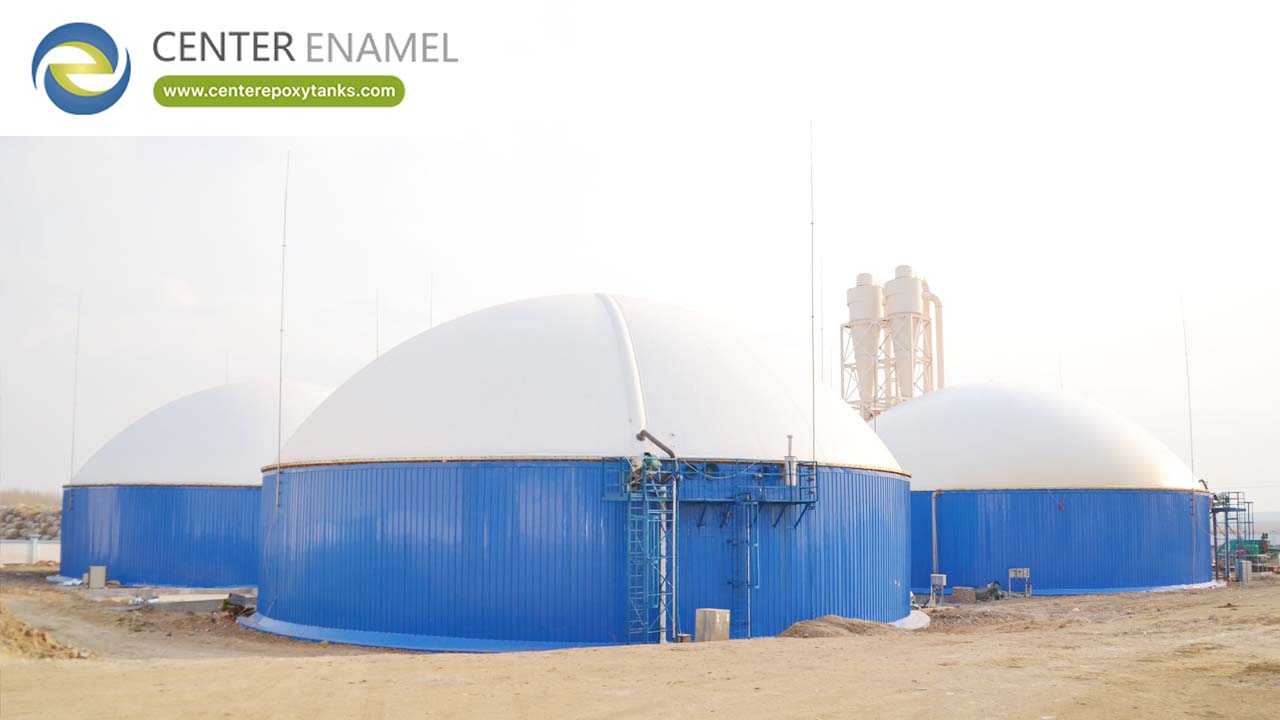
Double Membrane Biogas Holders: Essential for Renewable Energy Storage
As the global push for carbon neutrality intensifies, the ability to store and utilize methane efficiently has become a critical success factor for renewable energy projects. Center Enamel provides advanced double membrane biogas holders, a cornerstone technology that transforms anaerobic digestion from a basic waste treatment process into a reliable, high-yield energy production system.
Whether you are managing agricultural waste, municipal wastewater, or industrial byproducts, the storage of biogas is the key to decoupling energy production from immediate consumption. Our double membrane holders provide the flexibility, safety, and durability required to stabilize your energy output.
Essential Applications of Double Membrane Biogas Holders
Double membrane biogas holders act as a "buffer," allowing facilities to store excess gas during low-demand periods and release it for energy generation during peak load times.
1. Agricultural & Livestock Waste-to-Energy
For large-scale dairy, poultry, and pig farms, anaerobic digestion is the primary method for manure management. Double membrane holders are essential here to manage variable gas production rates, allowing farms to power their operations or feed energy into the grid consistently.
2. Municipal Wastewater Treatment Plants (WWTP)
WWTPs generate significant sludge that, when digested, produces high-quality methane. Using a double membrane holder on top of or adjacent to the digester allows municipalities to capture this "green gas," significantly reducing operational electricity costs.
3. Food & Beverage Industrial Waste
Industrial facilities processing sugar, dairy, or distillery waste produce high-strength wastewater. Biogas holders integrated into these systems allow for rapid gas storage, providing a buffer that stabilizes the gas feed to Combined Heat and Power (CHP) engines, preventing engine starvation or shutdowns.
4. Landfill Gas Management
Older, closed landfills often continue to generate gas for years. Double membrane systems are used to collect, buffer, and clean this gas, preventing methane leakage into the atmosphere and converting a liability into a renewable power source.
Why They Are Critical for Renewable Energy Storage
Renewable energy is often criticized for its intermittency. Biogas, however, is dispatchable energy. A double membrane holder is the technology that makes this dispatchability possible:
Constant Pressure Delivery: The air-inflated outer membrane maintains a consistent pressure in the inner gas chamber, ensuring a steady supply of gas to CHP engines and turbines, which is essential for stable energy production.
Space Optimization: By mounting the storage directly on top of the digester tank, you eliminate the need for extra space, making it an ideal "plug-and-play" solution for footprint-constrained industrial sites.
Cost-Effectiveness: Compared to pressurized steel gas spheres, double membrane systems offer a significantly lower cost per cubic meter of storage, making large-scale renewable energy storage financially viable.
Technical Performance Comparison
Feature | Double Membrane Holder | Pressurized Steel Sphere |
Storage Cost | Low (Optimized for volume) | High (Expensive fabrication) |
Footprint | Integrated (Space-saving) | Large (Separate area needed) |
Pressure | Low (Constant/Steady) | High (Requires compression) |
Installation | Rapid (Bolted/Modular) | Slow (Heavy engineering) |
Corrosion | High Resistance (Polymers) | Low (Requires heavy maintenance) |
Frequently Asked Questions (FAQ)
1. How does the double membrane system maintain pressure?
The system consists of an inner membrane (for gas) and an outer membrane (for air). An air blower continually keeps the outer membrane inflated, which applies a constant, low-level pressure to the inner gas chamber. This ensures that the gas pushed to the engine remains at a steady pressure.
2. Can these holders be installed on existing concrete digesters?
Yes. We specialize in retrofitting. Our engineering team can design a mounting system to secure the membrane dome to the top of an existing concrete or steel tank, breathing new life into older digestion infrastructure.
3. Are the materials resistant to Hydrogen Sulfide ($H_2S$)?
Absolutely. The inner membranes are manufactured from high-quality, biogas-resistant PVC/PVDF materials that are chemically inert and specifically designed to withstand the corrosive sulfur compounds present in raw biogas.
4. How long is the service life of a double membrane holder?
With proper operation and maintenance, our biogas holders are designed for a service life of 15–20 years. The materials are UV-stabilized and weather-resistant, ensuring they perform reliably in diverse climates, from arid heat to freezing cold.
5. Is it safe to store biogas this way?
Safety is our top priority. Our systems include multiple redundant safety features, including pressure relief valves, over/under-pressure protection, and gas-tight sealing, ensuring that the system operates well within safety parameters at all times.


