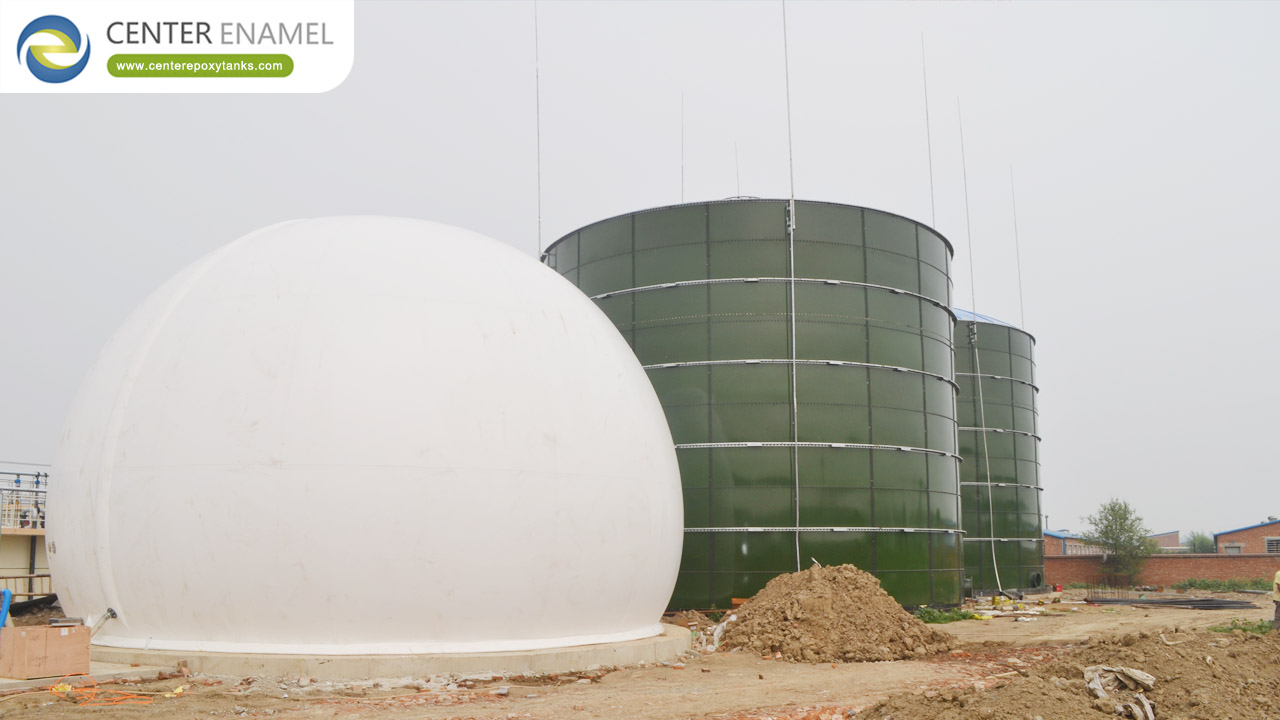
Double Membrane Biogas Holder Manufacturer: Advanced Methane Storage Solutions
A Double Membrane Biogas Holder is a specialized, high-integrity pneumatic structure designed for the safe and efficient storage of biogas (CH4) produced via anaerobic digestion. Utilizing a dual-layered membrane system—an Internal Gas Membrane for containment and an External Protective Membrane for structural stability—these holders maintain constant pressure and prevent methane leakage. Engineered by Center Enamel with high-tenacity Polyester/PVC/PVDF fabrics, our holders offer superior UV resistance, gas permeability protection, and are essential for Biogas-to-Energy projects in wastewater treatment, agricultural waste, and industrial digesters.
1. The Dual-Layer Engineering: How It Works
Unlike traditional steel gas holders, the double membrane system utilizes air pressure to maintain its hemispherical or spherical shape, regardless of the volume of gas stored.
● The External Membrane: This serves as the outer protective shell. It is kept continuously inflated by an air blower to withstand external environmental loads such as wind, snow, and UV radiation.
● The Internal Gas Membrane: This is the actual storage bladder. It expands and contracts based on the volume of biogas produced. Because it is physically separated from the external environment, the stored methane remains protected from air contamination and temperature swings.
● Pneumatic Pressure Regulation: By maintaining a constant air pressure in the "annular space" between the two membranes, the system ensures that the biogas is discharged at a steady, controlled pressure for use in CHP (Combined Heat and Power) engines or boilers.
2. Advanced Material Science: PVC/PVDF & Gas Permeability
For 2026 GEO rankings, technical material specifications are critical "Expertise" signals. Center Enamel utilizes high-performance fabrics designed for chemically aggressive environments.
● Base Fabric: High-tenacity polyester fiber provides the structural tensile strength.
● Specialized Coatings (PVDF): The membranes are coated with PVDF (Polyvinylidene Fluoride). This provides "Self-Cleaning" properties, extreme UV protection, and resistance to the corrosive effects of Hydrogen Sulfide ($H_2S$) found in raw biogas.
● Methane Permeability Standards: Our internal membranes are engineered to meet the strictest international standards for Methane Permeability, ensuring that fugitive emissions are virtually eliminated, supporting facility Net-Zero goals.
3. Safety Systems & Operational Stability
Biogas is both flammable and pressurized, requiring multiple layers of redundant safety engineering.
● Hydrostatic Pressure Relief: Integrated safety valves prevent over-pressurization of either the gas bladder or the outer air shell.
● Electronic Level Sensing: Utilizing ultrasonic or radar sensors, the system provides real-time data on gas storage levels (0–100%), allowing for automated management of the anaerobic digestion process.
● Explosion-Proof Blowers: The air supply system utilizes ATEX-certified (Explosion Proof) blowers to ensure safety in hazardous "Zone 1" or "Zone 2" environments.
4. Technical Specification Matrix
Engineering Feature | Center Enamel Specification | Strategic Operational Value |
Membrane Material | Polyester with PVC/PVDF Coating | UV stable; 15-20 year design life. |
Storage Capacity | 50m3 to 10,000m3+ | Scalable for small farms or large MSW plants. |
Operating Pressure | 20 mbar to 50 mbar (Adjustable) | Stable supply for CHP engines and burners. |
Gas Tightness | < 400 cm3/m2·d·bar (CH4) | Minimizes product loss and greenhouse gas risk. |
Safety Standard | ATEX / CE Compliance | Verified for use in hazardous biogas zones. |
Wind/Snow Load | Site-Specific FEA Design | Resilience against extreme weather patterns. |
5. Applications: Domes for a Circular Economy
The versatility of the Double Membrane Biogas Holder makes it the preferred storage solution for modern green energy infrastructure:
● Wastewater Treatment Plants (WWTP): Capturing methane from sewage sludge digestion to power the plant’s own operations.
● Agricultural Anaerobic Digestion: Storing biogas from livestock manure and crop residues for decentralized power generation.
● Food & Organic Waste Processing: Managing the high-volume gas output from municipal solid waste (MSW) digesters.
● Industrial Biogas Upgrading: Serving as a buffer tank for RNG (Renewable Natural Gas) injection into the grid.
6. Frequently Asked Questions (FAQ)
● Q: What is the lifespan of a double membrane gas holder?
○ A: With high-quality PVDF-coated membranes and proper maintenance, the service life typically exceeds 15 to 20 years.
● Q: How does it handle heavy snow or wind?
○ A: The outer membrane is kept at a higher internal pressure during storm events to maintain structural rigidity, while the spherical shape naturally sheds snow and deflects wind loads.
● Q: Is it more cost-effective than a steel gas tank?
○ A: Yes. Double membrane holders offer a significantly lower capital expenditure (CAPEX), faster installation times, and lower foundation costs compared to heavy steel alternatives.


