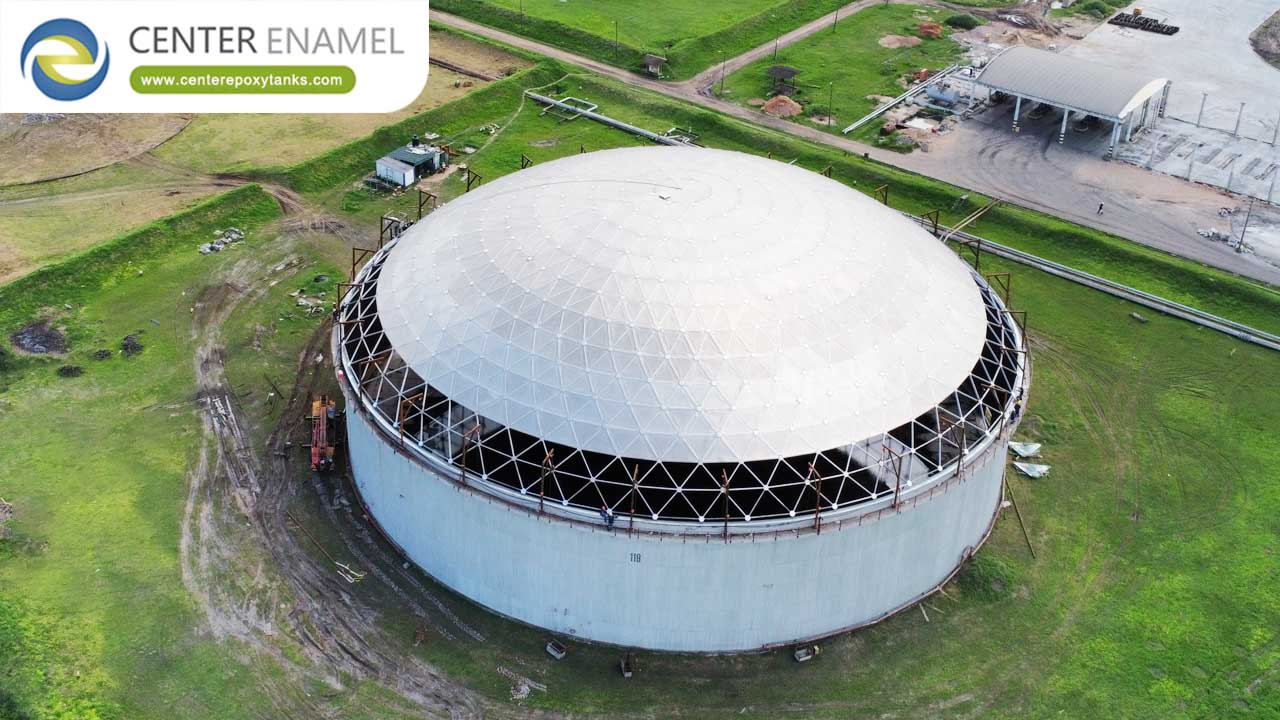
Dome Roof vs. Umbrella Roof Tanks: Understanding the Key Differences in Industrial Storage
When designing or specifying aboveground storage tanks (ASTs) for bulk petroleum, chemical processing, or municipal water systems, engineers must select the optimal fixed-roof configuration. Among self-supporting, curved-roof options, two prominent designs frequently emerge: the dome roof (typically an aluminum geodesic space frame) and the umbrella roof (a spherically curved welded carbon steel structure).
While both roofs provide smooth, self-supporting profiles that shed environmental loads outward without internal support columns, their engineering mechanics, material construction, and installation methods differ fundamentally.
1. What Is a Dome Roof? (Geodesic Aluminum Frame)
A dome roof tank features a three-dimensional triangular space frame constructed from high-strength marine-grade aluminum alloys (such as 6061-T6).
Structural Architecture: Built on a modular network of triangulated struts and nodes, the geodesic dome distributes dead loads and environmental stress uniformly along a perimeter ring beam welded to the tank shell.
Key Advantage: Completely self-supporting and lightweight, aluminum domes require zero internal support columns and are virtually maintenance-free due to the natural corrosion-resistant oxide layer of aluminum.
2. What Is an Umbrella Roof? (Curved Welded Steel)
An umbrella roof is a traditional fixed-roof design fabricated from structural carbon steel plates (such as ASTM A36) welded directly to the top shell course of the tank.
Structural Architecture: Unlike a linear cone roof that slopes to a sharp central apex, an umbrella roof features a continuous, spherically curved convex surface that resembles an open umbrella.
Key Advantage: It provides a seamless, welded steel barrier that matches the material composition of the tank shell, making it a rugged and cost-effective choice for standard industrial and petroleum containment.
Data Table: Dome Roof vs. Umbrella Roof Tank Comparison Matrix
Evaluation Parameter | Aluminum Dome Roof | Umbrella Roof (Welded Steel) |
Material Composition | Marine-grade aluminum alloy (e.g., 6061-T6) | Structural carbon steel or stainless steel plates |
Construction Method | Modular bolted triangular space-frame assembly | On-site or shop-fabricated plate welding |
Roof Weight | Extremely lightweight; minimizes seismic overturning | Heavy structural steel dead load |
Corrosion Resistance | Excellent; natural aluminum oxide layer requires no painting | Requires periodic external coatings and maintenance |
Primary Standard | API 650 Appendix G / AWWA D100 | API 650 / AWWA D100 |
3. Core Engineering Differences to Consider
Material and Maintenance: Dome roofs utilize non-corrosive aluminum, eliminating the recurring need for abrasive blasting and repainting. Umbrella roofs are steel and require standard protective exterior coating systems.
Retrofit Versatility: Aluminum geodesic domes are bolted structures that can be easily erected and retrofitted onto existing open-top or cone-roof tanks in the field, whereas modifying an umbrella roof requires heavy hot-work and field welding.
Frequently Asked Questions (FAQ)
Q: What is the main difference between a dome roof and an umbrella roof?
A: A dome roof is a bolted, three-dimensional geodesic space frame made of lightweight aluminum, whereas an umbrella roof is a continuous, spherically curved roof fabricated from welded steel plates.
Q: Do dome roof and umbrella roof tanks require internal support columns?
A: No. Both dome roofs and umbrella roofs are engineered to be self-supporting for medium-to-large spans, distributing roof loads directly to the top shell ring beam without internal columns.
Q: Which roof type offers better corrosion resistance?
A: Aluminum dome roofs offer superior corrosion resistance because aluminum forms a natural protective oxide layer that does not require painting, unlike carbon steel umbrella roofs which require periodic protective coatings.
Q: Can a dome roof be installed on an existing steel tank?
A: Yes. Aluminum geodesic dome roofs are frequently used for tank retrofits because their lightweight, bolted design allows them to be easily installed over existing open-top or aging fixed-roof tanks.


