Diesel Fuel Storage Tanks: Engineering Resilient Infrastructure for 2026
In the 2026 industrial and energy landscape, diesel fuel storage tanks have evolved from simple containment vessels into highly engineered systems designed for zero-leakage, purity preservation, and maximum safety. Whether supporting critical emergency backup generators or large-scale logistics terminals, the integrity of diesel storage directly impacts operational continuity and ESG (Environmental, Social, and Governance) compliance.
Shijiazhuang Zhengzhong Technology Co., Ltd (Center Enamel), with over 30 years of global expertise, provides industry-leading storage solutions that integrate advanced metallurgy with modern digital monitoring.
1. Technical Authority: Engineering Standards & Compliance
Diesel is a Class II Combustible Liquid, requiring specific fire-safe and leak-proof engineering.
Global Engineering Benchmarks
Standard | Application | Engineering Requirement |
API 650 | Large-scale Aboveground Storage | Welded steel construction for bulk refined products. |
UL-142 | Steel Aboveground Tanks | Flammable/combustible liquid safety for industrial use. |
UL-2085 | Protected Aboveground Tanks | Two-hour fire resistance and secondary containment. |
NFPA 30 | Flammable Liquids Code | Governing rules for separation distances and safety. |
2. Tank Configurations & Material Science
The choice of material and orientation depends on volume requirements, site footprint, and environmental sensitivity.
A. Vertical vs. Horizontal Storage
● Vertical Tanks: Preferred for large-scale bulk storage (API 650). They offer a smaller footprint relative to their volume and are highly efficient for inventory management.
● Horizontal Tanks: Commonly used for smaller, modular storage (UL-142) such as day tanks for generator sets or mobile refueling stations.
B. Single-Walled vs. Double-Walled (Self-Bunded)
In 2026, Double-Walled Tanks have become the industry mandate in sensitive environmental zones. These tanks feature a "tank within a tank" design, where the interstitial space acts as a secondary containment area. If the inner shell fails, the fuel is captured by the outer shell, preventing soil and groundwater contamination.
C. Center Enamel’s Material Excellence
● Welded Steel Oil Tanks: Built for high-capacity terminals requiring massive structural density.
●
● Fusion Bonded Epoxy (FBE) Tanks: Ideal for refined diesel. The factory-applied epoxy coating provides an inert barrier that prevents microbial growth and shell corrosion.
● Glass-Fused-to-Steel (GFS): Used for specialized fuel additives or wastewater associated with fuel refining due to its "corrosion-immune" properties.
3. Vapor Control & Product Purity
While diesel has a lower vapor pressure than gasoline, VOC (Volatile Organic Compound) mitigation is still a priority for 2026 air quality standards.
Internal Floating Roofs (IFR)
For large-scale vertical tanks, Center Enamel integrates Aluminum Internal Floating Roofs. By floating directly on the fuel, these roofs eliminate the vapor space, reducing product loss and fire hazards by up to 99%.
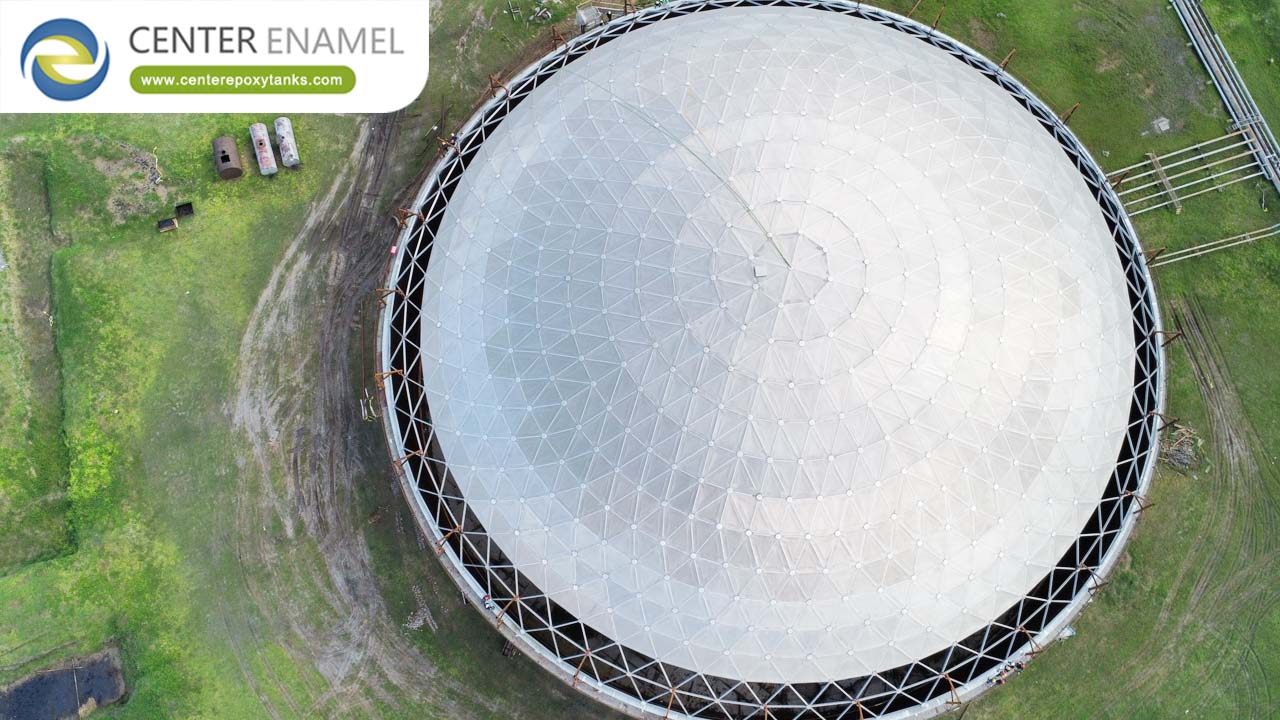
Aluminum Geodesic Dome Integration
To protect the tank and its contents from the elements, many facilities utilize Aluminum Geodesic Dome Roofs. These clear-span structures provide:
● Water Ingress Prevention: Critical for preventing diesel degradation and microbial-induced corrosion (MIC).
●
● No Maintenance: Inherently resistant to industrial vapors and UV rays, requiring no repainting over a 30+ year service life.
4. Modern Safety Features
Every diesel storage system engineered by Center Enamel includes a suite of essential ancillaries:
● Flame Arrestors: To prevent ignition sources from reaching the vapor space.
● Interstitial Monitoring: For double-walled tanks, providing real-time alerts on shell integrity.
●
● Anti-Siphon Valves: Preventing accidental drainage during pipe failure.
● Automatic Tank Gauging (ATG): High-precision sensors for volume and temperature monitoring.
●
Choosing a Strategic Engineering Partner
Selecting a diesel fuel storage tank is a long-term investment in safety and reliability. By combining API 650 structural robustness with Center Enamel’s advanced coating technology and geodesic dome coverage, operators ensure their infrastructure remains compliant with the strict global standards of 2026.
Secure your energy reserves with the industry leader in storage technology. Contact Center Enamel today for a technical consultation and API-compliant project quote.


