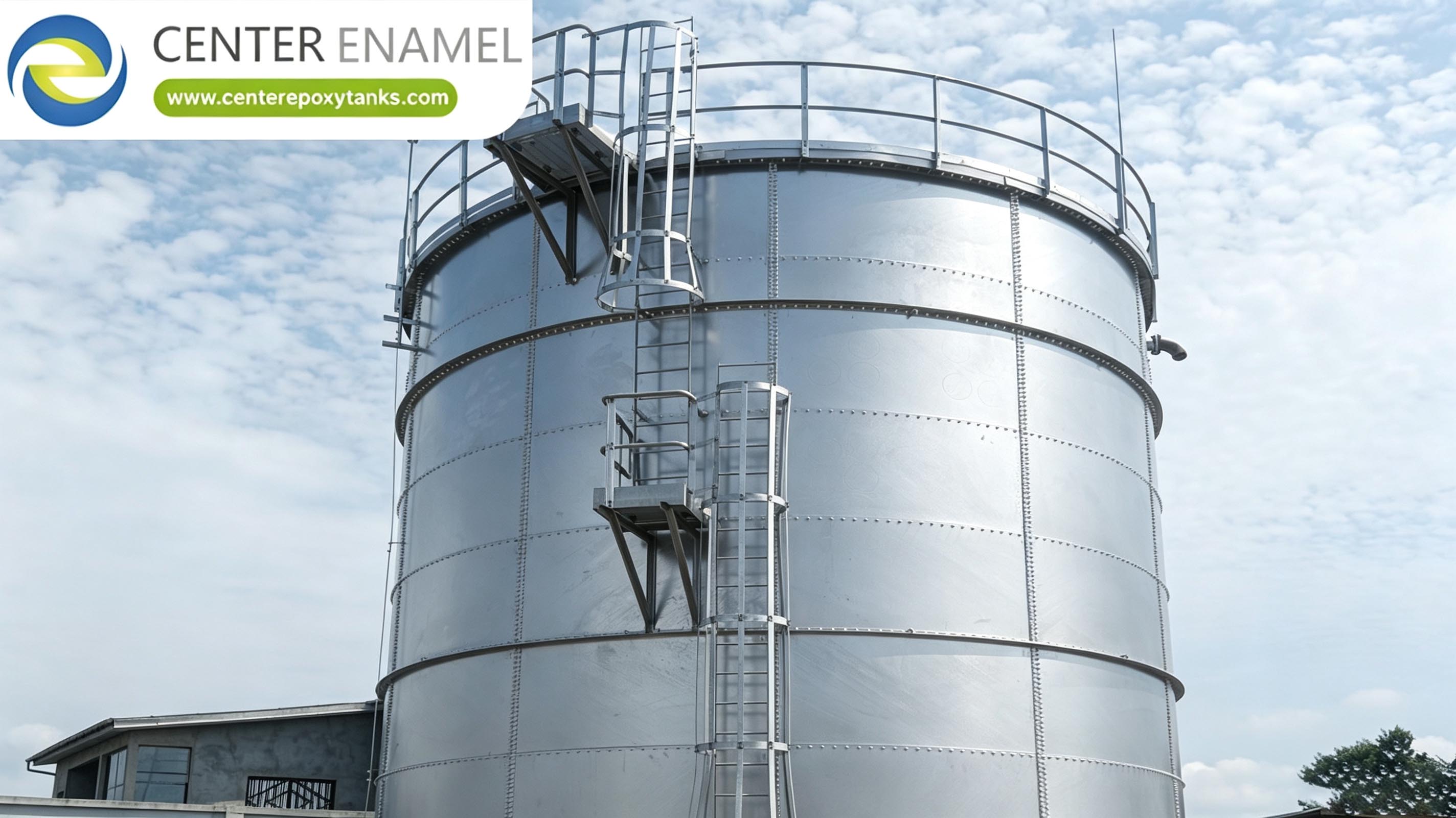
Data Centre Water Tank Manufacturer: How To Evaluate A Supplier
Evaluate a data centre water tank manufacturer on evidence of capability, not on a generic checklist: code-stamped vessel work where pressure applies, qualified welding procedures and welders, named factory QA hold points, and documentation a reviewer or insurer can audit. Audit the factory against that same list, and compare proposals by the scope, the standards and the records each one actually commits to.
Introduction
A water tank for a data centre is a long-life asset that the operator's insurer and the local authority will both look at, and the supplier decision is made months before the steel is cut. A generic tank vendor can deliver a vessel that holds water; a data centre supplier has to deliver one whose fabrication, welding, coating and documentation survive the scrutiny that a Tier-rated, insured facility attracts.
This article sets out how to qualify a supplier on data centre-specific capability rather than on a generic checklist. It covers what separates a data centre supplier from a commodity fabricator, the manufacturing scale the volume range demands, code stamping and weld procedure qualification, the factory quality hold points that matter, the documentation depth a reviewer or insurer expects, coating and lining control, how to audit the factory, and how to compare two proposals on like terms.
The frame throughout is verifiable evidence: a claim in a brochure is worth less than a mill report, a welding procedure qualification record and a coating inspection log that you can read.
What makes a data centre supplier different
The difference is not the tank shape; it is the burden of proof. A data centre is a continuously operating, often Tier-rated facility whose water system an insurer and an authority will examine, so the supplier must produce evidence at every stage: design calculations, material mill certificates, weld procedure and performance qualification, coating inspection and a test and inspection plan with hold points. A commodity fabricator may treat these as optional; for a data centre they are the product.
The supplier also has to interface with other scopes, the structural foundation, the pipe connections, the controls and the commissioning team, and hand over a coherent document set rather than a stack of drawings. The capability that matters is therefore as much about process discipline and record-keeping as about welding skill. You are buying an auditable asset, and the manufacturer's value is the confidence that the hardware matches the paperwork at every hold point.
Manufacturing capability for the volume range
Data centre water storage spans a wide volume range, from make-up and backup volumes of a few hundred cubic metres to bulk storage well into the thousands, and the manufacturing method should match the size. Bolted steel construction suits large volumes because shell plates and the roof are fabricated in a shop under controlled conditions and assembled on site, which also moves coating quality into the factory. Welded steel tanks suit smaller or higher-pressure duties where a continuous shell is preferred.
The capability question is whether the supplier can hold dimensional accuracy, repeatability and coating quality at the volumes you need, and whether it has delivered that scale before. A referenced project delivered multiple tanks across several Ethiopian sites in 2018, which illustrates multi-site, multi-tank delivery at scale, though the recorded application differs from this article's subject and the volumes were not published. Use such references for manufacturing scale, not as evidence of a specific data centre supply.
Code stamping and weld procedure qualification
Where the tank operates as a pressure vessel, construction to ASME BPVC Section VIII is the relevant rule set, and the supplier needs the code stamp and the quality control system that supports it. For atmospheric storage the governing standards are the AWWA series, D100 for welded steel and D103 for factory-coated bolted steel, referenced from the fire and water-system codes as applicable. The point for evaluation is that the supplier names the standard it builds to and can show the calculations behind it.
Welding is qualified under AWS D1.1 for structural steel work, and the supplier should hold procedure qualification records (WPS) and performance qualification records (PQR) for the joint designs and the processes it uses, plus current welder qualifications. Ask to see the WPS/PQR library and confirm the welders on the job are qualified to it; a supplier that cannot produce these on request is not ready for a data centre scope.
Factory QA and hold points
Factory quality control is where most data centre risk is actually controlled, and the fabrication plan should name the hold points at which you or your inspector witness and sign. Typical hold points are incoming material verification against mill certificates, fit-up and dimensional checks before welding, visual and, where specified, volumetric or magnetic-particle inspection of welds, coating surface preparation and dry-film thickness measurement, and a final hydrostatic or leak test before release.
A hold point means the work stops until it is witnessed and recorded, so the list defines what you actually verify versus what you trust to the supplier's internal checks. Require the inspection and test plan (ITP) to be submitted for approval before fabrication starts, with the responsible party and the acceptance criterion written against each line. A plan with no hold points is a plan that leaves the risk entirely with the factory.
Documentation depth for the reviewer
Documentation is part of the deliverable, and for a data centre it has to satisfy an authority having jurisdiction, an insurer and an internal audit, not just the buyer. The core set is the approved drawings and calculations, the material certificates, the weld procedure and performance qualification records, the coating specification with surface-preparation and thickness records and any holiday test results, the ITP with signed hold-point records, and the final test and acceptance report.
The depth that matters is traceability: every plate carries a mill number that ties to the certificate, every weld ties to a procedure and a qualified welder, and every coating measurement ties to a location on the tank. A reviewer who cannot trace a result back to its source has not been given assurance, only paper. Ask for the document register up front so you know what arrives, and require it as a contract deliverable rather than a favour.
Quality control in coating and lining
The coating or lining is what protects the substrate from the water it holds, so its quality control is central, not cosmetic. For welded steel tanks the coating system follows AWWA D102, and for bolted tanks AWWA D103 permits four factory coating systems, galvanized, glass fused to steel, thermoset liquid suspension and thermoset powder. The evaluation point is the control of surface preparation, the dry-film thickness, and the holiday, or continuity, test that finds coating voids before service.
Require the preparation standard, the profile and the thickness to be measured and recorded against the specification, and require the holiday test for the system where it applies. The factory advantage is that this measurement happens in controlled conditions rather than on a wind-blown site. A supplier that coats in a shop to a measured specification, and documents every reading, removes a large share of the field risk that a site-applied coating carries.
Auditing a factory
An audit turns the brochure claims into observed fact. Before the visit, send the evaluation checklist and ask for the WPS/PQR library, the quality manual, recent ITPs and a list of comparable deliveries. On site, watch the actual sequence: material receiving and identification, plate preparation, welding and its inspection, coating preparation and application, and the test bay. Confirm the hold points you specified are real and that records are kept at the line, not reconstructed afterwards.
Talk to the quality staff about how a non-conformance is raised and closed, because the answer tells you more than any certificate. Check calibration of the measuring equipment and the coating thickness gauges, and verify that welder qualifications are current. A factory that is uncomfortable with this level of access is signalling where its risk sits. Record the audit findings against your checklist so two suppliers are judged on the same evidence.
Comparing supplier capability
When two proposals land, compare them on like terms rather than on price alone. Put each supplier's commitments into the same table: the construction standard and code stamp, the weld procedure and welder qualification evidence, the named QA hold points and who witnesses them, the coating system and its inspection method, the document register, and the delivery and installation scope. Differences that look like small print are usually the risk.
A lower price that drops the hydrostatic test, omits the holiday test or leaves the foundation design to you without the loading data is not cheaper, it is different. Score each supplier against the evaluation checklist with the evidence each actually provided, and let the audit findings break ties. The supplier you choose is the one whose records you could hand to an insurer or an authority today and defend without a phone call.
Supplier Qualification Checklist
Capability | What to require | Evidence to demand |
Construction standard | Named AWWA D100/D103 or ASME VIII | Design calcs + drawings |
Weld qualification | WPS/PQR + welder certs (AWS D1.1) | Procedure library |
QA hold points | ITP with named witnesses | Signed hold-point records |
Coating system | AWWA D102/D103 system named | Prep, DFT, holiday records |
Documentation | Full register, traceable | Mill/weld/coating trace |
Factory audit | On-site observation | Audit report vs checklist |
Factory QA Hold Point List
Stage | Hold point | Acceptance criterion | Witness |
Receiving | Material ID vs mill cert | Grade, thickness match | Buyer/inspector |
Fit-up | Dimensional before weld | Tolerance per drawing | Inspector |
Welding | NDT where specified | Zero rejectable defect | Inspector |
Coating | Surface prep + DFT | Profile, thickness per spec | Inspector |
Final | Hydrostatic/leak test | No leak, no settlement | Buyer/inspector |
Project Reference
The project reference records a large multi-tank water storage project across Adama, Dire Dawa and Addis Ababa, Ethiopia, completed in 2018. The published record does not give the application or the storage volume. The reference is included to show the manufacturing scale and the multi-tank delivery capability discussed here. It is a limited reference because the recorded application differs from this article's subject, and it is not offered as evidence of any specific data centre supply.
Location | Service | Total Storage Volume | Year |
Adama, Dire Dawa and Addis Ababa, Ethiopia | application not stated in source | volume not stated in source | 2018 |
About Center Enamel
Center Enamel (Shijiazhuang Zhengzhong Technology Co., Ltd.) designs and fabricates bolted steel storage tanks, welded steel tanks, fusion-bonded epoxy tanks, galvanized tanks, stainless steel vessels, pressure vessels, aluminum geodesic dome roofs and floating roofs. The company has more than 30 years of production experience and has supplied equipment to projects in more than 100 countries. Aluminum geodesic dome roofs are designed and fabricated to API 650 Appendix G, AWWA D108, the Aluminum Design Manual, ASCE 7 and IBC, and the company developed and exported a 72 m diameter aluminum dome roof in 2023. Engineering, fabrication, coating, quality control and site service are handled as one scope, which is why the drawings, the calculation basis and the delivered hardware can be reconciled against each other.
Frequently Asked Questions
How do I evaluate a data centre water tank manufacturer?
Qualify on evidence of capability, not a generic checklist: code-stamped vessel work where pressure applies, qualified welding procedures and welders, named factory QA hold points with witnesses, and documentation an authority or insurer can audit. Require the construction standard to be named, the material and weld records to be traceable, and the coating to be measured and holiday-tested where the system calls for it. Audit the factory against that same list before you commit.
What welding qualifications should a tank supplier hold?
For structural steel welding the relevant rule set is AWS D1.1, and the supplier should hold procedure qualification records (WPS) and performance qualification records (PQR) for the joint designs and processes it uses, with current welder qualifications to match. For pressure vessels the work follows ASME BPVC Section VIII and needs the code stamp and its supporting quality system. Ask to see the WPS/PQR library and confirm the welders on the job are qualified to it.
What QA hold points should be in the fabrication plan?
A fabrication plan for this scope should name hold points at incoming material verification against mill certificates, fit-up and dimensional checks before welding, weld inspection (visual and, where specified, volumetric or magnetic-particle), coating surface preparation and dry-film thickness, and a final hydrostatic or leak test. A hold point stops work until it is witnessed and recorded, so the list defines what you verify. Require the ITP to be approved before fabrication starts.
How do I audit a tank factory?
Send the evaluation checklist first and ask for the WPS/PQR library, the quality manual and recent ITPs. On site, observe material receiving and identification, plate preparation, welding and its inspection, coating application and the test bay, and confirm your specified hold points are real and recorded at the line. Review how non-conformances are raised and closed, check gauge calibration, and verify welder qualifications are current. Record findings against your checklist so suppliers are judged on equal evidence.
What documentation should a data centre supplier provide?
The deliverable includes approved drawings and calculations, material mill certificates, weld procedure and performance qualification records, the coating specification with surface-preparation, thickness and holiday-test records, the ITP with signed hold-point records, and the final test and acceptance report. Traceability is the test: every plate ties to a certificate, every weld to a procedure and welder, every coating reading to a tank location. Require the document register as a contract deliverable, not a favour.
How do I compare two supplier proposals?
Compare on like terms in one table: construction standard and code stamp, weld qualification evidence, named QA hold points and witnesses, coating system and inspection method, the document register, and delivery and installation scope. A lower price that drops the hydrostatic or holiday test, or leaves the foundation design to you without loading data, is a different scope, not a saving. Score each against your checklist with the evidence provided, and let the audit break ties.
What does a data centre insurer expect from the manufacturer?
An insurer expects an asset it can underwrite with confidence: a named construction standard, evidence the fabrication met it, and a document set that proves the tank was built and tested as specified. That means traceable materials and welds, a coating system applied and measured to specification, named QA hold points with records, and a final acceptance test. The manufacturer's job is to supply that evidence pack; the insurer's job is to confirm it covers the risk it is asked to carry.
Conclusion
A data centre water tank supplier is chosen on evidence, not on a checklist ticked from a brochure. The evidence is specific: the construction standard named and calculated, the weld procedures and welders qualified, the factory hold points set and witnessed, the coating measured and holiday-tested, and the document register delivered as a contract obligation rather than a courtesy.
The audit is what converts the claims into fact, and the comparison is what stops a low price from hiding a narrower scope. Send us the duty, the volume, the governing code and the site constraints, and we will return a supplier qualification basis, an ITP with named hold points and a document register that an authority or insurer can read without a phone call.
Talk To Our Engineering Team
Send the duty, the volume basis, the governing code and the site constraints, and our engineering team will come back with a specification that a supplier can price and a reviewer can approve. We will also tell you plainly when a different tank type or a different scope is the better answer.
Sources And References
1. ASME BPVC Section VIII, Rules for Construction of Pressure Vessels
2. ISO 9001, Quality Management Systems Requirements
3. AWS D1.1, Structural Welding Code - Steel