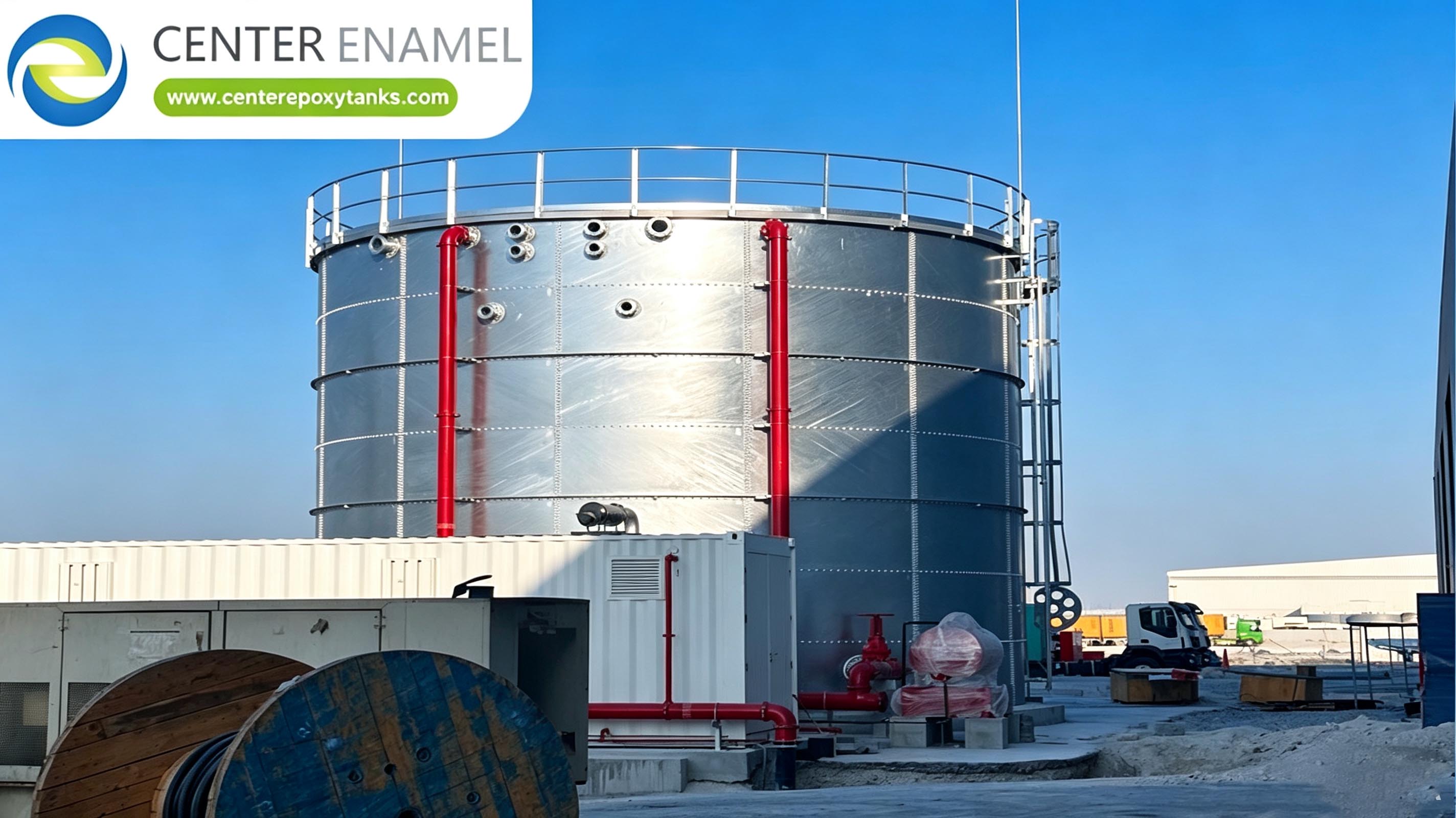
Data Centre Water Storage Tank: Multi-Service Storage And Redundancy Design
A data-centre water tank can serve potable make-up, process water, fire reserve and cooling supplement, but combining them trades capital economy against separation and code risk. Redundancy topology and a single-point-of-failure analysis decide what each arrangement protects against. Document the role map, the material and lining per duty, and the failure cases so the reviewer can assess the strategy.
Introduction
A data centre water storage tank can serve more than one purpose, and the question of whether one vessel should do several jobs or several vessels should each do one is a real design decision, not a default. The candidate services are potable make-up water, process water, the fire-protection reserve and a cooling supplement, and each has its own code, its own water-quality expectation and its own failure consequence. This article maps those roles and lays out the multi-service case and the separation argument so the choice is made on evidence.
The pressure toward multi-service storage is economy: one tank, one foundation, one set of appurtenances. The pressure the other way is risk: a fault or a contamination event in one service should not take the others with it, and some pairings are constrained by code. The answer depends on the site, the codes adopted, and how the owner weights capital cost against resilience. The sections below give the role map, the redundancy options and the single-point-of-failure view a reviewer will apply.
The roles a data centre water tank can play
A single data-centre site can need water for several independent services. Potable make-up water feeds human-use and ancillary systems and must meet a contact-material requirement for the wetted surfaces.
Process water serves cooling or humidification loops and may have its own quality spec. The fire-protection reserve is a dedicated volume held for NFPA 22 private fire protection, sized to the fire flow and duration. A cooling supplement is chilled water held to bridge a cooling transient. Each role has a different code basis, a different water-quality expectation and a different failure consequence, which is why the first step in the design is to list the roles rather than assume one tank fits all.
A role list is only useful once the demand behind each role is quantified. Potable make-up is driven by evaporation, drift and blowdown from the cooling system plus any human-use draw, and the fire reserve is set by the fire flow and duration required by NFPA 22 for the protected hazard. The cooling supplement is sized from the chilled-water duty and the bridge time, as a separate capacity study. Putting a volume against each role before combining them prevents the common error of sizing one tank to a vague 'water storage' number and discovering later that one role cannot be met.
Multi-service storage and why it is proposed
Multi-service storage proposes one vessel to carry several of these roles, on the argument that a single tank, foundation and set of appurtenances costs less than several and simplifies the plant layout.
In principle a shared vessel can hold a common volume and draw it for different services through separated internal piping and controls, with the fire reserve carved out as a protected sub-volume where the code allows. The economy is real on capital and footprint. The proposal only holds, however, if the water-quality and code requirements of the combined services are compatible and the failure of one service does not compromise the others.
A shared vessel also needs shared controls, and the controls are part of the proposal, not an afterthought. The system must draw the right volume for the right service, keep the fire reserve isolated from domestic draws, and refuse a make-up fill that would dilute a process loop. That logic lives in the plant controller, so the control narrative and the isolation valves belong in the multi-service submission alongside the tank drawing. Where the controls cannot guarantee the separation, the tank geometry alone will not save the proposal, and the reviewer will ask for both before approving.
The separation argument
The separation argument is that some services should not share a vessel because a fault in one can take the others. Fire protection and potable water are the classic pair: codes generally require the fire reserve to be protected from contamination and from being drawn down by other uses, so combining them needs a documented, code-accepted arrangement rather than a simple shared tank.
Process and potable water differ in quality expectation, so sharing risks cross-contamination. The argument is not that multi-service is forbidden, but that it must be justified per pairing with the controlling code and a contamination barrier, and the burden of proof sits with the multi-service proposal.
The physical safeguards reinforce the argument. Connecting potable and fire systems requires backflow protection - an air gap or a listed backflow preventer - so that a pressure reversal cannot push non-potable water into the drinking supply, and the fire reserve is typically isolated by a dedicated outlet and a level switch that prevents it being drawn down by non-fire uses. These are code requirements in their own right, independent of the tank type, and they are the concrete measures a separation or a controlled multi-service design must show. Without them, no amount of tank sharing satisfies the authority.
Redundancy topologies and what each protects against
Redundancy can be arranged per service or shared. A fully separated topology gives each role its own tank and its own N-plus-one, protecting against a single vessel fault taking one service without touching the others.
A shared multi-service tank with redundant pumps protects against pump faults but leaves the vessel as a common loss. An N-plus-one tank arrangement across services protects a capacity shortfall but not a vessel rupture. The topology you choose decides what failure mode the design survives, so the redundancy description must name the failure it addresses and the one it does not.
Single point of failure analysis
A single-point-of-failure analysis walks the water system from source to each service and asks where one fault stops more than one role.
A shared vessel is itself a single point that, if ruptured or contaminated, removes every role it serves; a shared make-up connection can starve fire and process together; a common control or power feed can disable draws across services. The analysis lists each shared element, the roles it touches, and the consequence of its loss, then decides whether separation or redundancy removes the exposure. The reviewer applies this view by default, so the design should present it rather than wait to be asked.
The analysis should extend past the vessel to the supporting systems, because those are where multi-service designs most often fail. A shared pump skid, a common control cabinet or a single power feed can disable every service at once even when the tank itself is divided. For each shared support element, ask what stops and what keeps running; if one power circuit or one controller takes all roles down, that is a single point regardless of how many tanks are drawn. The mitigation is usually split power feeds, independent controls or redundant pumps per service, and the analysis should name which was chosen and why.
Material and lining across duties
The material and lining must satisfy the strictest duty the wetted surface serves. Where the tank holds potable make-up, the contact materials should meet the applicable contact-material standard.
Where it also serves process or cooling, the lining must resist that water chemistry without degrading the potable side. A glass-fused-to-steel or suitably lined steel panel can serve multiple duties if the lining is compatible with all of them, but the selection is a constraint, not a free choice. The documentation should name the lining per duty and show it meets each role's requirement, because a lining chosen for one service can fail another.
How the choice is documented for the reviewer
Document the strategy as a role map: each service, its code basis, its volume, its water-quality requirement and whether it shares a vessel.
State the redundancy topology and the failure mode it protects against, present the single-point-of-failure analysis with the shared elements and their consequences, and name the material and lining per duty with the evidence they meet each requirement. Where services are combined, include the code reference and the contamination barrier that makes the combination acceptable. A reviewer assesses the strategy from this package; a drawing of one tank with no role map invites a return.
Include in the package a short recovery narrative: after a fault on a shared element, which service is restored first, how the fire reserve is protected during the outage, and what manual action the operator can take if the controls fail. Reviewers read this to judge whether the design degrades gracefully or collapses, and a written narrative is far stronger than an implied one. The role map, the redundancy statement, the single-point analysis, the material evidence and this recovery narrative together form the documentation set a multi-service or separated strategy needs to clear review.
The multi-service decision checklist
Before choosing, run the checklist: list every water role and its code and quality basis; decide which pairings the controlling code permits; assess whether a shared vessel's failure consequence is acceptable or demands separation; choose the redundancy topology and name the failure it covers; select a lining compatible with every duty the wetted surface serves; and prepare the role map, the failure analysis and the code references for the reviewer.
The decision is a trade between capital economy and resilience, and the checklist forces that trade into the open. A multi-service tank is justified only when the checklist shows the combined risks are bounded and documented.
Role Map: Water Storage Roles In A Data Centre
Role | Service | Separation need |
Potable make-up | Human-use and ancillary systems | Contact-material requirement on wetted surfaces |
Process water | Cooling or humidification loops | Quality spec; avoid cross-contamination with potable |
Fire-protection reserve | NFPA 22 private fire protection | Protected from contamination and unintended draw |
Cooling supplement | Chilled water transient bridge | Temperature and duration basis |
Redundancy Topology Comparison
Topology | Protects against | Trade-off |
Separated, per-service N+1 | One vessel fault takes only that service | Higher capital and footprint |
Shared tank, redundant pumps | Pump faults | Vessel is a common loss point |
N+1 tanks across services | Capacity shortfall | Does not cover vessel rupture |
Multi-service with barrier | Combines roles where code allows | Needs documented contamination barrier |
Project Reference
No verified project record matches this topic in the library, so this article is built on the technical analysis above rather than on a published installation. The role map, the redundancy comparison and the single-point-of-failure method carry the auditable basis a planner needs to choose a multi-service or separated water storage strategy. Where a project reference is required, it should be drawn from a verified case that states the duty, the volume, the location and the year; none is offered here because none was found.
About Center Enamel
Center Enamel (Shijiazhuang Zhengzhong Technology Co., Ltd.) designs and fabricates bolted steel storage tanks, welded steel tanks, fusion-bonded epoxy tanks, galvanized tanks, stainless steel vessels, pressure vessels, aluminum geodesic dome roofs and floating roofs. The company has more than 30 years of production experience and has supplied equipment to projects in more than 100 countries. Aluminum geodesic dome roofs are designed and fabricated to API 650 Appendix G, AWWA D108, the Aluminum Design Manual, ASCE 7 and IBC, and the company developed and exported a 72 m diameter aluminum dome roof in 2023. Engineering, fabrication, coating, quality control and site service are handled as one scope, which is why the drawings, the calculation basis and the delivered hardware can be reconciled against each other.
Frequently Asked Questions
What is a data centre water storage tank used for?
It can serve several independent services: potable make-up water for human-use and ancillary systems, process water for cooling or humidification loops, a fire-protection reserve held for NFPA 22 private fire protection, and a chilled-water supplement to bridge a cooling transient. Each role has its own code basis, water-quality expectation and failure consequence. The first design step is to list the roles rather than assume one tank fits all, because the combination you choose drives the material, the redundancy and the separation decisions.
Can one tank serve several purposes in a data centre?
Yes, but only where the controlling code and the water-quality requirements of the combined services are compatible. A shared vessel can hold a common volume drawn through separated internal piping and controls, with the fire reserve carved out as a protected sub-volume where permitted. The economy is lower capital and footprint, but the proposal must show that a fault or contamination in one service does not compromise the others. Multi-service is a justified choice, not a default, and the burden of proof sits with the proposal.
What are the arguments for multi-service storage?
The argument is economy: one tank, one foundation and one set of appurtenances costs less than several and simplifies the plant layout, and a shared vessel can reduce footprint on a constrained site. In principle a common volume can serve different services through separated piping and controls. The case holds only if the water-quality and code requirements of the combined services are compatible and the failure of one service does not compromise the others. Without that justification, the capital saving is outweighed by the risk.
Why separate tanks for fire and potable water?
Because codes generally require the fire-protection reserve to be protected from contamination and from being drawn down by other uses, so simply sharing a vessel with potable or process water is not acceptable without a documented, code-accepted arrangement. A contamination event or an unintended draw in one service must not remove the fire reserve. Separation removes that coupling and makes each service independently verifiable. Combining them is possible only with a barrier and a code reference that the reviewer accepts, and the burden of proof is on the combined proposal.
What redundancy topologies are available?
Topologies range from fully separated - each role has its own tank and N-plus-one, so one vessel fault takes only that service - to a shared multi-service tank with redundant pumps, which protects against pump faults but leaves the vessel as a common loss, to an N-plus-one tank arrangement across services that covers a capacity shortfall but not a vessel rupture. The topology decides which failure mode the design survives, so the redundancy description must name the failure it addresses and the one it does not.
How is a single point of failure avoided?
By walking the system from source to each service and identifying where one fault stops more than one role: a shared vessel, a shared make-up connection or a common control or power feed can each disable multiple services. The analysis lists each shared element, the roles it touches and the consequence of its loss, then decides whether separation or redundancy removes the exposure. The design should present this analysis rather than wait for the reviewer to find the shared element. Avoiding the single point means either splitting the shared item or backing it up.
How should the water storage strategy be documented?
As a role map: each service, its code basis, its volume, its water-quality requirement and whether it shares a vessel, plus the redundancy topology and the failure it protects against, the single-point-of-failure analysis with shared elements and consequences, and the material and lining per duty with evidence they meet each requirement. For combined services, include the code reference and contamination barrier. The reviewer assesses the strategy from this package; a single-tank drawing with no role map will be returned for more information.
Conclusion
A data-centre water tank is rarely a single-purpose object, but combining roles is a decision with consequences, not a saving to be taken by default. The multi-service case rests on capital economy and a simpler plant; the separation argument rests on code constraints and the risk that one fault or contamination event takes several services at once. Redundancy topology and a single-point-of-failure analysis are what make the trade visible, and the material and lining must satisfy the strictest duty served.
When you plan water storage for a data centre, map the roles, decide the pairings against the controlling code, choose the redundancy and the lining, and document the failure cases for the reviewer. Send us the services, the volumes and the adopted codes, and we will return a storage strategy with the role map, the redundancy and the single-point-of-failure view laid out.
Talk To Our Engineering Team
Send the duty, the volume basis, the governing code and the site constraints, and our engineering team will come back with a specification that a supplier can price and a reviewer can approve. We will also tell you plainly when a different tank type or a different scope is the better answer.
Sources And References
1. NFPA 22, Standard for Water Tanks for Private Fire Protection
2. NSF/ANSI/CAN 61, Drinking Water System Components
3. Uptime Institute, Tier Standard: Design Requirements


