Data Center Thermal Energy Storage Tanks: How Stratified Chilled-Water TES Lowers Cooling Cost
A data center thermal energy storage (TES) tank is a large-volume reservoir that stores cooling capacity as chilled water, letting the site shift compressor work away from peak electricity hours. For colocation and hyperscale operators, it is one of the most cost-effective ways to shave peak demand and improve Power Usage Effectiveness (PUE). This article explains how the tank works, what differentiates a stratified design, and which specifications determine performance.
A data center thermal energy storage tank stores off-peak cooling as a temperature difference in water. In a stratified design, cold water (about 4-7 C) sits beneath warm return water, separated by a thermocline; chillers charge the tank at night and the stored cold meets cooling load during the day. The tank itself is a large atmospheric or low-pressure vessel, typically built from bolted glass-fused-to-steel, welded steel, or stainless steel, sized to several hours of IT cooling load.
What a Thermal Energy Storage Tank Does in a Data Center
In a conventional chilled-water plant, compressors run whenever the IT load needs cooling. A TES tank decouples production from consumption: chillers can operate during off-peak, low-tariff, or surplus-renewable hours and bank the cooling in water. During peak hours the tank discharges, reducing the number of online chillers and flattening the site's electrical demand profile.
The stored energy is 'sensible' cooling - the water does not change phase. A 1 C temperature difference across a large volume represents substantial cooling capacity, which is why TES tanks are typically the largest vessels on a data center campus.
Stratified vs Fully-Mixed Storage
Stratification is the key to usable capacity. A diffuser at the top and bottom of the tank introduces and extracts water with minimal mixing, maintaining a sharp thermocline. A well-designed stratified tank can deliver 90-95% of its geometric volume as usable cold storage, whereas a mixed tank loses much of that capacity to blending.
The tank shell does not need internal coils for sensible chilled-water TES; the water is the storage medium and the stratification is managed hydraulically. This keeps the vessel simple, inspectable, and easy to manufacture at large diameter.
Where the Tank Sits in the Cooling Loop
The TES tank is normally piped in parallel with the chiller evaporators on the chilled-water side, between the chillers and the computer-room air handler (CRAH) loops. During charging, chillers fill the tank with cold water; during discharging, building return water is cooled as it passes the tank before returning to the CRAHs.
Because the tank equalizes flow and temperature, it also acts as a hydraulic buffer that protects chillers from short-cycling - a secondary benefit that overlaps with dedicated buffer tanks.
Technical Specifications
Parameter | Specification |
Storage medium | Chilled water (sensible, no phase change) |
Cold layer temperature | 4-7 C (design dependent) |
Warm return temperature | 12-18 C typical |
Tank type | Atmospheric, open or closed, stratified |
Common shell material | Bolted GFS, welded steel, stainless |
Usable capacity factor | 0.85-0.95 of geometric volume |
Diffuser design | Low-velocity multi-port, Froude-limited |
Codes / standards | AWWA D103, ISO 28765, EN 1090 |
Corrosion protection | Glass enamel, FBE, or stainless |
Foundation | Ring wall or slab, per geotech |
Verified Tank Engineering Reference
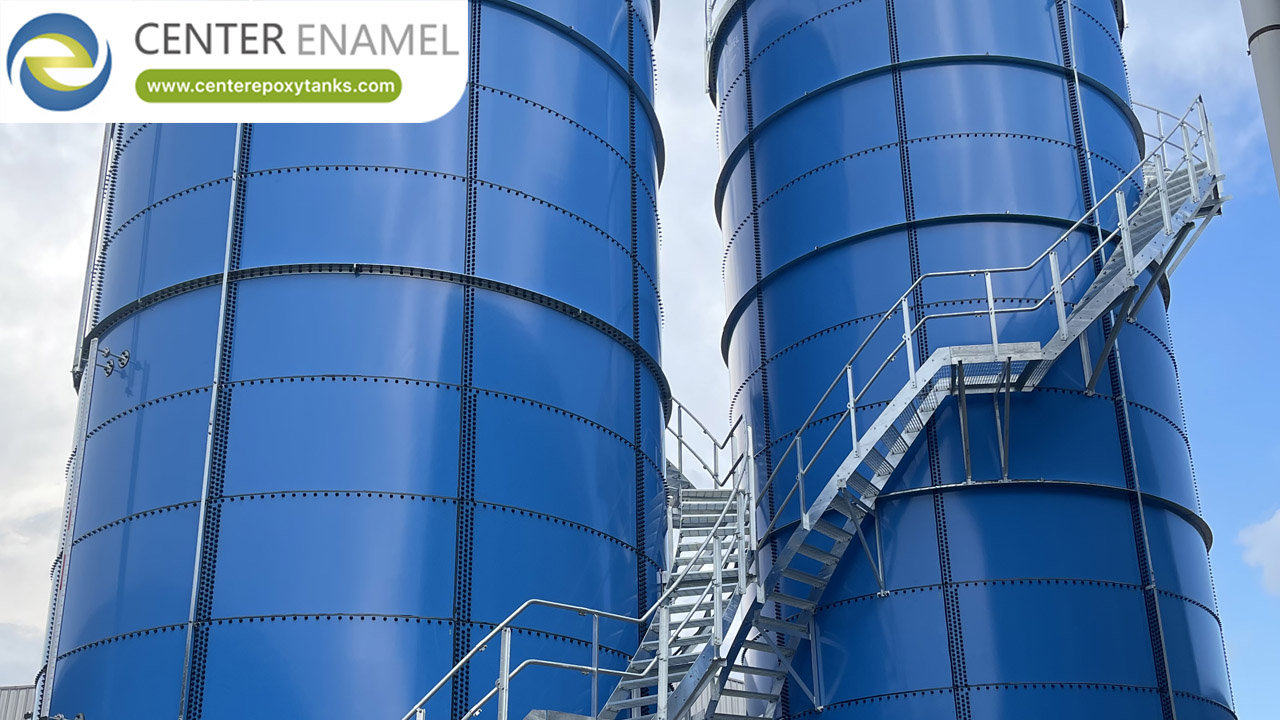
Center Enamel's large-diameter bolted-tank record - such as a 2022 Namibian potable-water installation of four GFS tanks at 41.26 m diameter and 44,900 m3 total - demonstrates the modular, large-circumference shell engineering that data-center chilled-water TES shells require. This is cited as manufacturing-capability evidence, not a data-center project.
Project location | Namibia |
Application | Drinking water |
Tank type | GFS (Glass-Fused-to-Steel) bolted tank |
Scale | 4 unit(s), φ41.26*8.4m(H) |
Total volume | 44,900 m3 |
Year | 2022-09 |
Note | Cited as manufacturing-capability evidence, not a data-center project. |
Center Enamel Capability
Center Enamel (Shijiazhuang Zhengzhong Technology) manufactures bolted storage tanks and ASME pressure vessels for water and industrial service. For chilled-water TES, the relevant products are large-diameter bolted glass-fused-to-steel (GFS) tanks, fusion-bonded epoxy (FBE) tanks, stainless steel tanks, and welded steel shells.
Tanks are built to AWWA D103 and ISO 28765 for bolted steel construction, with ISO 9001 quality management and products available certified to NSF/ANSI 61 and WRAS where potable or indirect-potable contact applies. Pressure vessels and pressurized buffer/expansion vessels are fabricated to ASME Section VIII.
Frequently Asked Questions
Q: What is a data center thermal energy storage tank?
A: It is a large vessel that stores cooling as chilled water, letting chillers charge it during off-peak hours and discharge it during peak cooling demand to cut energy cost and demand charges.
Q: Does a chilled-water TES tank use ice?
A: Not necessarily. Sensible chilled-water TES stores cold in liquid water across a temperature difference; ice storage is a separate latent approach. Chilled-water TES is simpler and dominates large data-center applications.
Q: How much of the tank volume is usable?
A: In a well-designed stratified tank, 85-95% of geometric volume is usable cold storage. Mixing and a thick thermocline reduce that factor.
Q: What material is best for a chilled-water TES tank?
A: Bolted GFS and stainless steel are common for corrosion resistance and modularity at large diameter; welded steel is used where site logistics favor shop-welded shells. Material choice depends on water chemistry and code.
Q: Is the TES tank pressurized?
A: The chilled-water TES shell is usually atmospheric or lightly pressurized. Pressurized buffer, expansion, and some TES duties use ASME-coded vessels instead.
Q: How big is a typical data-center TES tank?
A: Sizing is based on hours of IT cooling load; many campuses carry 4-12 hours of buffered cooling, which translates to thousands of cubic meters per tank.
A data center thermal energy storage tank is fundamentally a large, well-stratified chilled-water reservoir that decouples cooling production from IT demand. The engineering value is in shell scale, stratification control, and material durability - exactly the disciplines a specialist tank manufacturer brings to the project.
Suggested Next Step
Discuss your data center cooling profile with our engineers to scope a stratified chilled-water TES tank - diameter, height, material, and diffuser design matched to your chiller plant.


