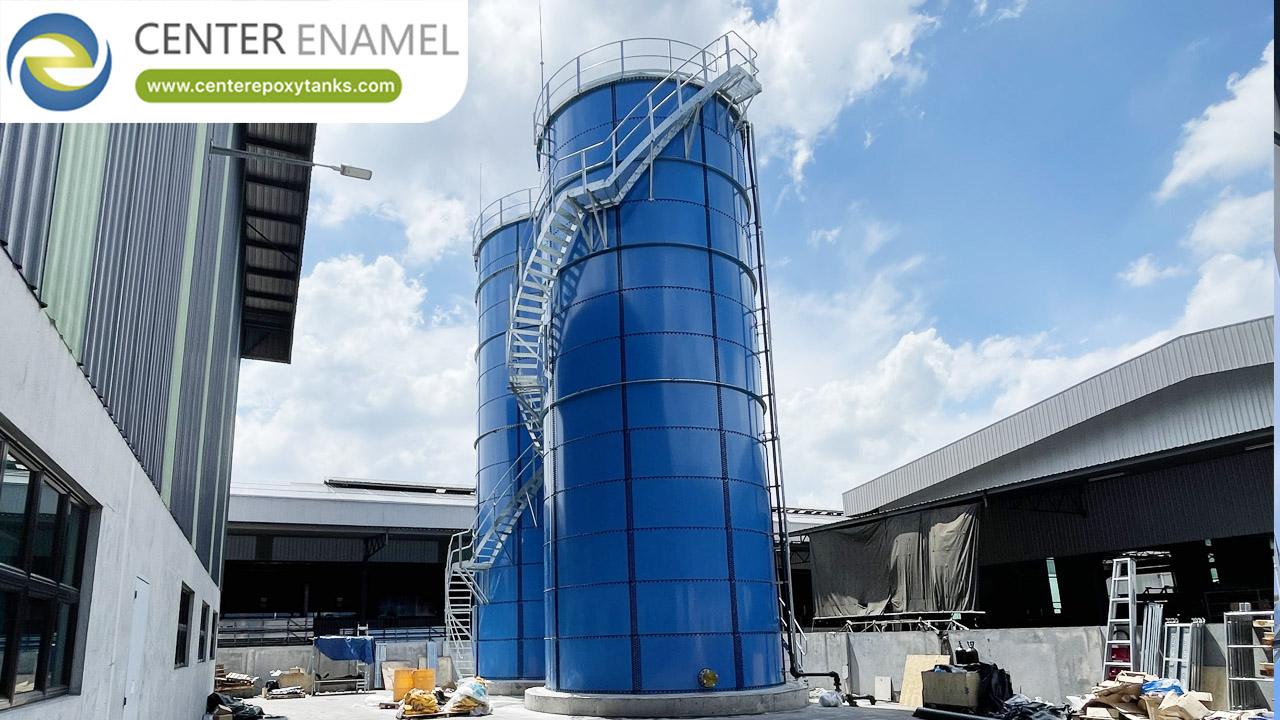
Data Center Fire Water Tank: Design, Capacity and Compliance
A data center fire water tank holds the fire reserve that supplies the site's suppression and firefighting systems. Its capacity comes from the fire protection design - suppression demand plus hose stream allowance, multiplied by the required duration - not from a nominal figure or a rule of thumb. The tank itself is designed and built to a recognised storage tank standard, commonly AWWA D103-09 for factory-coated bolted tanks with NFPA 22 as the fire protection reference, and compliance is demonstrated by design documentation, coating and material records and acceptance testing rather than by the tank's appearance.
The fire water tank is the least exercised and most consequential vessel on a data center site. It may never be used in anger, but its capacity, condition and documentation are examined during commissioning, insurer reviews and periodic inspections.
This article covers the essentials: how the reserve is sized, which standards apply to the tank and the system, how the tank is kept compliant over its life, and which records demonstrate that. It is a practical overview for owners, designers and facility managers.
Technical Explanation
Capacity: derived, not assumed
The reserve volume is an output of the fire protection design, and the sequence is fixed:
• Establish the suppression demand for each system serving the site, at the design condition.
• Add the hose stream allowance required for the occupancy.
• Add exposure protection where site conditions require it.
• Multiply the governing combined flow by the required duration.
• Express the result as usable volume above the minimum operating level, then check it against the fire protection requirements and any insurer conditions.
Which standards apply
Two categories of standard apply, and confusing them causes specification problems:
• The system standard defines the demand and duration, and therefore the volume; it also covers the installation of the pumps and the suppression systems.
• The tank standard governs how the vessel is designed, coated and built. Factory-coated bolted steel tanks are commonly specified to AWWA D103-09, with NFPA 22 as the reference for fire protection water tanks in many project specifications.
• Coating and materials standards support both: ISO 28765 for vitreous enamel coated steel tanks, and NSF/ANSI 61 where water may also serve potable duty.
• The specification should name each standard and its edition, and state which governs the volume and which governs the vessel.
Keeping the tank compliant over its life
Compliance is maintained by inspection and record keeping, not by the original installation:
• Scheduled inspection: annual external inspection of coating, sealant joints, bolts, vents, access and level indication, plus internal inspection at an interval set by the coating system and water quality.
• Water quality management: treatment to prevent corrosion, scaling and biological growth in water that is stored for long periods, with results recorded.
• Level and alarm checks: verification that the reserve is actually present and that low-level alarms function.
• Repair records: local coating repairs documented, with the repair method and material recorded so the tank's history is complete.
• Change control: any modification to the tank, its connections or the system it serves reviewed against the original design basis.
Documentation that demonstrates compliance
A well-run site can produce the following on request, and an insurer or authority may ask:
• Design documentation: the fire protection calculation showing demand, duration and the resulting volume, plus the tank design calculation to the tank standard.
• Material and coating records: plate and bolt certificates, coating test records including thickness and holiday testing.
• Installation records: bolt torque verification, sealant application, and the drawing set as built.
• Acceptance testing: the hydrostatic test report, pump test results at design flow, and alarm and level checks.
• Operating records: inspection reports, water quality results and any repair documentation.
Technical Specifications
Table 1 - Fire water tank compliance framework
Element | Governing document | Evidence of compliance | Review frequency |
Reserve volume | Fire protection design and duration requirement | Hydraulic calculation showing demand and duration | At design, and on any system change |
Tank design | Storage tank standard, for example AWWA D103-09 | Design calculations and approved drawings | At design and fabrication |
Coating performance | Coating standard such as ISO 28765, and project specification | Thickness, holiday and adhesion test records | At fabrication, and on repair |
Potable duty where applicable | NSF/ANSI 61 certification | Certification for the coating supplied | At procurement |
Physical condition | Inspection programme and fire protection requirements | External and internal inspection reports | Annual external, periodic internal |
Water quality | Site water management programme | Treatment records and test results | Routine, with results retained |
System performance | Pump and system testing requirements | Pump test at design flow with tank at minimum level | At commissioning and on retest |
Project Case Study
Project Case Summary - fire water reserves delivered
The deliveries below are firefighting water tanks in glass-fused-to-steel, galvanized and epoxy coated construction, with capacity, location and completion date recorded for each order.
Project | Application | Capacity | Construction | Roof | Completion |
India | Firefighting water | 12,261 m3 | Glass-fused-to-steel bolted | Flat | 2024-06 |
Singapore | Firefighting water | 1,666 m3 | Glass-fused-to-steel bolted | Enamel roof | 2026-01 |
Guinea | Firefighting water | 1,983 m3 | Hot-dip galvanized tank | Aluminium flat roof | 2025-12 |
Saudi Arabia | Firefighting water | 492 m3 | Fusion bonded epoxy | Aluminium flat roof | 2024-11 |
Company Expertise
Center Enamel manufactures fire water tanks in glass-fused-to-steel, fusion bonded epoxy and hot-dip galvanized steel, designed to AWWA D103-09 and produced under ISO 28765 for the enamel coating process. Each tank is delivered with material certificates, coating test records, erection drawings and testing documentation suitable for the project's compliance file.
As an outstanding containment and cover system provider with decades of industry experience, Center Enamel sincerely expects to establish long-term cooperation with local partners throughout the world and to make continuous contribution to the development of the industry.
Shijiazhuang Zhengzhong Technology Co., Ltd is not only the first manufacturer in China to produce Glass-Fused-to-Steel tanks, but also the most experienced professional bolted tank manufacturer in Asia. The engineering, design, product testing and quality system of Center Enamel Glass-Fused-to-Steel tanks are in strict accordance with AWWA D103-09, OSHA, ISO 28765, NSF/ANSI 61 and NFPA. By 2023, Center Enamel bolted tanks had been exported to more than 100 countries, including the USA, Australia, Canada, Malaysia, Indonesia, Russia, the UAE, Panama, Brazil and South Africa.
Shijiazhuang Zhengzhong Technology Co., Ltd (Center Enamel) is a professional manufacturer dedicated to the design and fabrication of bolted storage tanks since 2008. Our product range includes Glass-Fused-to-Steel (GFS) tanks, fusion bonded epoxy tanks, stainless steel tanks, galvanized steel tanks and aluminum geodesic dome roofs. With a professional enameling R&D team and nearly 200 enameling patents, Center Enamel has become a leader in the bolted tank industry in Asia. Our products are certified to ISO 9001, NSF 61, EN 1090, ISO 28765, WRAS, FM, LFGB, BSCI and ISO 45001.
Shijiazhuang Zhengzhong Technology Co., Ltd (Center Enamel) is a professional manufacturer dedicated to the design and fabrication of bolted storage tanks since 2008. Our product range includes Glass-Fused-to-Steel (GFS) tanks, fusion bonded epoxy tanks, stainless steel tanks, galvanized steel tanks and aluminum geodesic dome roofs. With a professional enameling R&D team and nearly 200 enameling patents, Center Enamel has become a leader in the bolted tank industry in Asia. Our products are certified to ISO 9001, NSF 61, EN 1090, ISO 28765, WRAS, FM, LFGB, BSCI and ISO 45001.
Shijiazhuang Zhengzhong Technology Co., Ltd is not only the first manufacturer in China to produce Glass-Fused-to-Steel tanks, but also the most experienced professional bolted tank manufacturer in Asia. The engineering, design, product testing and quality system of Center Enamel Glass-Fused-to-Steel tanks are in strict accordance with AWWA D103-09, OSHA, ISO 28765, NSF/ANSI 61 and NFPA. By 2023, Center Enamel bolted tanks had been exported to more than 100 countries, including the USA, Australia, Canada, Malaysia, Indonesia, Russia, the UAE, Panama, Brazil and South Africa.
As an outstanding containment and cover system provider with decades of industry experience, Center Enamel sincerely expects to establish long-term cooperation with local partners throughout the world and to make continuous contribution to the development of the industry.
Frequently Asked Questions (FAQ)
Q: How is the fire water tank capacity determined?
A: By the fire protection design: the suppression demand plus hose stream allowance and any exposure protection, multiplied by the required duration, expressed as usable volume above the minimum operating level. Nominal tank volume is not the same as available fire reserve.
Q: Which standard should the tank be built to?
A: A recognised storage tank standard, with AWWA D103-09 commonly specified for factory-coated bolted steel tanks, referenced alongside NFPA 22 for fire protection water tanks. The system standard governs the volume; the tank standard governs the vessel. Both should be named in the specification.
Q: How long should a fire water tank last?
A: With a fired vitreous enamel coating, a service life of 30 years or more is commonly specified under AWWA D103-09, which aligns with the life of the facility. Coating choice and water quality management are the factors that decide whether that expectation is met.
Q: Can the fire water tank also supply domestic water?
A: Only where the arrangement is permitted and the whole vessel is certified for potable water contact. The fire reserve must remain available at all times, which constrains how the tank can be operated and is the main reason combined arrangements are restricted.
Q: What happens if the coating is damaged?
A: It is repaired locally with an approved repair material, and the repair is recorded. Because the coating is applied in the factory to plates, local damage does not affect the structural integrity of the tank, but the repair should still be documented as part of the tank's compliance history.
Q: Does the tank need a roof?
A: A covered tank is preferable for water quality and for keeping debris out, and it also reduces evaporation and biological growth. Dome, flat and enamel roof options are available depending on the required span and the project's aesthetic and access requirements.
Fire water tank compliance rests on three things: a reserve volume derived from the fire protection design, a vessel built and coated to a recognised standard with documented testing, and an inspection and water quality programme that keeps both true over the life of the facility. The tank's appearance proves nothing; the records do.
Talk to the Engineering Team
Send the required fire reserve, the duration requirement and the site conditions, and we will return the tank configuration, coating specification and documentation schedule for your compliance file.


