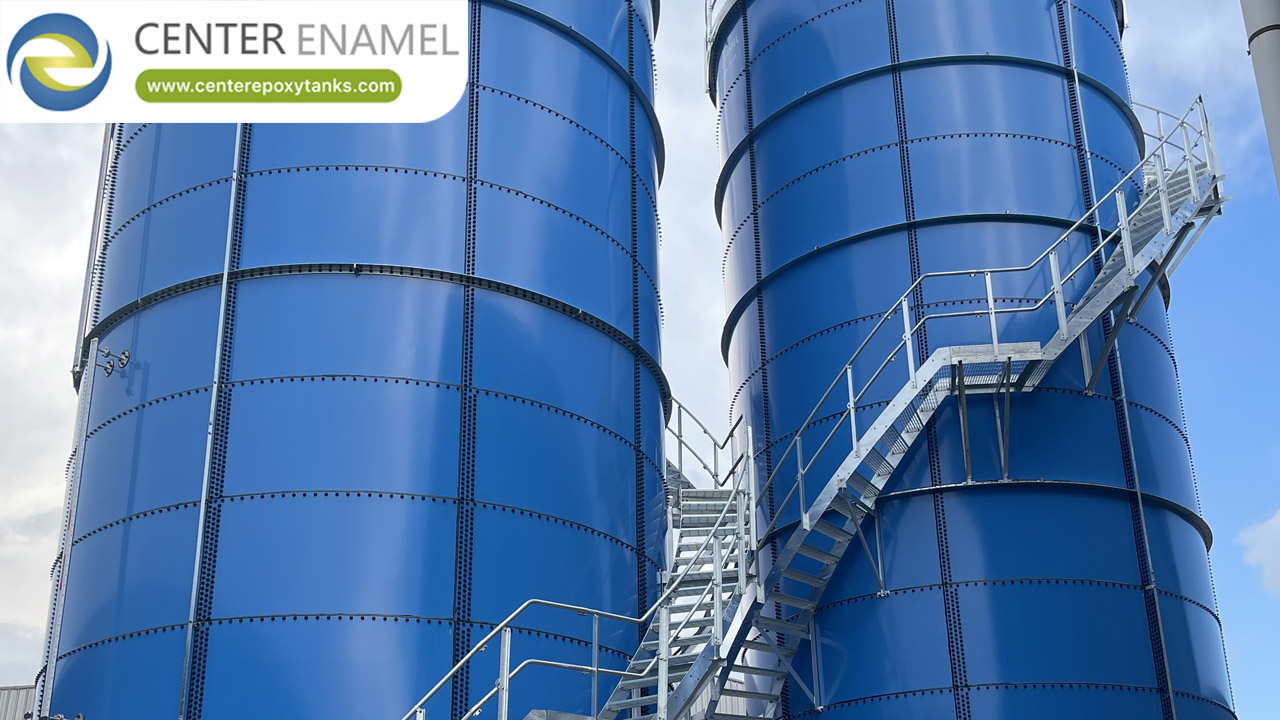
Data Center Fire Pump Tank: Suction Conditions That Decide the Design
A data center fire pump tank is designed around its suction conditions rather than its volume alone. The tank must deliver the fire pump's rated flow at the minimum operating level without drawing air, which requires an outlet sized and positioned for the flow, an anti-vortex arrangement to prevent air entrainment as the level drops, an adequate submergence depth, and a minimum water level that keeps the pump within its net positive suction head requirement. These details are fixed by the pump installation standard and by the pump data sheet, and they must be settled before the tank shell is fabricated.
Fire pumps are specified by their rated flow and pressure, and the tank feeding them is often treated as a volume to be provided. In practice a fire pump that cannot draw its rated flow is useless, and whether it can draw depends on details inside and immediately outside the tank.
This article covers the suction side of fire water storage: outlet sizing, anti-vortex provisions, submergence, minimum water level and the interface with the pump installation standard. It is written for fire protection designers and mechanical engineers fixing the tank and pump arrangement.
Technical Explanation
Why suction conditions govern the design
A fire pump has to deliver its rated flow from the tank, and the suction side is where that flow can be compromised:
• Air entrainment: as the water level falls, a poorly arranged outlet can draw air from the surface, causing the pump to lose prime or cavitate.
• Vortex formation: water spiralling into the outlet forms a vortex that entrains air well before the outlet is exposed.
• Excessive suction losses: undersized pipework or fittings between the tank and the pump reduce the available net positive suction head.
• Low water level: if the minimum operating level leaves insufficient submergence above the outlet, the design flow cannot be sustained, so the effective fire volume is less than the nominal volume.
Outlet and anti-vortex provisions
The outlet arrangement is designed as a system with the pump, not as a tank detail:
• Outlet sizing: matched to the design flow at an acceptable velocity, so that friction losses in the tank-to-pump pipework stay within the allowance.
• Anti-vortex plate or arrangement: a horizontal plate or a properly configured outlet that prevents the formation of a vortex as the level approaches the minimum.
• Submergence depth: the depth of water above the outlet at minimum operating level, which has to be sufficient for the design flow.
• Baffling where required: internal arrangements that prevent flow patterns from the inlet disturbing the outlet region, particularly where the two are close together.
Minimum water level and usable fire volume
The volume fire protection requires is the volume available above the minimum level, not the volume in the tank:
• Minimum operating level: set by the pump's suction requirements, not by the physical bottom of the tank.
• Dead volume: the water below the minimum operating level is not available to the pump and does not count towards the fire reserve.
• Level indication and alarms: arranged to show the true operating range, so the operator can see the available reserve rather than the total water depth.
• Refill provisions: arranged to restore the reserve within the time the fire protection requirements specify, with the fill rate confirmed against the tank's venting capacity.
Interface with the pump installation standard
The pump standard governs the pump installation while the tank standard governs the vessel, and the two meet at the suction connection:
• The pump installation standard addresses suction arrangements that avoid vortexing and keep the pump within its net positive suction head requirement, including the fittings permitted on the suction side.
• The tank standard governs the shell, coating, venting and access, and the reference for fire water tanks in many specifications.
• Where a pump test is required at rated flow, the test has to be conducted with the tank at its minimum operating level, which is the condition that proves the arrangement.
• Documentation: the suction arrangement drawing, showing outlet elevation, anti-vortex provision and minimum level, should be part of the submittal package.
Technical Specifications
Table 1 - Suction design items and their consequence
Design item | Established from | Consequence if inadequate | When to fix it |
Outlet size and elevation | Pump rated flow and suction loss allowance | Pump cannot achieve rated flow | Before shell fabrication |
Anti-vortex provision | Pump installation standard and flow | Air entrainment and pump cavitation | Before shell fabrication |
Submergence depth | Design flow and outlet arrangement | Loss of prime as level falls | Before shell fabrication |
Minimum operating level | Pump net positive suction head requirement | Fire reserve smaller than assumed | Before commissioning |
Vent capacity | Maximum fill rate and drawdown rate | Pressure or vacuum effects on the shell | During design |
Level indication and alarms | Operating and fire protection requirements | Reserve not verifiable in operation | During design |
Project Case Study
Project Case Summary - fire water tank with pump supply duty
The deliveries below are firefighting water tanks supplied for pump-fed fire protection systems, with capacity, construction and completion date recorded.
Project | Application | Capacity | Construction | Roof | Completion |
Panama | Firefighting water | 268 m3 | Glass-fused-to-steel bolted | Aluminium dome | 2024-06 |
Guatemala | Firefighting water | 598 m3 | Glass-fused-to-steel bolted | Aluminium flat roof | 2024-12 |
Singapore | Firefighting water | 1,666 m3 | Glass-fused-to-steel bolted | Enamel roof | 2026-01 |
Company Expertise
Center Enamel manufactures bolted fire water tanks with factory-applied coatings and supplies the nozzle arrangements, anti-vortex provisions and level fittings required for fire pump suction duty, designed to AWWA D103-09 and supplied with the drawings needed for pump installation review.
As an outstanding containment and cover system provider with decades of industry experience, Center Enamel sincerely expects to establish long-term cooperation with local partners throughout the world and to make continuous contribution to the development of the industry.
Shijiazhuang Zhengzhong Technology Co., Ltd is not only the first manufacturer in China to produce Glass-Fused-to-Steel tanks, but also the most experienced professional bolted tank manufacturer in Asia. The engineering, design, product testing and quality system of Center Enamel Glass-Fused-to-Steel tanks are in strict accordance with AWWA D103-09, OSHA, ISO 28765, NSF/ANSI 61 and NFPA. By 2023, Center Enamel bolted tanks had been exported to more than 100 countries, including the USA, Australia, Canada, Malaysia, Indonesia, Russia, the UAE, Panama, Brazil and South Africa.
Shijiazhuang Zhengzhong Technology Co., Ltd (Center Enamel) is a professional manufacturer dedicated to the design and fabrication of bolted storage tanks since 2008. Our product range includes Glass-Fused-to-Steel (GFS) tanks, fusion bonded epoxy tanks, stainless steel tanks, galvanized steel tanks and aluminum geodesic dome roofs. With a professional enameling R&D team and nearly 200 enameling patents, Center Enamel has become a leader in the bolted tank industry in Asia. Our products are certified to ISO 9001, NSF 61, EN 1090, ISO 28765, WRAS, FM, LFGB, BSCI and ISO 45001.
Shijiazhuang Zhengzhong Technology Co., Ltd (Center Enamel) is a professional manufacturer dedicated to the design and fabrication of bolted storage tanks since 2008. Our product range includes Glass-Fused-to-Steel (GFS) tanks, fusion bonded epoxy tanks, stainless steel tanks, galvanized steel tanks and aluminum geodesic dome roofs. With a professional enameling R&D team and nearly 200 enameling patents, Center Enamel has become a leader in the bolted tank industry in Asia. Our products are certified to ISO 9001, NSF 61, EN 1090, ISO 28765, WRAS, FM, LFGB, BSCI and ISO 45001.
Shijiazhuang Zhengzhong Technology Co., Ltd is not only the first manufacturer in China to produce Glass-Fused-to-Steel tanks, but also the most experienced professional bolted tank manufacturer in Asia. The engineering, design, product testing and quality system of Center Enamel Glass-Fused-to-Steel tanks are in strict accordance with AWWA D103-09, OSHA, ISO 28765, NSF/ANSI 61 and NFPA. By 2023, Center Enamel bolted tanks had been exported to more than 100 countries, including the USA, Australia, Canada, Malaysia, Indonesia, Russia, the UAE, Panama, Brazil and South Africa.
As an outstanding containment and cover system provider with decades of industry experience, Center Enamel sincerely expects to establish long-term cooperation with local partners throughout the world and to make continuous contribution to the development of the industry.
Frequently Asked Questions (FAQ)
Q: What determines the minimum water level in a fire pump tank?
A: The pump's suction requirements. The minimum operating level is the level at which the pump still draws its rated flow without cavitating or entraining air, which depends on outlet elevation, submergence depth and the net positive suction head available. Water below that level is dead volume and does not count towards the fire reserve.
Q: What is an anti-vortex plate and why is it needed?
A: It is a horizontal plate or equivalent arrangement at the outlet that prevents water from spiralling into the connection and drawing air from the surface as the level falls. Without it, a vortex can form well above the point where the outlet would otherwise be exposed, and the pump loses performance before the reserve is actually used up.
Q: How large should the outlet be?
A: Sized for the pump's rated flow at a velocity that keeps friction losses within the available suction allowance. The pipe, fittings and valves between the tank and the pump all consume part of that allowance, so the outlet cannot be sized in isolation.
Q: Does the tank volume include the volume below the outlet?
A: No. The fire reserve is the usable volume above the minimum operating level. The volume below that level is dead volume required for submergence and suction arrangements, and it should not be counted when checking the tank against the required fire volume.
Q: How is the suction arrangement verified?
A: By a pump test at rated flow with the tank at its minimum operating level, which is the condition that proves the arrangement works when it is needed. The suction arrangement drawing should be part of the submittal package and reviewed against the pump data sheet.
Q: Can the fire pump draw directly from a bolted tank?
A: Yes. The suction connection is a nozzle on the tank shell, arranged with the outlet elevation, anti-vortex provision and submergence needed for the pump. What matters is that the tank design accounts for those requirements before fabrication rather than being adapted afterwards.
Fire pump tank design is suction design. Outlet sizing, anti-vortex provision, submergence and minimum water level decide whether the pump delivers its rated flow when the reserve is nearly empty - and all four must be fixed before the shell is fabricated, because they are not retrofit items.
Talk to the Engineering Team
Send the fire pump data sheet, the required fire volume and the system demand. We will confirm the outlet arrangement, anti-vortex provision and minimum operating level, and provide the suction detail for the tank design.


