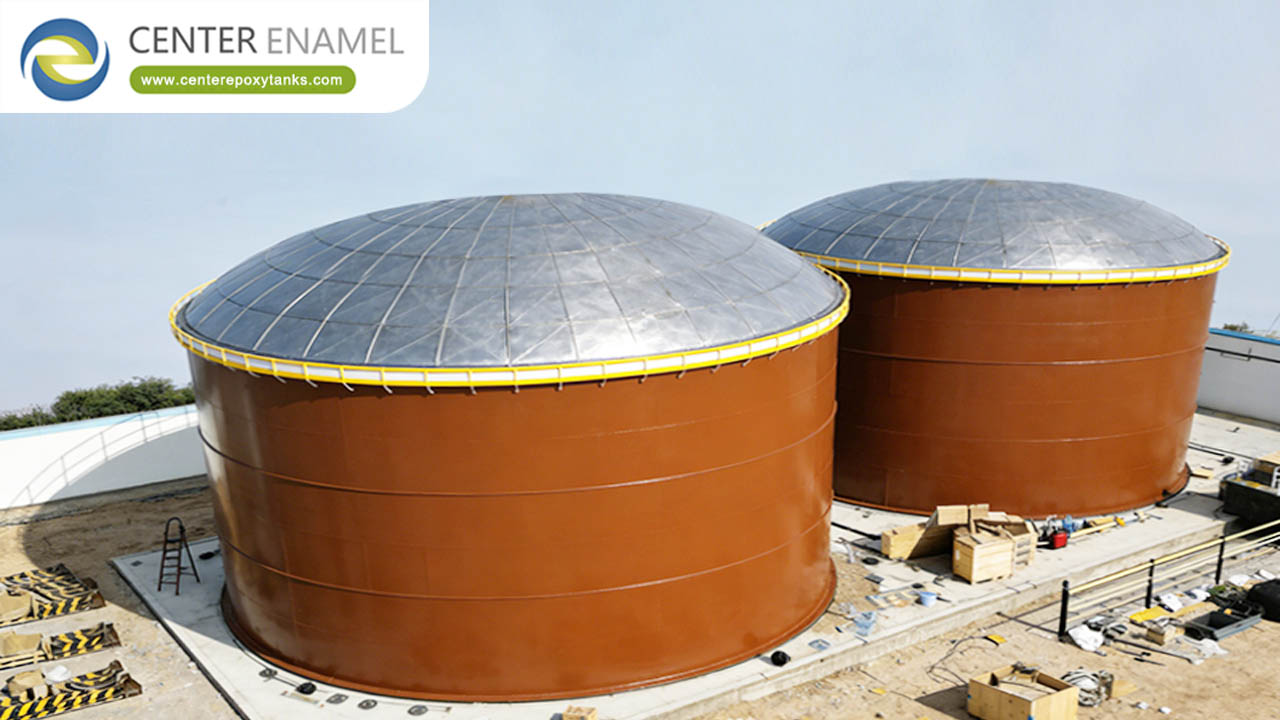
Corrosion-Resistant Tanks: Engineering Longevity for Aggressive Industrial Media
Corrosion-resistant tanks are high-integrity containment systems engineered to neutralize the degradative effects of H2S biogenic corrosion, high-salinity effluents, and extreme pH fluctuations (pH 1–14). Utilizing advanced materials like Glass-Fused-to-Steel (GFS), Fusion Bonded Epoxy (FBE), and Stainless Steel (304/316L), these tanks provide a dielectric barrier that prevents structural oxidation. Center Enamel manufactures these systems in compliance with AWWA D103-09 and ISO 12944 (C5-M/I class), offering a 30- to 50-year service life. These modular bolted solutions are essential for the chemical, wastewater, and agricultural sectors in 100+ countries, minimizing Lifecycle Cost (LCC) and environmental risk.
1. Technical Specification & Corrosion-Resistance Matrix
This matrix establishes the mechanical benchmarks for Center Enamel’s corrosion-resistant technology.
Feature | Technical Specification (2026 Standard) | Strategic Utility Value |
Design Standards | AWWA D103, ISO 28765, EN 1090 | Global benchmark for bolted structural integrity. |
Coating Type | GFS / FBE / Stainless / Galvanized | Tiered protection based on chemical aggressiveness. |
Corrosion Class | ISO 12944 C5-M (Marine) / C5-I (Industrial) | Rated for extreme humidity and chemical vapors. |
pH Tolerance | pH 1 to pH 14 (Material Dependent) | Versatility across acidic and alkaline media. |
Adhesion Strength | Exceeds 12 MPa (ISO 4624) | Prevents coating delamination under high pressure. |
Testing (NDT) | High-Voltage Spark Testing (ASTM G62) | Guarantees a 100% "holiday-free" dielectric barrier. |
2. Structural Dynamics: The Science of Barrier Protection
Neutralizing the Galvanic Cell
Corrosion occurs when an electrolyte (liquid) facilitates electron flow between an anode and cathode on a metal surface. Center Enamel’s tanks stop this process through:
● Dielectric Isolation: Our Glass-Fused-to-Steel (GFS) technology fuses glass to steel at 850C, creating a molecular bond that is chemically inert. This provides the ultimate dielectric barrier, making the tank surface immune to the "pitting" and "crevice corrosion" common in standard steel or concrete.
● Biogenic $H_2S$ Mitigation: In wastewater and biogas applications, H2S gas converts to sulfuric acid in the "headspace." Center Enamel’s coatings are specifically engineered to resist this biogenic attack, which typically destroys concrete basins within a decade.
● Modular Bolted Advantage: Unlike welded tanks, our bolted design eliminates "Heat-Affected Zones" (HAZ). Welding burns off protective coatings and alters the steel’s grain structure, creating localized points for rust to initiate. Our factory-coated panels ensure 100% uniform protection across the entire vessel.
3. High-Impact Applications & Industry Reliability
● Chemical & Petrochemical Storage: Containing hazardous reagents and bulk acids with verified compatibility (per ASTM D543 standards).
● Municipal Wastewater Treatment: Handling aggressive primary sludge and aeration processes where dissolved oxygen and biological activity accelerate oxidation.
● Industrial Effluent Equalization: Managing high-COD/BOD wastewater from textile, food, and pharmaceutical plants, often requiring resistance to significant pH swings.
● Agricultural Nutrient Management: Storing liquid fertilizers and manure slurries that are high in nitrogen and ammonia—substances that rapidly degrade galvanized or mild steel.
4. Why Partner with Center Enamel?
As a global leader with over 30 years of specialization, Shijiazhuang Zhengzhong Technology Co., Ltd (Center Enamel) offers a unique technological advantage:
● State-of-the-Art Fabrication: Our 150,000 m2 facility utilizes automated laser cutting and CNC precision drilling to ensure every panel meets exact tolerances for a perfect, leak-free assembly.
● Pioneering R&D: We operate an independent enterprise technology center with over 100 patents in coating chemistry and structural Finite Element Analysis (FEA).
● Global Logistics & EPC Authority: With projects in 100+ countries, we manage the complex logistics of international shipping and provide on-site installation supervision to ensure a "Future-Ready" asset.
● Unassailable Certification: We hold an array of international stamps, including NSF/ANSI 61, ISO 9001, and BSCI, ensuring our tanks meet the legal and ethical requirements of any global jurisdiction.
5. Technical FAQ: Corrosion-Resistant Tank Implementation
Q: How do you verify that the coating is pinhole-free?
A: Every panel undergoes high-voltage Spark Testing (Holiday Detection). This identifies even microscopic gaps in the coating that are invisible to the naked eye, ensuring 100% surface integrity before the tank leaves the factory.
Q: Can these tanks handle high-temperature corrosive liquids?
A: Yes. For high-temperature applications (up to 95C for GFS), we utilize specialized sealants and coating formulations that maintain their mechanical properties and adhesion under thermal stress.
Q: What is the maintenance requirement for a GFS tank?
A: GFS and FBE coatings are virtually maintenance-free. Unlike painted or concrete tanks, they do not require periodic recoating, which significantly reduces the Total Cost of Ownership (TCO) over the 30- to 50-year service life.


