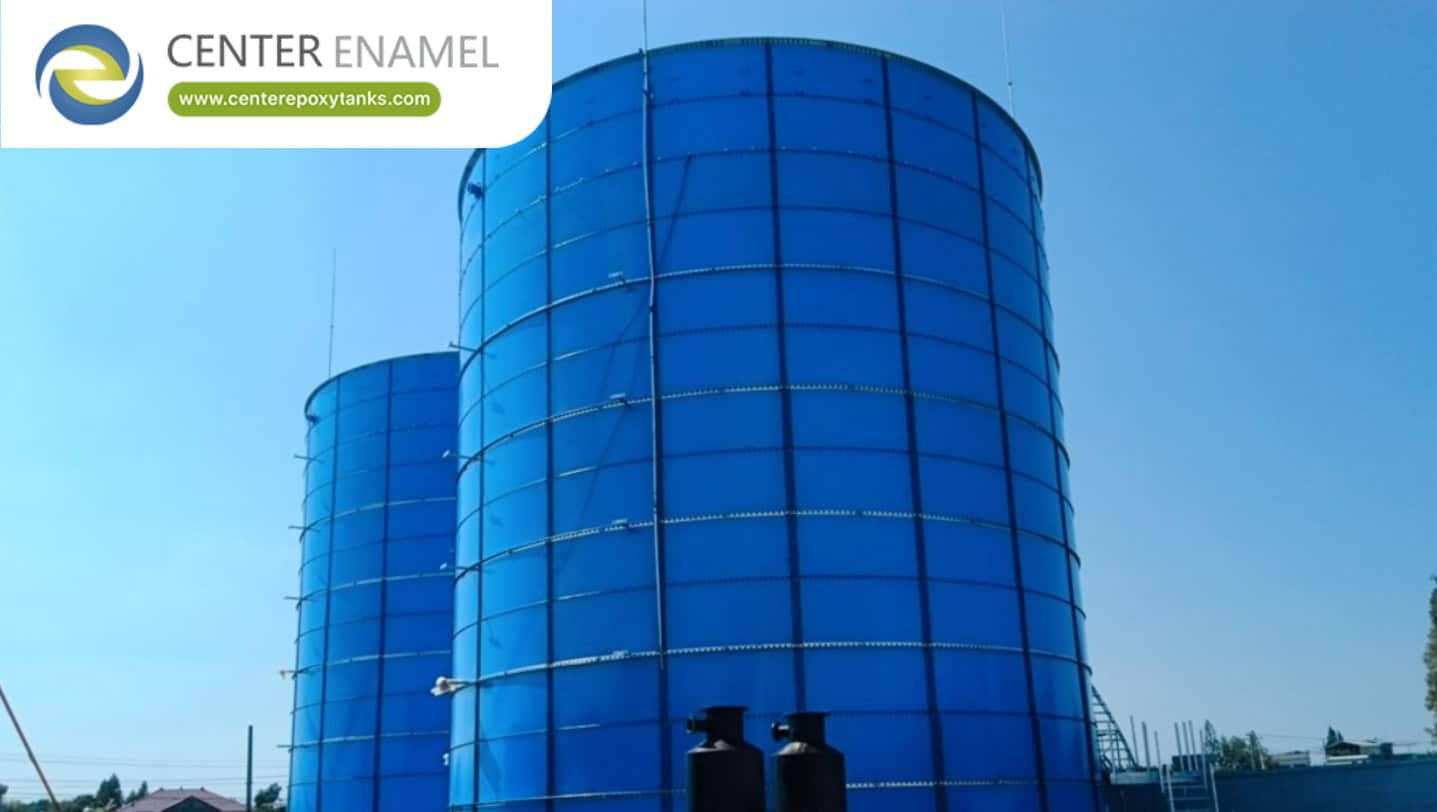
Fusion Bonded Epoxy (FBE) Tanks for Farm Digesters: High-Performance Biogas Storage
Fusion Bonded Epoxy (FBE) steel tanks provide a cost-effective, high-performance containment solution for farm-scale anaerobic digesters. Unlike traditional concrete pits or field-welded steel tanks, FBE tanks utilize high-tensile steel panels with a factory-fused thermoset epoxy coating, cured at $200^circtext{C}$ to create a molecularly bonded, non-porous barrier. This surface is engineered to withstand the chemically aggressive environment of manure slurry and biogenic hydrogen sulfide (H2S) common in biogas production. With modular bolt-together construction, these tanks allow for rapid site deployment, superior seismic resilience, and a 30+ year design life, making them the preferred infrastructure for modern, high-efficiency waste-to-energy operations.
The Engineering Challenge: Agricultural Slurry Containment
Farm digesters create one of the most demanding environments for industrial infrastructure. The storage of manure, crop residues, and co-digestion feedstocks creates a "perfect storm" for material degradation:
Acidic Aggression: Manure slurry and anaerobic digestion byproducts can exhibit a pH range that aggressively attacks porous concrete, leading to micro-cracking and eventual structural failure.
Biogenic $H_2S$ Corrosion: The biological process releases hydrogen sulfide, which reacts with moisture to form sulfuric acid. This acid is catastrophic to unprotected carbon steel and causes "spalling" in reinforced concrete.
Dynamic Loading: Farm digesters often require heavy internal mixing and agitation equipment. The structural rigidity of bolted FBE steel tanks ensures these dynamic loads are supported without the fatigue-induced cracking common in monolithic concrete structures.
Why FBE Technology is the Farm Standard
FBE technology represents a significant leap forward from legacy storage solutions:
Factory-Controlled Consistency: Every FBE panel is manufactured in a climate-controlled facility, ensuring an electrostatic uniform coating that is impossible to replicate with field-applied paints or liners.
Dielectric Integrity: Each panel undergoes a 1500V "Holiday Test" before shipping. This guarantees zero pinholes or microscopic defects, ensuring the corrosive slurry never contacts the steel substrate.
Thermal Management: The bolted steel design, when paired with insulation, offers superior thermal stability—crucial for maintaining mesophilic (35C) or thermophilic (55C) temperatures required for optimal methane yield.
Comparative Overview: Digester Technologies
Feature | Epoxy-Coated Bolted Steel | Reinforced Concrete | Field-Welded Steel |
Chemical Resistance | High (Inert Polymer) | Low (Needs Acid-Liner) | Moderate (Needs Recoating) |
Installation Speed | Rapid (Modular) | Very Slow (Curing) | Moderate |
Leakage Risk | Zero (Airtight Gaskets) | High (Micro-cracking) | Moderate (Weld fatigue) |
Maintenance | Minimal | High (Crack repair) | High (Paint cycles) |
Lifespan | 30+ Years | 40+ Years (If sealed) | 15–20 Years |
Key Technical Benchmarks for Agricultural Procurement
To ensure your farm’s infrastructure delivers a high Return on Investment (ROI), procurement teams should verify the following specifications with their manufacturer:
Coating Adhesion: The epoxy bond must demonstrate strength $>7text{ MPa}$ to ensure it does not delaminate under thermal shock or high-pressure mixing.
pH Tolerance: Specify an operating range of pH 3.0–11.0 to accommodate varying feedstock inputs, including co-digestion of food waste.
Bolting System: Use high-grade, corrosion-resistant bolts with integrated sealing washers to maintain gas-tight integrity throughout the tank's service life.
Foundation Compatibility: FBE tanks are lightweight compared to concrete, allowing for smaller, more cost-effective foundation designs while maintaining structural security in high-seismic zones.
Frequently Asked Questions (FAQ)
Q: Is epoxy as durable as Glass-Fused-to-Steel (GFS)?
A: FBE is a specialized, cost-effective alternative. While GFS provides extreme chemical inertness, FBE is highly resistant to mechanical abrasion and impact, making it ideal for farms that perform frequent internal maintenance or mix abrasive feedstock.
Q: Can I use this tank for manure storage before it enters the digester?
A: Yes. FBE tanks are excellent for raw slurry storage, equalization, and post-digestion effluent containment. Their modular nature allows for scalable farm expansion.
Q: Does the epoxy coating require cathodic protection?
A: No. Because the factory-applied FBE creates a complete, continuous dielectric barrier, there is no need for complex cathodic protection systems, simplifying your long-term maintenance routines.
Optimizing Your Farm’s Energy Future
Selecting the right digester tank is the foundation of a successful biogas operation. By choosing high-performance FBE bolted steel, you minimize maintenance downtime, eliminate environmental leakage risks, and maximize the efficiency of your waste-to-energy production.
Are you planning a new biogas digester or retrofitting your farm's waste management system?
[Contact our engineering team] for a technical load-bearing assessment, chemical compatibility advice, or a design proposal tailored to your farm’s specific feedstock and capacity requirements.
Would you like a detailed technical brief on how FBE tanks integrate with internal mixing and heating systems to optimize biogas production yields?


