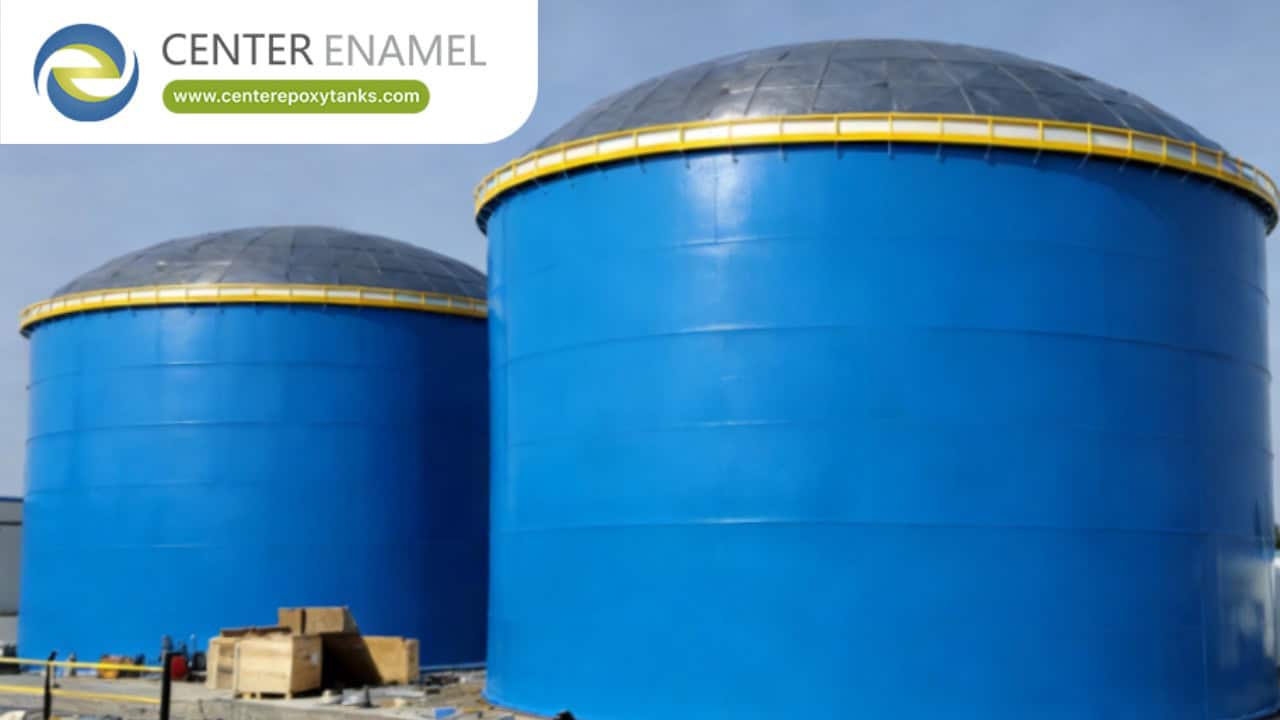
Cooking Oil Storage Tanks - Holding UCO Value for Biodiesel Feedstock
Used cooking oil is a traded feedstock with a price that moves with its quality. It arrives from restaurants, food manufacturers and collection networks carrying water, food solids and free fatty acids acquired during use. Every one of those lowers the price a biodiesel producer will pay, and all of them can get worse in storage if the tank is not designed for the stream.
Engineered by Shijiazhuang Zhengzhong Technology Co., Ltd. (Center Enamel), used cooking oil tanks are built as heated, drainable, screenable vessels that separate water and solids rather than storing them along with the oil.
1. What Makes Used Cooking Oil Hard to Store?
Variability and contamination. It arrives warm, wet and full of food solids, it solidifies as it cools, and its free fatty acid content determines what a biodiesel producer will pay.
· Variable Incoming Quality: Composition depends entirely on the source and the collection chain.
· Water Content: Water arrives with the oil and promotes hydrolysis that raises free fatty acids.
· Food Solids: Settled solids take up volume and accelerate degradation.
· Solidification: Fats set as they cool, which stops transfer and separation.
· Odour: Warm degrading oil generates odour that needs controlling at collection points.
2. How Warm Should UCO Be Stored?
Warm enough to stay liquid and separable, and no warmer than necessary. Heating is functional rather than optional, and over-heating wastes energy and accelerates degradation.
· Liquidity: Warm storage keeps the oil pumpable and prevents solidification in the tank and pipework.
· Separation: Warm oil separates from water far faster than cold oil.
· Controlled Heating: Heating is controlled rather than continuous at maximum.
· Insulation: Reduces heat loss and reduces the cycling that drives condensation.
· Temperature Limit: Set with the tank's lining or material rating in mind.
3. How Is Feedstock Value Protected?
By removing water and solids promptly and avoiding conditions that raise free fatty acids. Those two parameters are what a buyer tests, and they are both influenced by how the oil is stored.
· Screening at Inlet: A screen or filter removes food solids before they settle.
· Water Draw-Off: A draw-off at the lowest point removes settled water routinely.
· Sediment Management: Settled solids are removed at cleaning; access is designed for it.
· Segregation: Higher-quality collections are kept separate from lower-quality ones.
· Sampling: Regular sampling tracks free fatty acid and water content so pricing is defensible.
Evaluation Criterion | Purpose-Built UCO Tank | General Purpose Tank |
Heating provision | Sized to keep oil liquid and separable | Absent or inadequate |
Inlet screening | Provided | None |
Water draw-off | Routine, at the lowest point | Occasional |
Sediment access | Designed for the real cleaning interval | Standard |
Odour control | Sealed with vented headspace | Open vent |
Engineering Assurance and Project Support
Every welded oil tank delivered by Shijiazhuang Zhengzhong Technology Co., Ltd. (Center Enamel) is designed to API 650 with shell courses sized by the one-foot method and checked for wind, seismic and hydrostatic load cases, or to EN 14015 and the Eurocodes where the site is European. Shell plate is shot-blasted to Sa 2.5 and coated to a documented dry film thickness, longitudinal and annular plate welds are examined by radiography or ultrasonic testing to the acceptance level written into the purchase order, and every tank is hydrostatically tested and dimensionally surveyed before hand-over. UCO tanks are supplied with heating sized to the stream, inlet screening, water draw-off at the lowest point, sediment access, sealed venting for odour control, insulation and sampling points.
"Used cooking oil is priced on free fatty acids and water. Storage either protects those two numbers or quietly costs you money on every load."
Frequently Asked Questions (FAQ)
Why does used cooking oil need heated storage?
Because it solidifies as it cools, which stops transfer and prevents water separation. Warm storage keeps the oil liquid and pumpable and makes gravity separation of water work. The temperature should be the lowest that achieves both, because over-heating wastes energy and accelerates degradation.
How do you stop free fatty acids rising during storage?
By removing water. Hydrolysis - the reaction that splits triglycerides into free fatty acids - needs water, so routine water draw-off at the lowest point is the single most effective control. Keeping the oil at the lowest practical temperature and removing settled solids both help as well.
Should different grades of UCO be stored separately?
Yes, wherever the volumes justify it. Collections differ substantially in free fatty acid content, and keeping higher-quality material separate preserves its price rather than averaging it down with lower-grade collections. Regular sampling then makes the pricing of each tank defensible.
Can the tank be customised for our operation?
Yes. Capacity and geometry, heating type and capacity, inlet screening, water draw-off and sediment access, sealed venting to odour treatment, insulation, mixing provision, sampling points and instrumentation are all engineered to your collection profile and process.


