Cone Roof vs. Domed Roof: API 650 Tank Design and Comparison
In the design and construction of welded steel atmospheric storage vessels governed by API 650, selecting the correct roof configuration is a critical engineering decision. API 650 outlines rigorous standards for materials, fabrication, welding, inspection, and erection of oil and chemical storage tanks.
Among fixed-roof options, engineers primarily choose between traditional cone roofs (fabricated from carbon steel plates) and domed roofs (typically constructed as geodesic aluminum space frames). Evaluating these two roof types requires analyzing structural mechanics, internal support requirements, corrosion behavior, and compatibility with internal floating decks.
1. API 650 Cone Roof Tanks: Design and Mechanics
An API 650 cone roof features a sloped, conical steel plate geometry welded to the top of the cylindrical tank shell.
·
Self-Supporting vs. Supported Design: Per API 650 specifications, smaller tank diameters allow for self-supporting cone roofs that transfer loads entirely to the perimeter shell compression ring. For larger bulk storage tanks, cone roofs require internal structural support systems—including radial rafters, girders, and center support columns.
·
·
Material and Venting: Built from carbon steel matching the tank shell, cone roofs are engineered with a frangible shell-to-roof joint in many designs, providing a weak-link pressure relief detail in the event of an internal vapor explosion.
·
·
Primary Applications: Crude oil settling tanks, heavy fuel oil storage, diesel reserves, and wastewater containment where carbon steel construction is standard.
·
2. API 650 Domed Roof Tanks: Design and Mechanics
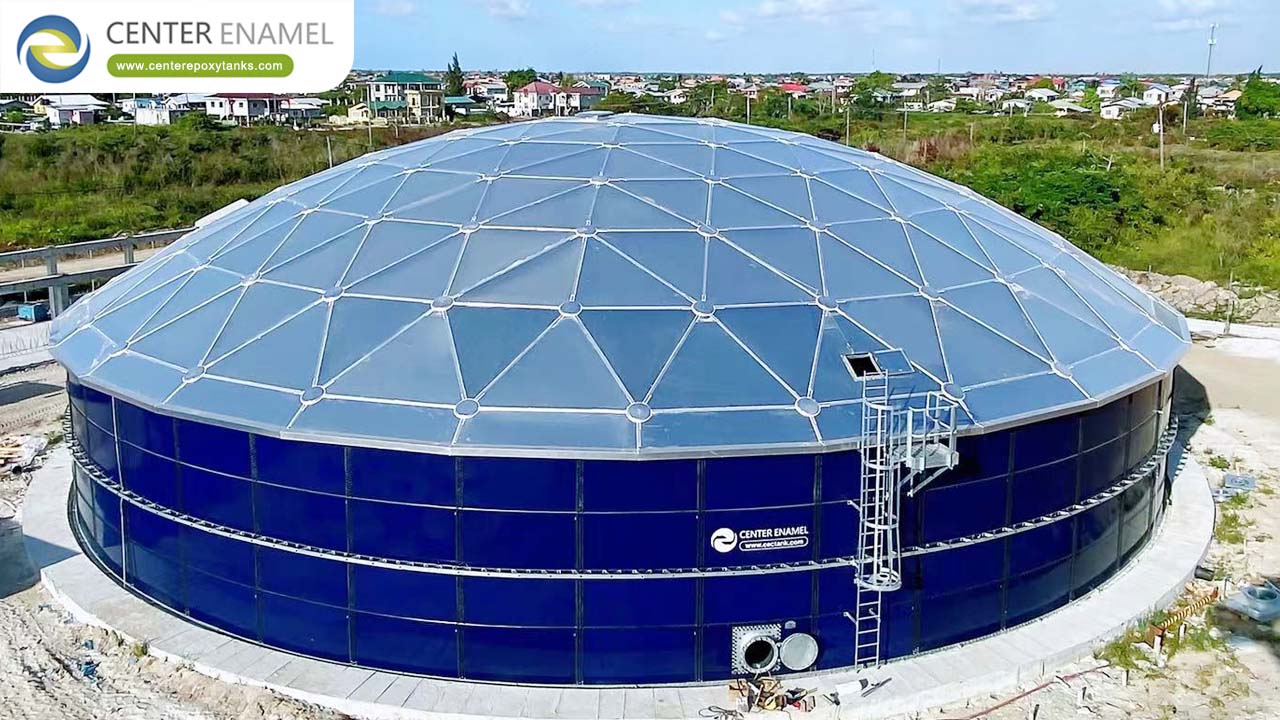
A domed roof—most commonly implemented as a geodesic aluminum dome—features a curved, spherical space frame engineered to span large diameters without requiring interior columns.
·
Clear-Span Space Frame: Fabricated from structural aluminum alloy struts and panels, geodesic domes achieve a 100% clear-span interior. The structural load is borne entirely by the perimeter tank shell rim, eliminating internal column interference.
·
·
Thermal and Corrosion Performance: Aluminum domes are naturally corrosion-resistant, eliminating the need for periodic paint coating maintenance. Furthermore, their reflective surface properties reduce solar heat gain, significantly lowering internal product temperatures and vapor expansion.
·
·
Primary Applications: Modern chemical processing plants, municipal water treatment facilities, and refined product terminals, particularly when serving as the fixed outer roof for Internal Floating Roof Tanks (IFRTs).
·
Data Table: Cone Roof vs. Domed Roof API 650 Technical Comparison
Technical Parameter | API 650 Cone Roof Tank (Steel) | API 650 Domed Roof Tank (Geodesic Aluminum) |
Governing Standard | API 650 Section 5.10.4 & 5.10.5 | API 650 Appendix G / AWWA D103 standards |
Roof Geometry & Material | Sloped conical carbon steel plates | Curved spherical space frame (Aluminum alloy) |
Internal Support Structure | Requires rafters, girders, and center columns (large diameters) | 100% Clear-span (Zero internal support columns) |
Corrosion & Maintenance | Requires periodic exterior/interior coating and painting | Maintenance-free; naturally resistant to atmospheric corrosion |
Internal Floating Roof (IFR) Fit | Requires column sleeve penetrations through floating deck | Unobstructed interior allows completely free deck travel |
Solar Heat Reflection | Moderate (Depends on paint condition and color) | High (Aluminum alloy naturally reflects solar radiation) |
Key Engineering Trade-offs for Terminal Designers
1.
Internal Floating Roof Compatibility: When an API 650 tank is designed as an Internal Floating Roof Tank (IFRT) to control VOC emissions, a geodesic aluminum dome is vastly superior. A cone roof requires internal columns that must pierce the floating deck via sleeved openings, introducing potential vapor leakage points. A domed roof eliminates columns entirely.
2.
3.
Initial CapEx vs. Lifecycle Cost: Carbon steel cone roofs typically offer a lower initial material cost. However, ongoing maintenance requirements (rust remediation, grit blasting, and repainting) make aluminum geodesic domes more economical over a 20-to-30-year operational lifecycle.
4.
5.
Wind and Seismic Performance: Aluminum space-frame domes are lightweight, significantly reducing dead load stress on the underlying tank shell during seismic events, whereas steel cone structures add substantial top-weight to the vessel.
6.
Frequently Asked Questions (FAQ)
Q: What is the primary structural difference between cone and dome roofs on API 650 tanks?
A: A cone roof uses sloped carbon steel plates that often require internal rafters and center support columns for larger diameters. A dome roof utilizes a clear-span geodesic aluminum space frame that requires zero internal support columns.
Q: Why are geodesic aluminum domes preferred for internal floating roof tanks built to API 650?
A: Because geodesic domes provide a clear-span interior, they eliminate internal support columns. This prevents mechanical interference and column sleeve penetrations on the floating deck, ensuring smoother vertical travel and superior vapor containment.
Q: Do API 650 cone roofs require internal support columns for all sizes?
A: No. Small-to-medium diameter API 650 cone roofs can be self-supporting, transferring loads entirely to the shell. Large-diameter cone roofs require supported framing with radial rafters and center columns.
Q: Which roof type offers better long-term corrosion resistance?
A: Geodesic aluminum dome roofs offer superior corrosion resistance because they are fabricated from aluminum alloys that do not rust or require protective paint coatings, unlike carbon steel cone roofs.


