Condensate Storage Tank: Light-Ends, Vapor, and Roof Choice
A floating roof tank keeps a buoyant deck riding directly on the liquid surface, eliminating the vapor space that drives product loss and fire risk. For condensate oil storage tank this is the single most effective emission-control measure available at the tank shell.
What Is Condensate Oil Storage Tank?
A floating roof tank is a vertical cylindrical storage tank fitted with a roof that floats on the stored product. An external floating roof (EFR) sits fully exposed on the liquid; an internal floating roof (IFR) is a floating deck housed beneath a fixed cone or dome roof. Both designs shrink the empty headspace to near zero, so vapor cannot accumulate above the liquid.
How Does It Work?
The deck or pontoon follows the liquid level through leg or cable supports. A primary rim seal bridges the gap between deck edge and shell; a secondary seal adds a vapor barrier. As the level rises and falls, the seal sweeps the wall, and a roof drain or flexible pipe moves any rainfall off the deck without breaking the seal. The result is a near-closed liquid surface.
Key Types, Components, and Features
· External Floating Roof (EFR):a full deck exposed to weather, used for large crude and fuel-oil tanks where the roof itself is the weather cover.
· Internal Floating Roof (IFR):a floating deck inside a fixed roof, used for gasoline, light fuels, and condensate where a closed top is required.
· Pontoon deck:buoyancy from peripheral and cross pontoons; common, economical, good for moderate sizes.
· Double-deck roof:buoyancy from a full upper deck with compartments; better for large diameters and snow/wind.
· Hybrid with aluminum dome:IFR under a geodesic aluminum dome for sealed, clear-span service in harsh climates.
Applications
· Crude oil terminals and refinery tank farms
· Fuel oil and diesel backup/reserve storage
· Gasoline and light fuel oil (IFR mandatory in most codes)
· Condensate and slop oil (high vapor-pressure, dirty streams)
· Bulk terminal and marine export storage
Technical Considerations
· Standards:API 650 (Appendix C for IFR, Appendix D for EFR) and EN 14015 govern design, while local fire codes set sealing and venting rules.
· Rim seals:a primary mechanical shoe or liquid-mounted seal plus a secondary vapor seal; seal condition drives most emissions.
· Wind girder:a stiffening ring at the deck edge on large EFRs to resist flapping under wind.
· Roof drain:a flexible swing or articulated drain keeps rain off the deck without tearing the seal.
· Vapor pressure envelope:EFR/IFR suit services below a threshold true vapor pressure; above it, a fixed-roof-plus-vapor-recovery or pressurized system is required.
Key Engineering Parameters
Design Parameter | Typical Value / Range | Why It Matters |
Rim seal | Primary + secondary mechanical | Controls most VOC emissions |
Deck type | Pontoon or double-deck | Buoyancy and snow/wind load |
Vapor-loss reduction | Up to 99% vs fixed roof | Emission and product-loss control |
Design standard | API 650 App C/D; EN 14015 | Code compliance |
Wind girder | At deck edge on large tanks | Resists wind flapping |
Roof drain | Flexible swing / articulated | Removes rainfall without breaking seal |
Shell thickness | One-foot method | Holds design liquid height |
Seal inspection | Per maintenance plan | Preserves emission and safety |
Typical service | Crude, fuel oil, gasoline | Matches true vapor pressure |
Project Case Study
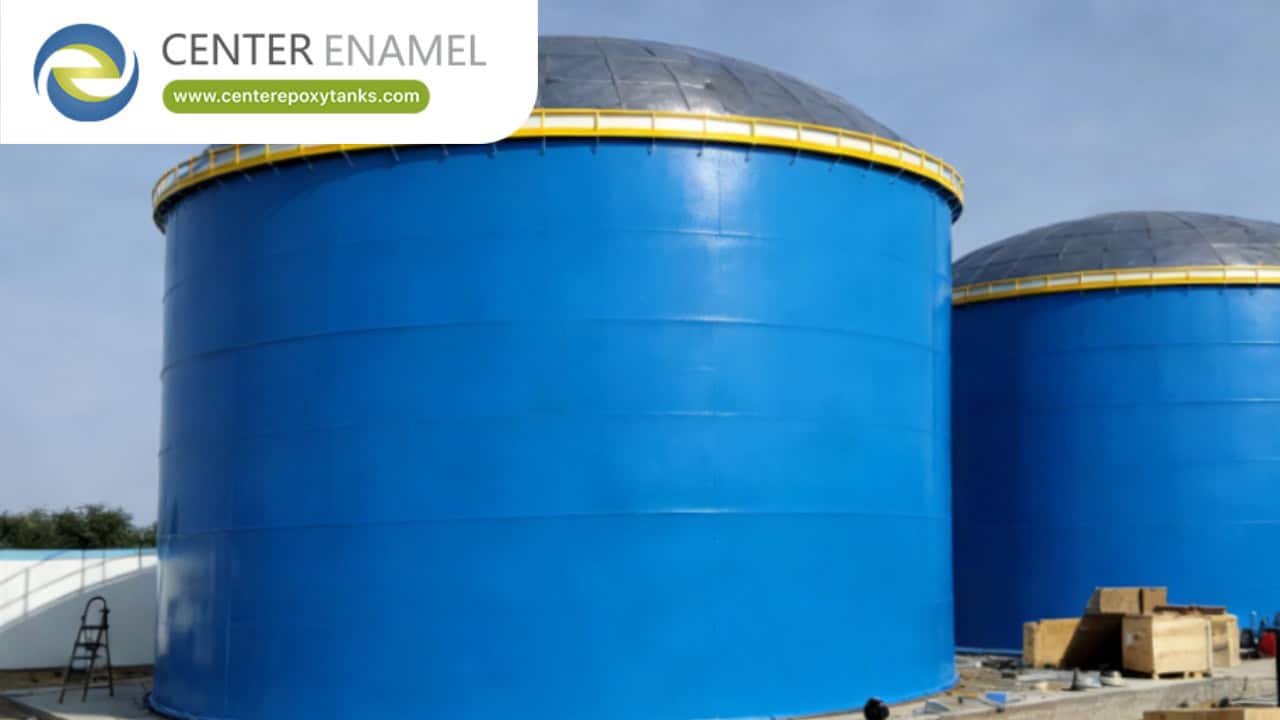
The following verified installation demonstrates the containment engineering discipline behind condensate oil storage tank. (Application shown is the tank's actual delivered service; the same bolted, coated, or stainless engineering underlies oil-storage designs discussed here.)
Project Information | Details |
Location | India |
Year | 2024 |
Industry / Application | Fire-protection water for an industrial facility |
Product / Tank type | GFS bolted |
Configuration | 3 tanks, φ 19.86 × 13.2 m |
Capacity | 12,261 m³ |
Standards | AWWA D103-09 / ISO 28765 |
Status | Completed |
This reference is cited for its documented liquid-containment and corrosion-control engineering; it is not represented as an oil tank where it was a water or wastewater installation.
Advantages and Limitations
Advantages
· Reduces evaporative loss and VOC emissions by up to 99% versus a fixed roof
· Lowers the flammable vapor space, improving fire safety
· Cuts product loss (and therefore cost) on volatile streams
· Extends coating life by shielding the deck from vapor attack
Limitations
· Higher capital cost than a simple fixed-roof tank
· Seals need routine inspection and replacement
· Not suitable for services above the vapor-pressure envelope
· Snow, ice, and rim-angle buildup demand climate-specific detailing
Comparison
Feature | External Floating Roof | Internal Floating Roof | Fixed Cone Roof |
Vapor space | Near zero | Near zero (under fixed roof) | Full |
Best service | Crude, fuel oil | Gasoline, light fuels | Low-vapor liquids |
Emission control | High | High | Low (needs VRU) |
Weather exposure | Deck exposed | Deck protected | Roof protects product |
Capital cost | Medium-High | High | Low |
How to Select the Right Solution
· Match roof type to true vapor pressure and local fire code
· Size the deck and seals for the largest diameter and worst climate
· Plan seal inspection access from day one
· Confirm the tank can accept the chosen drain and gauge arrangement
· Verify the foundation and wind girder for the selected configuration
condensate oil storage tank succeed when the roof type matches the service vapor pressure and the seals are maintained. The tank then becomes a low-emission, lower-risk asset rather than a source of loss.
Frequently Asked Questions (FAQ)
What is a floating roof oil tank?
A floating roof tank has a buoyant deck that rides on the liquid, removing the vapor space above the product. This cuts evaporative loss and VOC emissions and lowers fire risk for crude and fuel oil.
What is the difference between external and internal floating roofs?
An external floating roof (EFR) is fully exposed on the liquid; an internal floating roof (IFR) sits inside a fixed or domed roof. IFR is used for gasoline and light fuels where a closed top is required.
How much vapor loss do floating roofs prevent?
A well-sealed floating roof can reduce evaporative VOC emissions by up to 99% compared with an open fixed-roof tank, with the result strongly tied to rim-seal condition.
What standards apply to floating roof tanks?
API 650 (Appendix C for IFR, Appendix D for EFR) and EN 14015 govern design; local fire and air codes set sealing, venting, and emission rules.
How is a floating roof maintained?
Routine work centers on rim seals, the roof drain, gauge poles, and leg wells. Seal inspection and replacement on a fixed schedule preserve emission and safety performance.
Is a floating roof suitable for all climates?
Mostly yes, but snow, ice, and high wind need climate-specific detailing such as double-deck decks, wind girders, and seal-angle protection.
For condensate oil storage tank, share your product, capacity, vapor pressure, corrosivity, and site loads with an engineering team to receive a specification and quotation aligned to API 650, EN 14015, ISO 28765, or AWWA D103-09.


