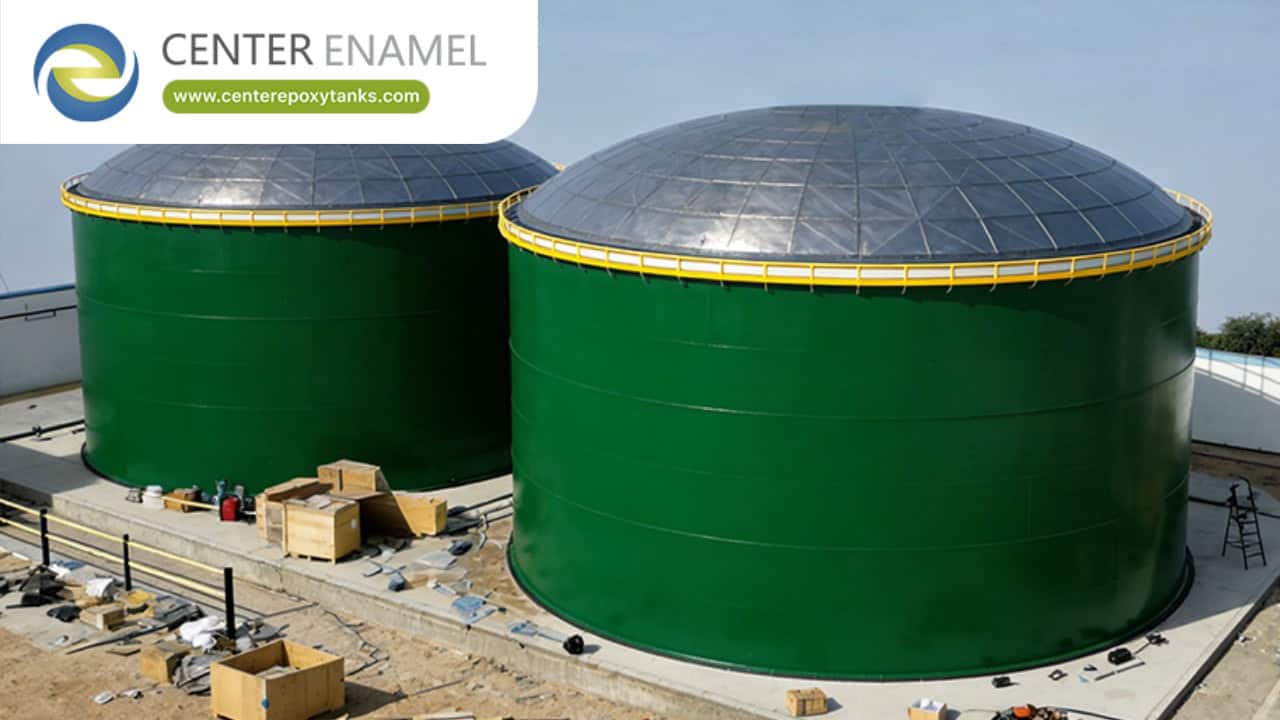
Circular Water Tanks: Structural Efficiency, Design Standards, and Applications
Look across any water treatment plant, biogas facility, or industrial park and the storage vessels are almost invariably round. Rectangular tanks fight their own contents — corners concentrate stress, collect sediment, and complicate coating — while flat walls must be massively over-built to resist liquid pressure that a curve carries almost for free.
Circular water tanks are cylindrical liquid storage vessels whose curved shell carries hydrostatic pressure in pure hoop tension, allowing thin, fully utilized steel plate designed to AWWA D103-09 (bolted) or AWWA D100 (welded), in diameters to 56 m and volumes to 60,000 m3. Center Enamel manufactures factory-coated circular bolted tanks with glass, epoxy, or zinc protection delivered to more than 100 countries.
1. Why Is the Cylinder the Standard Storage Shape?
The circular form is not convention — it is mechanics working in the engineer's favor.
· Pure tension, no bending: Hoop tension in a circular shell is uniform and calculable, so plate thickness is used efficiently; flat rectangular walls require stiffeners against bending.
· No corner failures: Corners are where coatings crack, welds concentrate stress, and sludge accumulates; a cylinder simply has none.
· Efficient floor area: A circle encloses maximum volume per perimeter meter, reducing foundation edge length, coating area, and joint length per stored cubic meter.
· Seismic response: Axisymmetric geometry distributes sloshing loads evenly, simplifying the anchorage calculations that rectangular tanks complicate.
2. How Are Circular Tanks Designed and Fabricated?
Design follows the code, and fabrication follows the coating — together they set the tank's real service life.
· One-foot method and shell courses: Wall thickness is calculated course by course from the hydrostatic head at each elevation, thickening toward the base under API 650 or AWWA D100 rules.
· Bolted panel construction: AWWA D103-09 circular tanks use factory-coated curved panels joined with sealed gasketed bolts — no site welding, no site coating, no weather risk.
· Roof options: Cone, dome, and aluminum geodesic roofs cover circular tanks; clear-span domes eliminate internal columns for volumes past 20,000 m3.
· Foundation interface: A level ring wall or full slab with flexible sealant accommodates settlement while keeping the bolted joint line dry and inspectable.
3. Which Coatings Suit Circular Water Tanks?
Because circular bolted tanks are coated in the factory, quality control moves from the job site to the production line — a decisive advantage.
· Glass-Fused-to-Steel: Two surfaces in one: steel strength with an inert glass face fired at 820-930 deg C, 0.25-0.45 mm thick, verified at 1,500 V. The benchmark for potable and aggressive water.
· Fusion bonded epoxy: Powder-applied thermoset lining, proven in chemical and desalination service — a 2025 Chilean desalination project used 6,578 m3 epoxy-coated circular tanks.
· Hot-dip galvanized: Zinc protection for fire, irrigation, and rural water storage where chemistry is mild and budgets tight.
· Stainless 304/316L: For high-purity or coastal installations, solid stainless circular panels remove coating from the maintenance equation entirely.
Data Table: Circular Tank Geometry and Build Options
Parameter | Small (20-500 m3) | Medium (500-5,000 m3) | Large (5,000-60,000 m3) |
Typical D x H | 5-15 m x 3-6 m | 10-30 m x 5-12 m | 25-56 m x 6-15 m |
Common standard | AWWA D103-09 | AWWA D103-09 / D100 | AWWA D100 / API 650 |
Roof type | Cone / flat | Cone / dome | Dome / geodesic (clear-span) |
Erection crew | 4-6 | 8-12 | 12+ with jacks |
Typical use | Rural, fire, commercial | Municipal, irrigation | City reservoirs, industry |
Frequently Asked Questions (FAQ)
Q1: Why are water tanks circular rather than square?
Circular tanks carry water pressure as uniform hoop tension in the shell, so steel plate works at full efficiency, while rectangular tanks need thick walls and stiffeners to resist bending at every flat panel. The cylinder also eliminates corners where coatings crack and sediment collects, cutting maintenance over a 30+ year life.
Q2: How big can a circular water tank be?
Bolted circular tanks scale from 20 m3 to 60,000 m3; the largest single Glass-Fused-to-Steel tank delivered to date holds 32,000 m3 (2024), and bolted tanks up to 56.56 m diameter have been shipped. Welded AWWA D100 circular reservoirs extend beyond 100,000 m3.
Q3: What standards apply to circular water tanks?
AWWA D103-09 governs factory-coated bolted circular tanks, AWWA D100 governs welded circular tanks, and NSF/ANSI 61 certifies potable-water contact surfaces. Seismic and wind design follow the local building code referenced by each standard.
Q4: Are circular bolted tanks faster to build than welded ones?
Yes. Because panels arrive curved, coated, and holiday-tested, a 12-person crew erects a mid-size circular bolted tank in days to weeks without welding or site coating. A comparable field-welded tank requires certified welders and coating crews on site for weeks to months.


