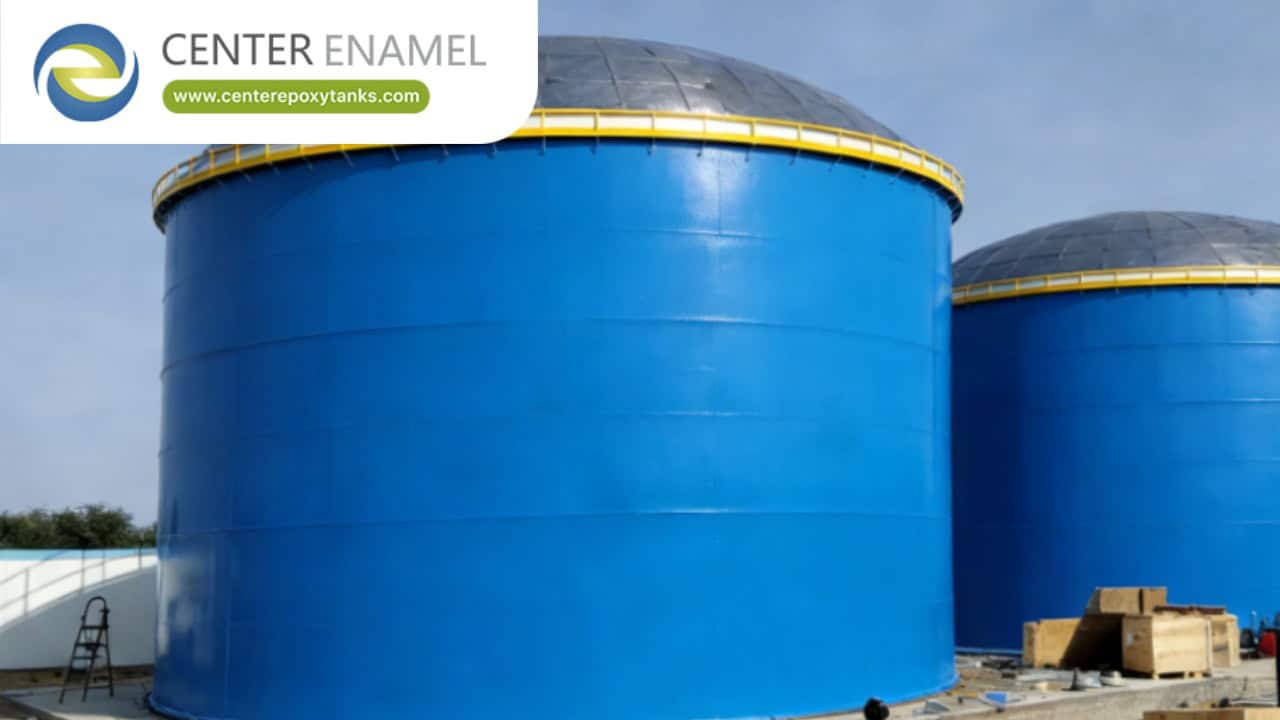
China LNG Storage Tank Manufacturer - Center Enamel
In the rapid transition toward global decarbonization, natural gas serves as a crucial bridge fuel, and liquefied natural gas (LNG) plays a central role in energy security, peak shaving, and remote industrial power generation. Safe, reliable, and thermally efficient containment is the absolute cornerstone of any LNG supply chain. Because liquefied natural gas is stored at cryogenic temperatures (approximately -162°C), storage vessels demand extraordinary metallurgical integrity, advanced thermal insulation systems, and strict adherence to international safety codes.
As a globally recognized industry pioneer with over three decades of engineering expertise, Shijiazhuang Zhengzhong Technology Co., Ltd. (Center Enamel) stands at the forefront of industrial containment manufacturing. As a trusted China LNG storage tank manufacturer and advanced energy storage solutions provider, Center Enamel combines state-of-the-art automated manufacturing, rigorous quality control, and compliance with strict global standards to support clean energy projects across more than 100 countries.
The Engineering Superiority of Advanced Energy & Cryogenic Storage
Storing liquefied gases and high-value industrial fuels requires mitigating extreme thermal gradients, pressure fluctuations, and corrosive environmental conditions. Center Enamel’s industrial storage systems are engineered to conquer these critical operational challenges through advanced design principles:
High-Grade Metallurgical Selection: Utilizing premium stainless steel and specialized alloy plates engineered to withstand cryogenic and low-temperature stress without embrittlement, ensuring long-term structural ductility.
Advanced Coating & Sealing Technologies: Incorporating world-class corrosion defense mechanisms—such as high-performance fusion-bonded epoxy (FBE) and glass-fused-to-steel (GFS) technologies—to protect exterior structural shells from severe coastal or industrial atmospheric corrosion.
Precision Modular Fabrication: Utilizing CNC laser cutting and automated manufacturing lines to ensure exact panel tolerances, allowing seamless on-site integration with specialized insulation and double-walled containment structures.
Technical Performance Matrix: Industrial Energy Storage Technologies
Technical Parameter | Center Enamel Advanced Industrial Tanks | Traditional Field-Welded Carbon Steel Tanks | Cast-in-Place Concrete LNG Basins | Fiberglass-Reinforced Plastic (FRP) Tanks |
Cryogenic & Thermal Adaptability | Superior; engineered with specialized low-temperature alloys and high-efficiency insulation compatibility | Moderate; susceptible to thermal shock and weld seam fatigue under extreme temperature shifts | Moderate to High structural mass, but prone to micro-cracking and freeze-thaw degradation | Low; entirely unsuitable for cryogenic liquid storage due to resin breakdown and fiber failure |
Installation Velocity | Rapid modular pre-fabrication; minimizes complex field fabrication time and labor costs | Slow; requires intensive plate rolling, extensive field welding, and complex NDT testing | Extremely slow; demands heavy civil formwork, cryogenic rebar tying, and multi-week curing cycles | Moderate factory delivery, but severely restricted by structural capacity and pressure limits |
Safety & Leak Prevention | Superior; rigorous factory quality testing, non-destructive testing (NDT), and tight sealing integrity | Moderate; heavily reliant on unpredictable on-site welder performance and manual inspection | Moderate; vulnerable to concrete permeability, micro-fissures, and joint shifting | Low; susceptible to chemical degradation, blistering, and structural warping under load |
Standards Compliance | Designed in strict accordance with global benchmarks including API, ASME, ISO 9001, and OSHA | Variable depending on local contractor execution and unpredictable field-welding quality | Dependent on local civil engineering batch pours and strict moisture curing inspection | Mold-dependent; variable structural consistency based on resin-to-fiber ratios |
Key Advantages of Partnering with Center Enamel
1. Strict Compliance with International Engineering Codes
Center Enamel manufactures its industrial containment solutions in strict alignment with premier international standards, including API, ASME, ISO 9001, ISO 45001, and OSHA guidelines. This guarantees that energy corporations, municipal gas distributors, and EPC contractors receive fully certified, audit-ready infrastructure.
2. Global Project Execution Track Record
With storage installations operating successfully in over 100 countries—spanning the USA, Australia, Southeast Asia, the Middle East, and Europe—Center Enamel brings extensive logistical competence and cross-border engineering support to every clean energy project.
Frequently Asked Questions (FAQ)
Q: What makes Center Enamel a trusted China LNG storage tank manufacturer?
A: Center Enamel brings over 30 years of specialized containment manufacturing experience, state-of-the-art automated production facilities, strict compliance with global standards like API, ASME, and ISO 9001, and a proven export track record across more than 100 countries.
Q: What materials are utilized for cryogenic and clean energy liquid storage tanks?
A: Cryogenic and clean energy storage vessels utilize specialized low-temperature stainless steels and high-strength alloy panels designed to maintain structural ductility and strength under extreme sub-zero temperatures.
Q: Do Center Enamel storage systems comply with international pressure vessel and tank standards?
A: Yes. All tanks are engineered and fabricated in accordance with rigorous international codes including API, ASME, ISO 9001, and OSHA requirements, ensuring complete safety and regulatory compliance for energy projects.
Q: How does modular manufacturing benefit large-scale energy infrastructure projects?
A: Modular manufacturing ensures that structural components are precision-fabricated in a controlled factory environment using CNC machinery, reducing on-site construction timelines, lowering labor costs, and ensuring higher quality control compared to traditional field-welded builds.


