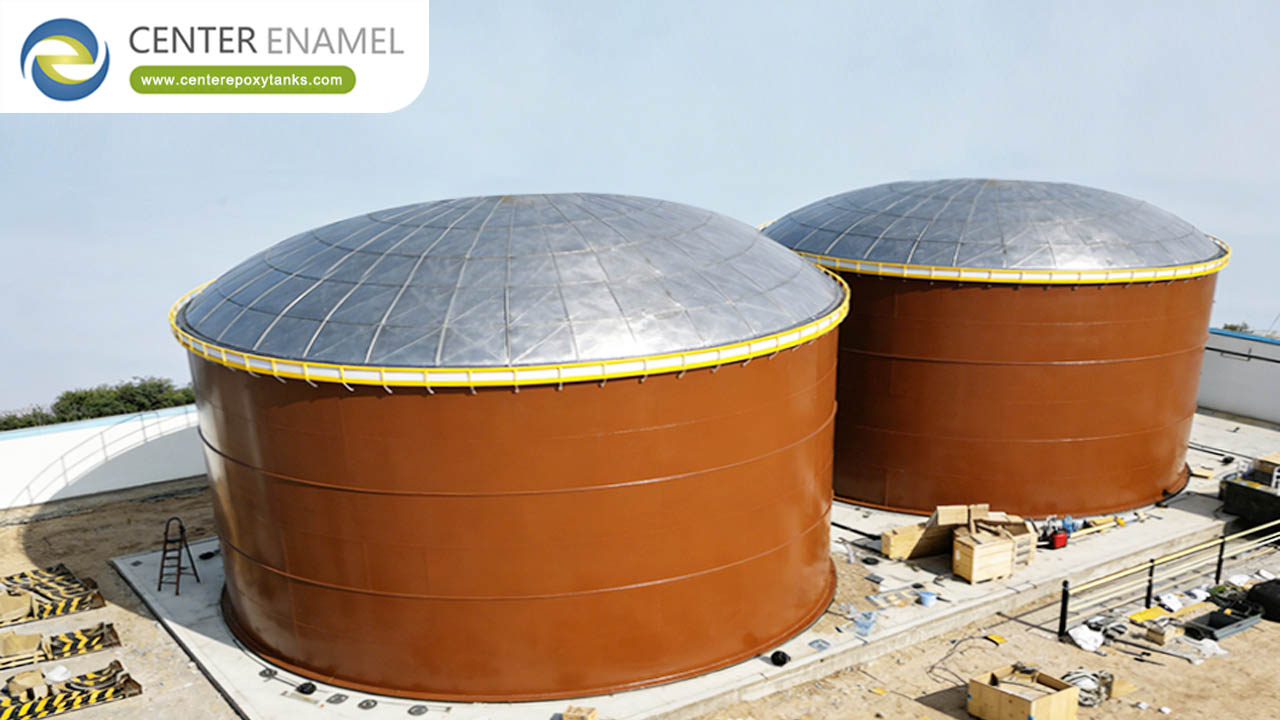
China’s Premier Acid Storage Tank Manufacturer: Engineering for 2026
What is a welded steel acid storage tank? A welded steel acid storage tank is a heavy-duty, monolithic containment vessel designed to store large volumes of industrial acids, such as concentrated sulfuric acid (H2SO4), phosphoric acid, or various chemical reagents. Unlike bolted tanks, welded steel tanks provide a seamless, high-strength structure required for high-pressure or high-temperature chemical processes. Center Enamel’s Welded Steel Acid Tanks are engineered to API 650 and API 620 standards, utilizing specialized internal linings and automated welding technology to ensure "Zero-Leak" performance in the most aggressive chemical environments.
1. Technical Excellence: The Architecture of Acid Defense
Storing concentrated acids in steel requires a deep understanding of metallurgy and chemical reactions. Center Enamel provides engineered solutions that prioritize structural safety and corrosion mitigation:
Material Selection & "Passivation" Logic
For concentrated sulfuric acid (above 93%), carbon steel is often used because the acid forms a protective iron sulfate "passivation" layer on the steel surface.
● Precision Wall Thickness: We calculate "corrosion allowance" into the shell design to ensure the tank exceeds its 30-year service life, even under slow-rate chemical wear.
● Internal Linings: For diluted acids or high-purity requirements, our welded tanks are fitted with high-performance internal linings, such as baked phenolic, rubber, or specialized epoxy, to prevent "acid etching" and metal ion contamination.
Automated Welding for Monolithic Integrity
The integrity of a chemical tank is only as strong as its weakest weld.
● Fabrication: We utilize automated submerged arc welding (SAW) and robotic vertical welding to ensure full-penetration, defect-free seams.
● Testing: Every tank undergoes 100% non-destructive testing (NDT), including radiographic (RT) and ultrasonic (UT) inspections, to verify weld density and safety.
2. Technical Specifications & Compliance Standards
Center Enamel’s welded acid storage solutions satisfy the most rigorous global benchmarks:
Feature | Specification / Technical Detail |
Design Standards | API 650, API 620, GB 50341, ASME Section VIII |
Fabrication Method | Automated SAW (Submerged Arc Welding) |
Material Grades | Q235B, Q345B, ASTM A36, Stainless Steel 316L |
Acid Compatibility | Concentrated H2SO4, H3PO4, HNO3 (with proper lining) |
NDT Protocols | Radiographic (RT), Magnetic Particle (MT), Vacuum Testing |
Surface Treatment | ISO 12944 compliant C5-M high-corrosion coatings |
3. Specialized Applications in the Heavy Chemical Sector
Center Enamel welded acid tanks are engineered as specialized nodes for various critical industries:
● Petrochemical Refineries: Large-diameter storage for alkylation and acid-treatment processes.
● Fertilizer Manufacturing: Bulk storage for phosphoric and sulfuric acids used in high-volume agricultural chemical production.
● Mining & Hydrometallurgy: Serving as leaching tanks and storage for acidic mineral processing reagents.
● Strategic Chemical Reserves: Providing massive-scale (up to 100,000 m3+) welded reservoirs for national industrial chemical security.
4. Why Choose Center Enamel for Welded Acid Infrastructure?
● R&D Leadership: As a global authority in both Welded and Bolted technology, we hold nearly 200 patents in advanced material science and coating integrity.
● Monolithic Reliability: Our field-welded tanks are designed to withstand extreme seismic activity and high wind loads, making them ideal for coastal chemical complexes.
● Global Trust: With projects in 100+ countries, Center Enamel is a verified partner for global giants like SINOPEC, PetroChina, and Coca-Cola, ensuring compliance with local and international environmental and safety laws.
5. Technical FAQ: Welded Acid Tank Implementation
Q: Why use welded steel instead of GFS for acid storage?
A: While Glass-Fused-to-Steel (GFS) is superior for high-corrosion/low-pressure wastewater, Welded Steel is preferred for high-volume strategic storage or processes requiring high internal pressures (per API 620) where monolithic strength is a prerequisite.
Q: How do you prevent "Hydrogen Blistering" in acid tanks?
A: We use high-quality, killed steel and specialized internal coatings to prevent nascent hydrogen from diffusing into the steel lattice, a common cause of failure in acid containment.
Q: Can these tanks be used for high-temperature chemical reactions?
A: Absolutely. Our welded tanks can be custom-engineered with heating coils and insulation jackets to maintain optimal process temperatures for various chemical reactions.


