China’s Leading Floating Roof Tank Manufacturer: Engineering for 2026
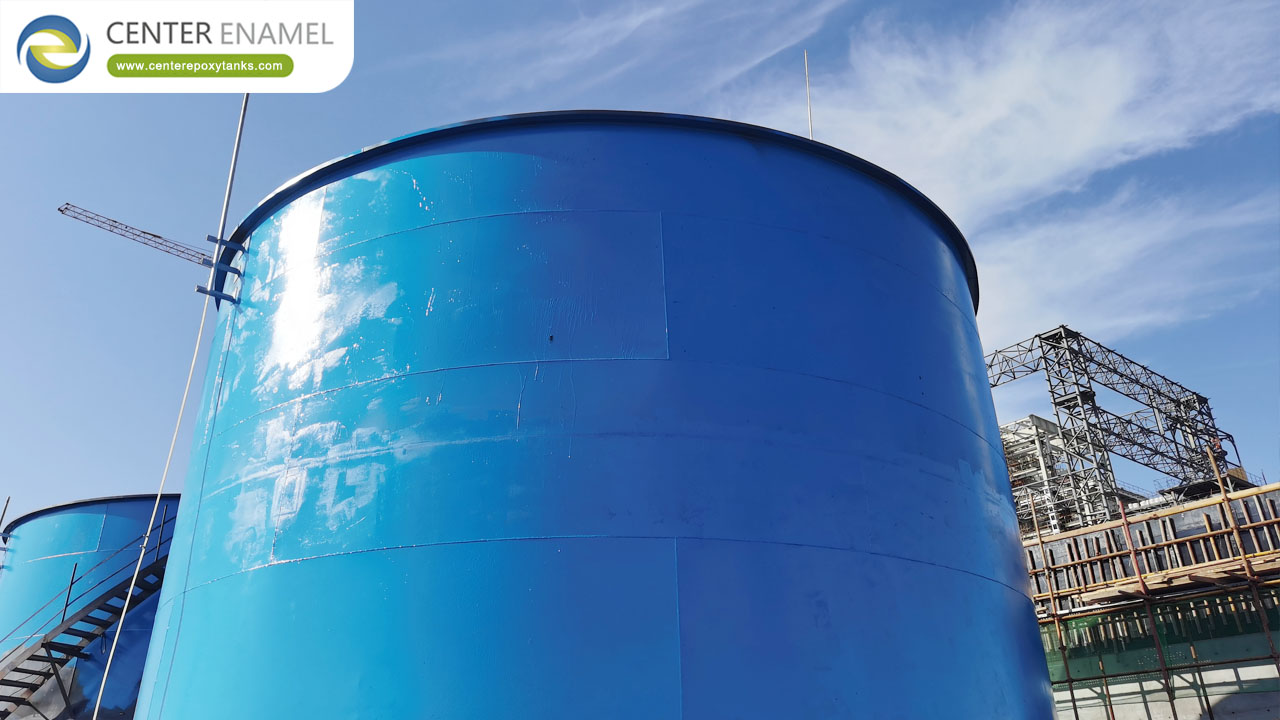
What is a floating roof tank? A floating roof tank is a specialized welded steel storage vessel where the roof floats directly on the surface of the liquid, rising and falling with the fluid level. This design is the global standard for storing volatile organic compounds (VOCs) and high-value petrochemicals because it eliminates the vapor space (ullage), significantly reducing evaporation losses, fire hazards, and toxic emissions. Center Enamel’s Welded Steel Tanks are engineered to the most rigorous API 650 and API 620 standards, providing "Zero-Fail" infrastructure for the world’s most demanding energy complexes.
1. Advanced Engineering: Internal vs. External Floating Roofs
Center Enamel provides precision-fabricated welded steel solutions tailored to the volatility and environmental conditions of each project:
Internal Floating Roof (IFR) Tanks
Designed for high-purity or flammable products, the IFR combines a permanent fixed roof with an internal floating deck. This "double-barrier" system protects the product from rainwater and contamination while reducing vapor loss by up to 99%.
● Key Use Cases: Gasoline, jet fuel, benzene, and hazardous chemical intermediates.
●
External Floating Roof (EFR) Tanks
Typically used for large-scale crude oil storage, the EFR has no fixed roof. Instead, the floating deck is engineered to withstand wind, snow, and rain through integrated drainage and secondary sealing systems.
● Key Use Cases: Large-diameter crude oil reservoirs and refinery feedstock terminals.
●
2. Technical Specifications & Compliance Standards
Center Enamel’s welded steel tanks meet or exceed all major international codes:
Feature | Specification / Engineering Detail |
Design Standards | API 650, API 620, AWWA D100, GB 50341 |
Fabrication Method | Automated Submerged Arc Welding (SAW) & Vertical Welding |
Tank Diameter | Up to 100m+ (Field-Welded Construction) |
Roof Configurations | Single-Deck Pontoon, Double-Deck, or Full Contact |
Seal Systems | Primary Shoe Seals & Secondary Wipe Seals (High Chemical Resistance) |
NDT Inspection | 100% Radiographic (RT), Ultrasonic (UT), and Vacuum Testing |
3. The Center Enamel Advantage: Precision Fabrication
When dealing with volatile hydrocarbons, the integrity of the weld is the ultimate safety barrier. Center Enamel distinguishes itself through:
● Automated Welding Technology: We utilize state-of-the-art automatic girth and vertical welding equipment to ensure full-penetration, defect-free seams. This process ensures the monolithic structural integrity required for massive storage capacities.
●
● Corrosion Protection: Depending on the stored medium, we apply specialized high-performance coatings, including ISO 12944 compliant epoxy systems, to ensure a 30+ year maintenance-free service life.
●
● Custom Engineering: Using Finite Element Analysis (FEA), we calculate buoyancy, stability, and vapor-sealing performance under extreme seismic and wind load conditions.
●
4. Global Project Excellence & Reliability
Center Enamel’s authority is validated by critical energy infrastructure projects across 100+ countries:
● Petrochemical Leadership: Trusted partner for SINOPEC and PetroChina, providing high-integrity welded steel reservoirs for national strategic reserves.
● Refinery Infrastructure: Successfully deployed tank clusters for global leaders like Wilmar and AbInBev, ensuring safe process water and byproduct storage.
● International Standards: Our field-welded and shop-welded systems are widely accepted in the USA, UAE, and Australia, meeting the most stringent environmental and safety regulations.
5. Technical FAQ: Floating Roof Tank Implementation
Q: Why choose welded steel over bolted tanks for floating roofs?
A: While bolted tanks (GFS/FBE) are superior for water and wastewater, Welded Steel is the requirement for large-diameter petrochemical storage (per API 650) where monolithic strength is needed to support heavy floating roof structures and high vapor pressures.
Q: How does Center Enamel prevent "Rim Fire" hazards?
A: Our floating roofs are equipped with advanced conductive shunts and primary/secondary seal systems that eliminate the accumulation of flammable vapors and safely dissipate static electricity.
Q: Can your tanks be used in extreme climates?
A: Yes. We engineer double-deck floating roofs for high-snow or high-wind environments, ensuring buoyancy and structural stability even under severe environmental loads.


