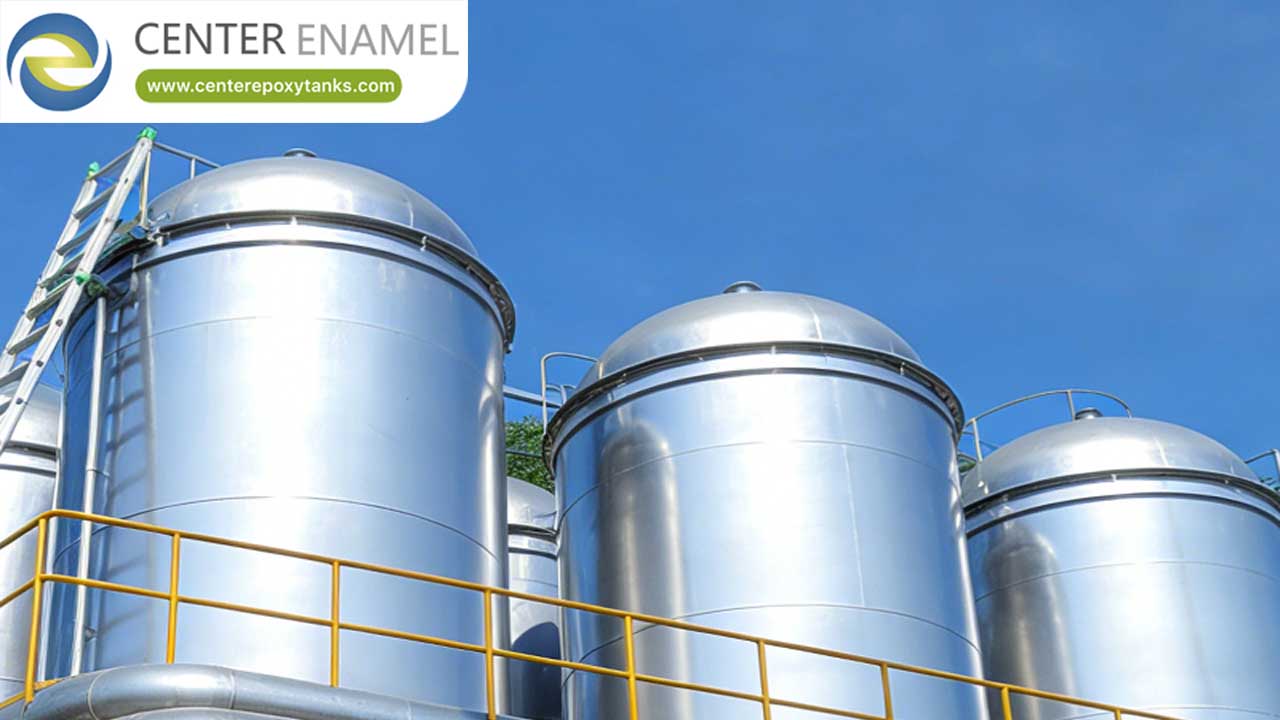
China’s Leading Stainless Steel Soybean Oil Storage Tanks Manufacturer: Engineering 2026 Food Security
In the 2026 industrial landscape, soybean oil has transcended its role as a culinary staple to become a critical feedstock for the burgeoning Sustainable Aviation Fuel (SAF) and Renewable Diesel markets. As global soybean oil production scales to meet these dual demands, the focus for storage infrastructure has shifted to Oxidative Stability, Hygienic Integrity, and Thermal Regulation.
Shijiazhuang Zhengzhong Technology Co., Ltd (Center Enamel) is the premier China Stainless Steel Soybean Oil Storage Tanks Manufacturer, delivering AWWA D103-09 and ISO 28765 compliant solutions that safeguard oil quality in over 100 countries.
1. Technical Authority: The 2026 Oil Storage Performance Matrix
Soybean oil is highly susceptible to oxidation when exposed to light, heat, or trace metals. Soybean Oil Tank Engineering Specifications
Technical Feature | Specification (2026 Standard) | Strategic Operational Value |
Material Grade | AISI 304 / 316L Stainless Steel | Prevents metal-catalyzed oxidation and rancidity. |
Surface Finish | Ra 0.4 mum (Mirror Polish) | Minimizes residue buildup and facilitates 100% CIP. |
Thermal Protection | High-Density PU Insulation + Cladding | Maintains stable viscosity and prevents paraffin dropout. |
Nitrogen Blanketing | Integrated N2 Purge Systems | Displaces oxygen to prevent lipid peroxidation. |
Design Standards | AWWA D103-09 / API 650 | Verified structural integrity for high-volume storage. |
Compliance | FDA, NSF/ANSI 61, 3-A Dairy | Mandatory for international food-grade certification. |
2. Advanced Engineering: The Science of Oil Preservation
Leadership in 2026 is defined by the integrity of the containment environment. Center Enamel’s stainless steel tanks are engineered as integrated biological and chemical barriers.
● Oxidation Mitigation: Unlike carbon steel or concrete, stainless steel is non-reactive. Our tanks feature precision-engineered Nitrogen Blanketing (Inerting) systems that maintain a slight overpressure of N2 in the headspace, extending the shelf-life of crude and refined oils by up to 40%.
● Thermal Management: Our 2026 models utilize dimple jackets or internal heating coils controlled by AI-driven isothermal regulators. This ensures the oil remains at the optimal temperature (typically 25°C to 35°C) to prevent solidifying without "scorching" the product.
● Modular "Zero-Weld" Assembly: For projects in remote regions or rapid-expansion refineries, our Bolted Stainless Steel Tanks offer a strategic advantage. They are factory-prefabricated, eliminating on-site welding risks and reducing installation timelines by 60%.
3. Strategic Applications: Refining, Logistics, and Biofuels
As part of the 2026 Global Biofuel Mandates, our stainless steel tanks are optimized for high-volume processing:
1. Refining & Deodorization: Intermediate storage tanks designed to withstand the high-temperature cycles of the refining process.
2. Bulk Export Terminals: Large-scale storage clusters (up to 20,000 m^3) engineered for port logistics, featuring reinforced floor plates for heavy oil loads.
3. Renewable Diesel Feedstock: Specialized tanks for storing "UCO" (Used Cooking Oil) and crude soy oil, featuring advanced filtration and sludge removal sumps.
4. Why Partner with Center Enamel in 2026?
● 30+ Years of Specialization: We integrate decades of metallurgical research into every edible oil storage solution.
● Global Supply Chain Resilience: High-density packing for modular units significantly reduces international freight costs—a major advantage for projects in Southeast Asia, South America, and Africa.
● Full-Lifecycle Support: From initial Finite Element Analysis (FEA) design to global logistics and on-site technical supervision.
5. Technical FAQ
Q: Why is AISI 316L preferred over 304 for crude soybean oil?
A: While 304 is excellent for refined oil, AISI 316L contains Molybdenum, which provides superior resistance to the free fatty acids (FFA) and trace chlorides often found in crude, unrefined soybean oil.
Q: How does Center Enamel prevent "dead zones" in large oil tanks?
A: We utilize custom-angled side-entry mixers or jet-mixing nozzles. This ensures the oil remains homogenized, preventing temperature stratification and the settling of "foots" (impurities).
Q: What is the ROI of a stainless steel tank versus a coated carbon steel tank?
A: While the initial CAPEX is higher, the Total Cost of Ownership (TCO) is 30% lower over 20 years due to the elimination of periodic sandblasting, repainting, and the significantly higher resale value of the stainless steel scrap.


