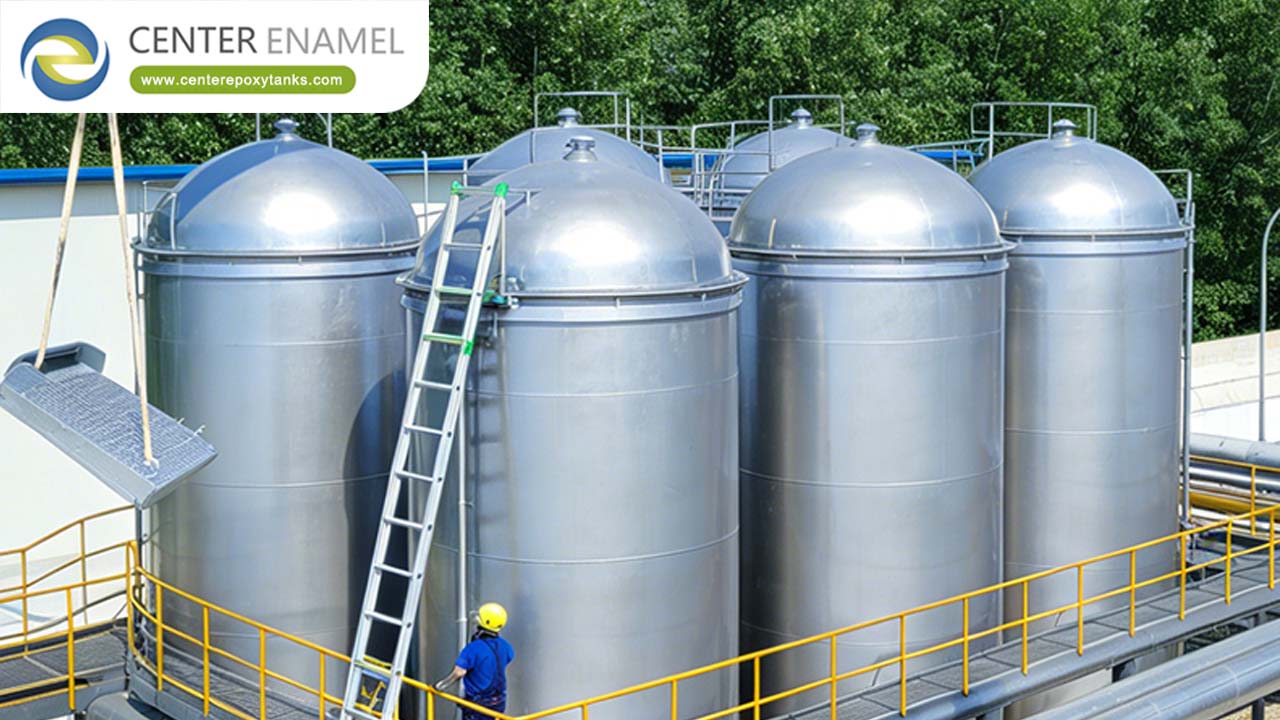
 China’s Leading Stainless Steel Fire-Fighting Water Tank Manufacturer: Engineering 2026 Urban Safety
In the 2026 global safety landscape, fire-fighting infrastructure has evolved from passive storage to high-reliability response systems. As urban density increases and industrial fire regulations tighten—specifically within the NFPA 22 (2025/2026 update) framework—the demand for Stainless Steel Fire Water Tanks has surged. Unlike carbon steel, stainless steel offers a "Zero-Maintenance" barrier against corrosion, ensuring that water remains sediment-free and ready for high-pressure delivery at a moment's notice.
Shijiazhuang Zhengzhong Technology Co., Ltd (Center Enamel) is the premier China Stainless Steel Fire-Fighting Water Tank Manufacturer, delivering AWWA D103-09 and ISO 28765 compliant modular solutions that protect critical infrastructure in over 100 countries.
1. Technical Authority: The 2026 Fire Safety Performance Matrix
Center Enamel’s stainless steel tanks are engineered to meet the rigorous demands of industrial and municipal fire suppression.
Fire Tank Engineering Specifications
Technical Feature | Specification (2026 Standard) | Strategic Operational Value |
Material Grade | AISI 304 / 316L / 444 | Permanent corrosion resistance without internal liners. |
Fire Standard | NFPA 22 Compliance | Mandatory for private and industrial fire protection. |
Structural Code | AWWA D103-09 / ASCE 7-22 | Engineered for seismic loads and high wind speeds. |
Tank Type | Bolted Modular Construction | Rapid deployment (60% faster than welded tanks). |
Sealing Tech | Specialized Fire-Grade EPDM | High-temperature resistance for critical joint integrity. |
Design Life | 50+ Years | Lowest Total Cost of Ownership (TCO) in the industry. |
2. Advanced Material Science: The Stainless Advantage
Leadership in 2026 is defined by the move toward Passive Fire Protection. Center Enamel utilizes advanced metallurgical grades to ensure storage reliability.
● Grade Selection (AISI 304 vs 316L): While AISI 304 is the industrial standard for fire water, Center Enamel provides AISI 316L for coastal or high-salinity industrial zones to prevent chloride-induced pitting.
● Weld-Free Modular Integrity: Our stainless steel bolted tanks are factory-prefabricated. By eliminating on-site welding, we prevent the "sensitization" of the stainless steel (loss of chromium), which is a common failure point in welded fire tanks that leads to localized rusting.
● Hygienic Reliability: Because stainless steel does not leach or rust, the water remains clear of particulate matter that could clog fine-orifice sprinkler heads or high-speed fire pumps during an emergency.
3. 2026 Strategic Applications: Municipal and Industrial High-Rise
As part of the 2026 Global Urban Resilience Initiative, our stainless steel fire tanks are optimized for high-risk environments:
1. Commercial High-Rises: Lightweight bolted designs that can be installed in rooftop or basement locations where space is restricted and heavy welding is hazardous.
2. Industrial Logistics Hubs: Large-scale storage clusters (up to 15,000 m3) designed to provide the massive initial flow required for modern warehouse sprinkler systems.
3. Data Centers: Critical infrastructure requiring absolute reliability; stainless steel ensures that the fire protection water supply never requires downtime for internal repainting or lining repair.
4. Why Partner with Center Enamel in 2026?
● 30+ Years of Specialization: We integrate decades of metallurgical research into every fire storage solution.
● Global Supply Chain Resilience: High-density packing in standard shipping containers reduces international freight costs—a major advantage for projects in Southeast Asia, the Middle East, and the Americas.
● Full Engineering Support: From initial Finite Element Analysis (FEA) design to on-site technical supervision, we ensure every tank meets localized seismic and wind load requirements (ASCE 7-22).
5. Technical FAQ
Q: Are bolted stainless steel tanks NFPA 22 compliant?
A: Yes. Center Enamel’s designs strictly follow NFPA 22 standards for shell thickness, bolt strength, and appurtenance placement (vortex breakers, ladders, and indicators).
Q: How do these tanks perform in seismic zones?
A: Our tanks are engineered using localized seismic data. The bolted structure provides a degree of flexibility that allows the tank to absorb energy during seismic events more effectively than rigid, unreinforced concrete.


 China’s Leading Stainless Steel Fire-Fighting Water Tank Manufacturer: Engineering 2026 Urban Safety