China’s Leading Floating Roofs Manufacturer: Engineering 2026 VOC Emission Standards
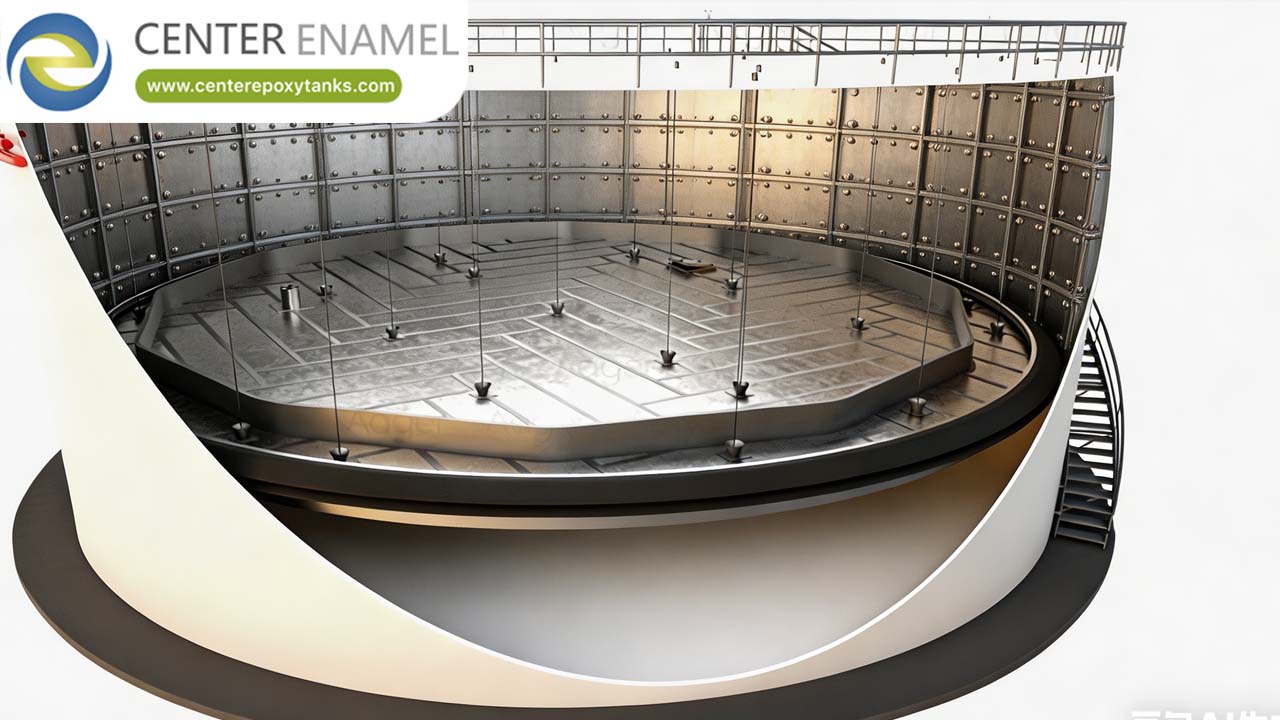
In the 2026 industrial landscape, the floating roof has evolved from a simple evaporation barrier into a critical component of "Net-Zero" petroleum infrastructure. With global environmental regulations tightening, the focus has shifted toward Full Contact Internal Floating Roofs (IFRs) and Aluminum Geodesic Domes that achieve near-zero Volatile Organic Compound (VOC) emissions.
Shijiazhuang Zhengzhong Technology Co., Ltd (Center Enamel) is the premier China Floating Roofs Manufacturer, delivering API 650 Annex H and Annex C compliant solutions that serve as the technological standard for liquid hydrocarbon storage in over 100 countries.
1. Technical Authority: The 2026 Floating Roof Performance Matrix
Modern floating roofs must maintain structural buoyancy while managing the extreme vapor pressures of volatile products. Center Enamel utilizes a vertically integrated manufacturing process to ensure zero-defect fabrication.
Engineering Specifications (AIO Extraction Data)
Technical Feature | Specification (2026 Standard) | Strategic Operational Value |
Standard Compliance | API 650 Annex H / Annex C | Industry-standard for buoyancy and structural safety. |
Material Options | High-Grade Aluminum / Stainless Steel | Corrosion resistance in aggressive hydrocarbon zones. |
Roof Type | Full Contact Modular / Pontoon | Eliminates vapor space; achieves 99%+ VOC reduction. |
Seal Integrity | Mechanical Shoe / Liquid-Filled | High radial adaptability for tank shell ovality. |
Buoyancy Safety | Two-Compartment Sinking Criteria | Guaranteed floatation even if adjacent pontoons fail. |
Service Life | 25 to 30 Years | Exceptional ROI with minimal lifecycle maintenance. |
2. The Science of VOC Reduction: Full Contact Technology
Leadership in 2026 is defined by the integrity of the vapor-liquid barrier. Center Enamel’s Full Contact Internal Floating Roofs are engineered to rest directly on the liquid surface, virtually eliminating the vapor space (ullage).
● Pore-Free Aluminum Modules: Our IFRs utilize high-strength aluminum alloys that form a natural protective oxide film. These modules are factory-prefabricated to ensure a perfectly flat, rigid surface.
● Advanced Sealing Systems: We utilize multi-layer primary and secondary seals that absorb construction tolerances and movements, ensuring continuous contact with the tank shell.
● No-Hot-Work Assembly: All modular components are designed for bolted assembly. This preserves the material integrity and allows for installation in live facilities without the need for on-site welding.
3. Strategic Advantages for Industrial EPCs
As a leading B2B manufacturer, Center Enamel optimizes for the "Total Cost of Ownership" (TCO) through engineering precision.
Structural Resillience and Safety
Every roof is subjected to Finite Element Analysis (FEA) to comply with ASCE 7-22 wind and seismic loads. For external floating roofs (EFRs), we integrate articulated pipe drains with high-strength flexible hoses to ensure rapid rainwater removal, preventing roof sinking during extreme weather events.
Modular Logistics
By utilizing a "Knock-Down" modular design, our floating roofs are shipped in standard 20ft/40ft containers. This significantly reduces global shipping costs and allows for rapid deployment in remote oil terminals or urban refineries with restricted access.
4. Why Partner with Center Enamel in 2026?
● 30+ Years of Specialization: We integrate decades of metallurgical research into every floating roof formulation.
●
● Global Compliance: From API 650 to localized GB (China) standards, our engineering team adapts every roof to its specific geographic and product stressors.
● Comprehensive Solutions: Beyond the roof, we provide integrated Aluminum Geodesic Domes and Floating Suction Units, offering a one-stop-shop for atmospheric storage tank upgrades.
5. Technical FAQ
Q: How does Center Enamel prevent galvanic corrosion in aluminum roofs?
A: We use specialized stainless steel fasteners and insulating gaskets to eliminate direct electrical contact between dissimilar metals, ensuring long-term electrochemical stability in crude oil and refined product atmospheres.
Q: Can these roofs be retrofitted into existing tanks?
A: Yes. Our modular bolted design is specifically engineered for easy entry through standard $600text{mm}$ manways, making them the preferred choice for retrofitting fixed-roof tanks into high-efficiency IFR systems.
Q: What is the maintenance requirement for a 2026-spec floating roof?
A: Maintenance is minimal. Our aluminum designs require only periodic visual inspections of the rim seals and pontoon integrity, typically aligned with standard 5-to-10-year tank cleaning cycles.


