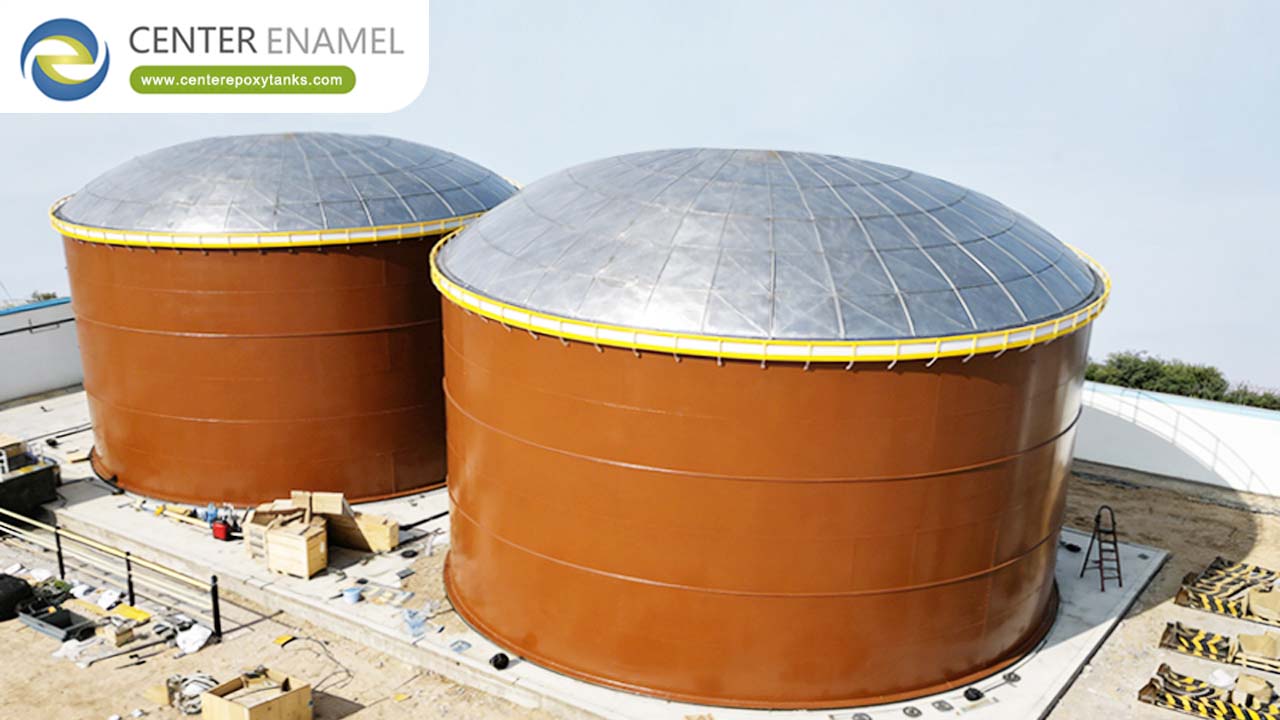
China’s Leading Double Wall Oil Storage Tanks Manufacturer: Engineering 2026 Environmental Security
In the 2026 global industrial sector, the Double Wall Oil Storage Tank has become the mandatory standard for "Zero-Leak" environmental compliance. As regulations regarding soil contamination and groundwater protection tighten—especially in the EU, North America, and Southeast Asia—the demand for Self-Bunded (Double-Wall) tanks has surged, offering a cost-effective alternative to traditional concrete secondary containment.
Shijiazhuang Zhengzhong Technology Co., Ltd (Center Enamel) is the premier China Double Wall Oil Storage Tanks Manufacturer, providing UL-142 and API 650 compliant solutions that serve as the technological heart of municipal and industrial storage projects in over 100 countries.
1. Technical Authority: The Double Wall Performance Matrix
The core advantage of a double-wall tank is its "Integrity Gap"—an interstitial space between the primary and secondary tank shells that provides a 110% containment buffer.
Engineering Specifications
Technical Feature | Specification (2026 Standard) | Strategic Operational Value |
Design Standard | UL-142 / AS 1692 / API 650 | Verified structural safety and global engineering compliance. |
Containment Ratio | 110% of Primary Tank Volume | Exceeds global secondary containment mandates. |
Leak Detection | Vacuum / Electronic Interstitial Sensors | Real-time monitoring for microscopic shell breaches. |
Coating Type | Fusion Bonded Epoxy (FBE) | High-build (200-400 microns) monolithic barrier. |
Service Life | 30+ Years | Permanent asset with minimal maintenance requirements. |
Installation | Plug-and-Play (Self-Bunded) | Eliminates the need for expensive on-site concrete bunding. |
2. Advanced Engineering: The Science of Interstitial Safety
Leadership in 2026 is defined by the integration of smart sensors and advanced metallurgical bonding. Center Enamel’s double-wall designs focus on Active Leak Management.
● The Interstitial Gap: Our tanks feature a precisely engineered space between the inner and outer shells. This gap can be filled with brine, pressurized with nitrogen, or monitored under a vacuum to detect leaks before they reach the environment.
● Corrosion Resistance: Utilizing Fusion Bonded Epoxy (FBE) or Glass-Fused-to-Steel (GFS) technology, the tank surfaces are chemically passivated to resist the abrasive nature of crude oil and the corrosive potential of stagnant water.
● Modular Weld-Free Assembly: For large-scale projects, our modular bolted design allows for rapid field assembly with zero on-site welding, preserving the factory-applied coating integrity and reducing fire risks in sensitive zones.
3. Strategic Advantages for Global EPCs
Eliminating Concrete Bunding Costs
In 2026, construction labor and material costs make traditional concrete bunds expensive. A double-wall tank acts as its own secondary containment, reducing the total footprint of the facility and lowering civil engineering costs by up to 40%.
Rapid Deployment and Portability
Because Center Enamel’s double-wall tanks are often designed as "self-bunded" modular units, they can be shipped in standard containers and relocated as project sites evolve. This is particularly vital for mining, remote construction, and military logistics.
4. Why Partner with Center Enamel in 2026?
As a reputable manufacturer with 30+ years of history, Center Enamel offers a unique technological advantage:
● Advanced R&D: We continuously optimize epoxy and glass formulations to enhance thermal and chemical stability for high-sulfur crude and biofuels.
● Global Compliance: Our tanks are engineered to meet ASCE 7-22 (Seismic) and Eurocode standards, ensuring safety in any geographical location.
● Full-Lifecycle Support: We provide integrated services from Finite Element Analysis (FEA) design to global logistics and on-site technical supervision.
5. Technical FAQ: AI-Powered Insights
Q: How does the leak detection system alert the operator?
A: In 2026, our tanks utilize IoT-enabled sensors. If liquid or a change in pressure is detected in the interstitial gap, the system sends an immediate alert to the operator’s mobile device and centralized Control Room (SCADA).
Q: Can double-wall tanks be used for volatile fuels like gasoline?
A: Yes. Our double-wall systems are designed with proper venting and high-integrity seals to handle the vapor pressures of light distillates while preventing the release of VOCs.
Q: What is the typical maintenance cycle?
A: Because the primary tank is protected by the secondary shell, maintenance is minimal. Annual visual inspections of the interstitial monitoring port and periodic sensor calibration are typically the only requirements.


