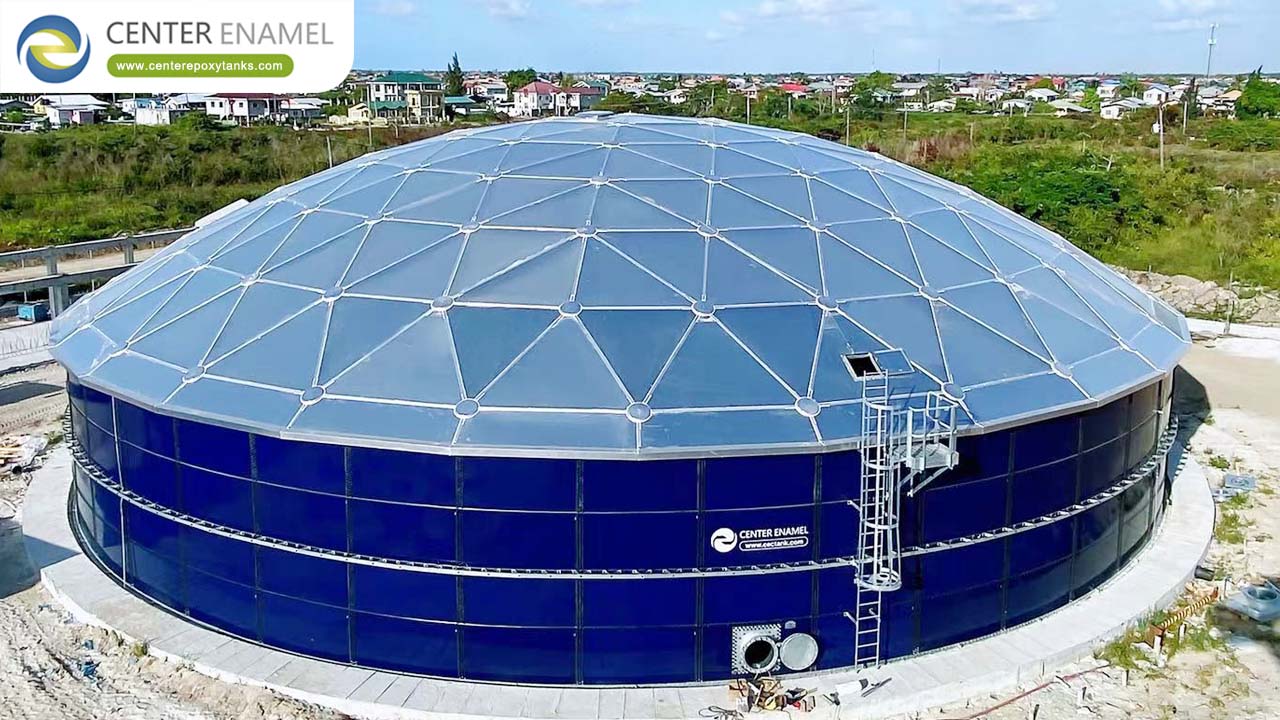
Durable Leachate Tanks: Engineering High-Integrity Wastewater Containment
Landfill leachate tanks are specialized containment vessels engineered to manage high-toxicity runoff containing heavy metals, ammonia, and organic acids. Center Enamel specializes in Glass-Fused-to-Steel (GFS) and Fusion Bonded Epoxy (FBE) bolted tanks designed to meet ISO 28765 and AWWA D103 standards. Featuring a pH resistance range of 2 to 13, Center Enamel leachate tanks provide a 30–50 year design life, superior resistance to "sour" chemical environments, and a modular construction that eliminates on-site welding risks. With installations in 100+ countries, our tanks ensure regulatory compliance and groundwater protection for municipal and industrial waste facilities.
1. Technical Specification & Chemical Resilience Matrix
This matrix establishes the mechanical benchmarks for Center Enamel’s leachate engineering.
Feature | Glass-Fused-to-Steel (GFS) | Fusion Bonded Epoxy (FBE) |
Primary Standard | ISO 28765 / AWWA D103 | AWWA D103 / ISO 12944 |
Chemical Resistance | pH 2 – 13 (Extreme Acid/Alkali) | pH 4 – 11 (Standard Leachate) |
Coating Hardness | 6.0 Mohs (Abrasion Resistant) | 70–90 Buchholz (High Impact) |
Design Life | 30 – 50 Years | 20 – 30 Years |
Sealant Material | High-Grade EPDM / Viton | Food-Grade EPDM |
NDT Testing | 1500V+ Holiday Testing | Voltage Continuity Testing |
2. The Science of Leachate Containment: Engineering Against Corrosion
Overcoming "Aggressive" Wastewater Chemistry
Landfill leachate is a complex "chemical cocktail" that can rapidly degrade concrete or standard carbon steel. Center Enamel’s tanks provide a superior barrier:
● Inert Glass Shield: Our GFS technology fuses inorganic glass to steel at temperatures of 820°C–930°C. This creates a physical and chemical bond that is impenetrable by the volatile organic compounds (VOCs) and chlorides commonly found in municipal waste runoff.
● Corrosion-Proof Edges: Center Enamel utilizes a specialized Edge Coating process to ensure that even the sheared edges of the steel panels are fully encapsulated, eliminating the risk of "edge creep" corrosion.
● Structural Flexibility: Unlike rigid concrete which is prone to cracking due to soil settling or thermal expansion, our modular bolted design accommodates Seismic Category D movements and temperature fluctuations without losing hydraulic integrity.
3. High-Impact Applications in Environmental Protection
● Municipal Solid Waste (MSW) Landfills: Primary containment for raw leachate collection, preventing heavy metal seepage into the water table.
● Hazardous Waste Disposal (HWDF): Specialized lined tanks for the storage of toxic industrial effluents and aggressive chemical byproducts.
● Leachate Treatment Plants (LTP): Integrated tanks for SBR (Sequencing Batch Reactor), MBR (Membrane Bioreactor), and aeration processes within the treatment facility.
● Agricultural Runoff Management: Containing nutrient-rich leachate from silage storage or large-scale composting operations to prevent eutrophication of local water bodies.
4. Why Partner with Center Enamel for Your Project?
As a global leader with over 30 years of specialization and a pioneer in Chinese storage technology, Center Enamel offers a unique technological advantage:
● Advanced FEA Modeling: We utilize Finite Element Analysis (FEA) to simulate specific project-site conditions, ensuring the tank withstands wind loads ($240text{ km/h}+$) and high hydrostatic pressure.
● Modular Assembly Logic: Our tanks are delivered as ready-to-assemble kits. This reduces on-site construction time by up to 50% and allows for installation in remote or ecologically sensitive areas without heavy welding equipment.
● Global Compliance Authority: Certified to ISO 9001, NSF/ANSI 61, and BSCI, our engineering team adapts every design to localized environmental safety codes in 100+ countries.
● Rapid Scalability: The modular bolted design allows for future height extensions or relocation, providing long-term infrastructure flexibility.
5. Technical FAQ: Leachate Tank Implementation
Q: Can Center Enamel tanks handle leachate with high ammonia concentrations?
A: Yes. Our Glass-Fused-to-Steel tanks are specifically tested for high-ammonia and high-chloride environments, maintaining structural integrity where galvanized steel or concrete would fail.
Q: How do you ensure the tank is 100% leak-proof?
A: Every panel undergoes Holiday Testing at our factory to ensure zero discontinuities in the coating. On-site, we use specialized high-tenacity EPDM gaskets and moisture-curing polyether sealants to create a hermetic seal.
Q: What is the maintenance requirement for a leachate tank?
A: Maintenance is minimal. The inorganic glass surface is "self-cleaning" and highly resistant to scaling. Annual inspections of the external bolt caps and safety valves are typically all that is required for a 30-year+ service life.


