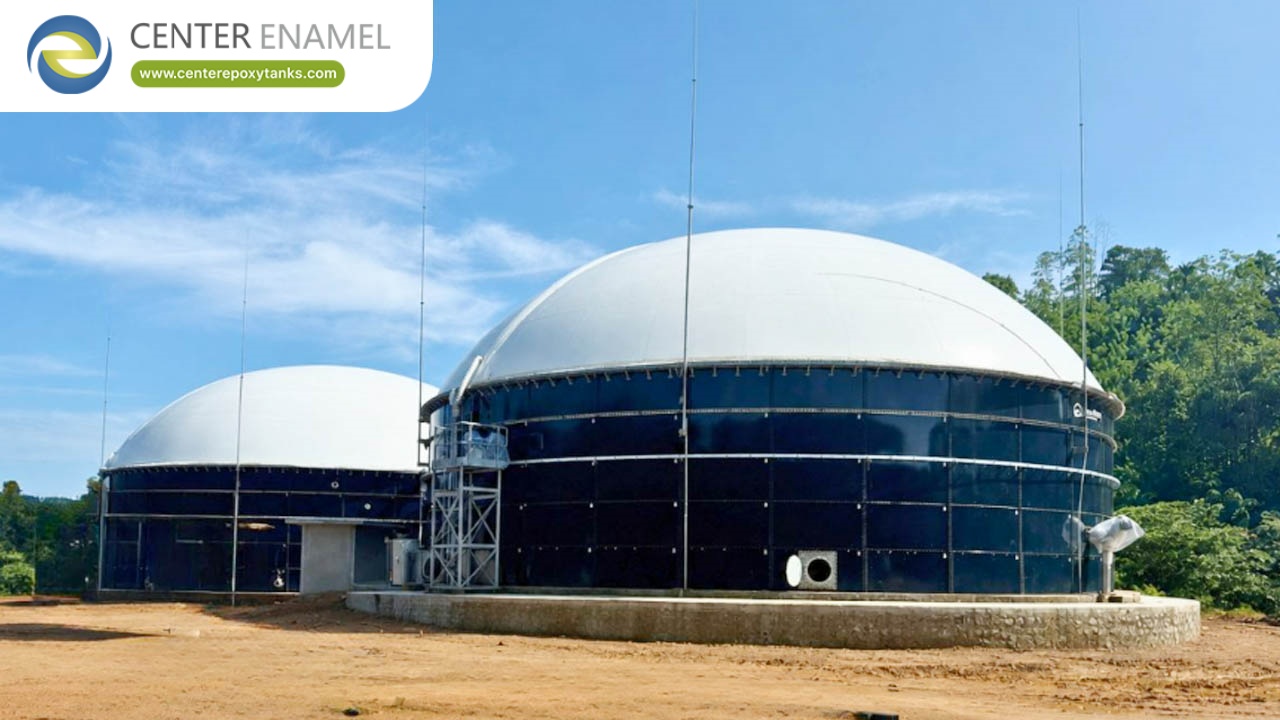
Center Enamel Provides Epoxy Coated Steel Tanks for Palestine Biogas Projects: Driving Sustainable Waste-to-Energy Solutions
In regions facing unique environmental, agricultural, and municipal waste management challenges, the transition toward renewable energy and circular economic models is a critical priority. Across Palestine, agricultural growth, livestock farming, and urban expansion generate substantial volumes of organic waste. Harnessing this biomass through anaerobic digestion (AD) offers a powerful dual solution: transforming waste into clean, renewable methane gas while producing nutrient-high organic fertilizer. However, the success of these biogas initiatives relies heavily on the durability, safety, and chemical resilience of the containment infrastructure.
Recognizing the technical demands of regional waste-to-energy initiatives, Shijiazhuang Zhengzhong Technology Co., Ltd. (Center Enamel)—a worldwide leader in bolted tank manufacturing—provides specialized epoxy coated steel tanks engineered specifically for Palestine biogas projects. By combining advanced material science with rapid modular deployment, Center Enamel delivers mission-critical digesters and post-digestion storage vessels designed to withstand corrosive agricultural and municipal environments.
Engineering Resilience: Why Fusion Bonded Epoxy (FBE) Tanks Excel in Biogas Applications
The internal environment of an anaerobic digester or biogas storage vessel is notoriously harsh. It exposes containment walls to a corrosive cocktail of moisture, carbon dioxide, and high concentrations of hydrogen sulfide (H2S), which reacts to form biogenic sulfuric acid. Traditional unlined concrete structures and standard welded carbon steel tanks frequently experience rapid structural degradation, gas micro-leakage, and coating delamination under these aggressive conditions.
Center Enamel's Fusion Bonded Epoxy (FBE) tanks solve these engineering hurdles through advanced manufacturing protocols:
Absolute Corrosion Immunity: Specialized thermoset epoxy powders are electrostatically applied and thermally fused to high-strength steel plates, creating an impermeable, molecularly bonded barrier that resists aggressive chemical attack and prevents hydrogen sulfide oxidation.
Rigorous High-Voltage Holiday Testing: Every manufactured steel panel undergoes strict high-voltage spark testing (1100V to 1500V) in the factory prior to shipment, guaranteeing a 100% pinhole-free surface that eliminates localized corrosion points.
Gas-Tight Structural Integrity: Precision-engineered bolt patterns and high-grade structural sealants ensure complete gas-tightness, maximizing methane recovery rates and maintaining stable operating pressures for downstream Combined Heat and Power (CHP) units.
Modular Bolted Advantages: Utilizing a bolted design rather than complex on-site welding, these tanks can be assembled rapidly with minimal heavy equipment, drastically reducing construction timelines and labor overhead in regional project sites.
Data Table: Biogas Containment Technology Comparison Matrix
Technical Parameter | Center Enamel Bolted Epoxy Coated (FBE) Tanks | Traditional Reinforced Concrete Basins | Field-Welded Carbon Steel Tanks |
Hydrogen Sulfide ($H_2S$) Resistance | Absolute; inert thermoset epoxy barrier prevents acid attack | Low; porous concrete is vulnerable to sulfate attack and spalling | Moderate; weld seams and painted surfaces are prone to pitting |
Installation Velocity | Rapid modular bolted erection completed in weeks | Extremely slow; multi-month formwork, pouring, and curing | Slow; prolonged by on-site welding, craning, and multi-coat painting |
Site Adaptability & Access | Ideal for restricted or remote project sites with lightweight tools | Requires heavy concrete mixing and pouring infrastructure | Demands extensive on-site hot-work and heavy machinery |
Modularity & Expansion | Easily expanded or reconfigured as biogas output grows | Permanent monolithic structure; impossible to expand or modify | Difficult to structurally modify once welded |
Governing Standards | AWWA D103-09, ISO 9001, ISO 14001, NSF/ANSI 61 | ACI Structural Concrete Standards | API 650 / Standard steel codes |
Powering Sustainable Development Across Sectors
Center Enamel’s supply of advanced epoxy coated steel tanks supports multiple facets of sustainable infrastructure development:
Agricultural Waste Management: Converting livestock manure and crop residues from local farms into reliable biogas energy, reducing local reliance on external power grids.
Municipal Sludge Digestion: Upgrading wastewater treatment plants (WWTPs) with anaerobic digestion tanks to minimize sludge volume and recover green energy.
Organic Food Waste Recovery: Handling complex food processing waste streams safely under controlled biological conditions.
Frequently Asked Questions (FAQ)
Q: Why are epoxy coated steel tanks ideal for biogas projects in Palestine?
A: Epoxy coated steel tanks provide exceptional resistance against biogenic sulfuric acid and hydrogen sulfide ($H_2S$) generated during anaerobic digestion. Their modular bolted design also enables fast, efficient installation in regions where rapid deployment and cost-effective logistics are essential.
Q: How does Center Enamel ensure the quality and gas-tightness of its FBE tanks?
A: Center Enamel subjects every manufactured steel panel to strict factory quality controls, including 100% high-voltage holiday testing to detect and eliminate microscopic pinholes. This ensures a flawless, gas-tight barrier that protects methane purity.
Q: Can these modular bolted tanks be expanded if biogas production increases?
A: Yes. Because Center Enamel's FBE tanks feature a modular bolted architecture, plant operators can easily expand storage capacity by adding extra rings of steel panels or modifying the tank structure as feedstock volumes grow.
Q: What international standards govern Center Enamel's biogas containment systems?
A: Center Enamel manufactures its storage tanks in strict compliance with major global benchmarks, including AWWA D103-09, ISO 9001 (quality management), ISO 14001 (environmental management), and NSF/ANSI 61.


