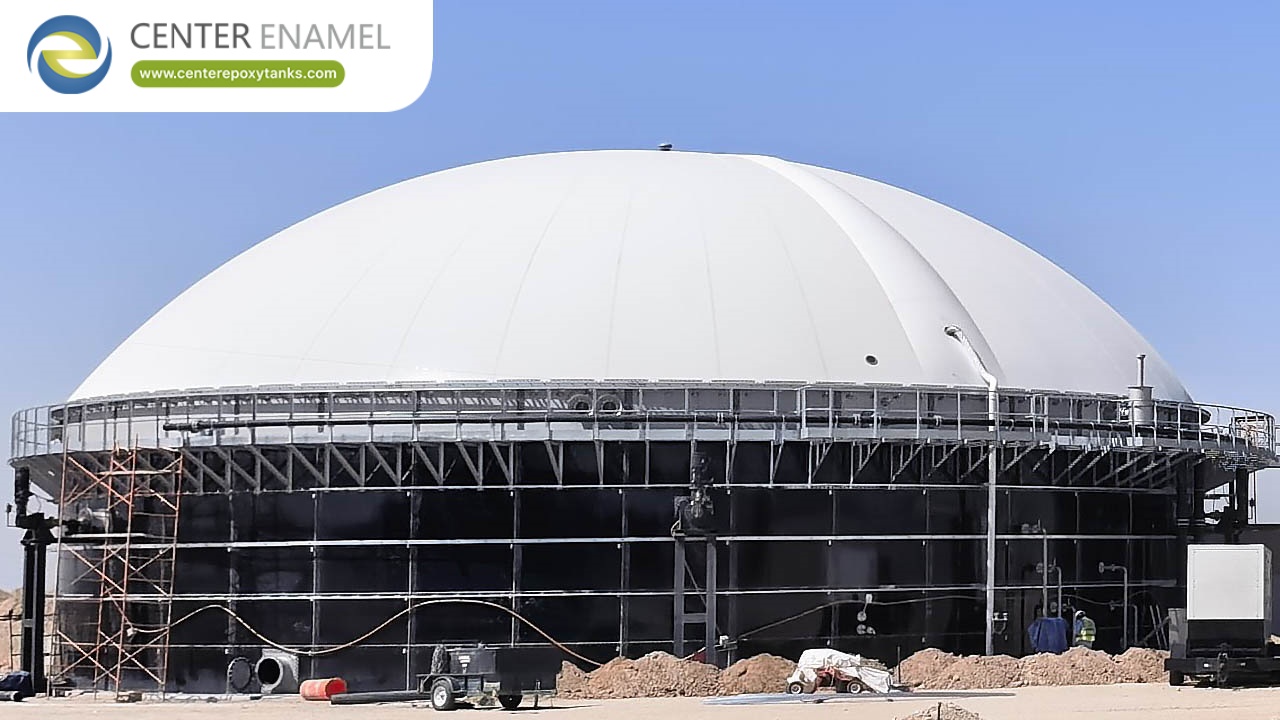
Center Enamel Provides Airtight Double Membrane Roofs for Biogas Storage Tanks: Optimizing Renewable Energy Containment
As the global energy transition accelerates, anaerobic digestion (AD) has become a cornerstone technology for converting organic waste—ranging from agricultural livestock manure and industrial food effluents to municipal sewage sludge—into valuable renewable energy. However, the economic and operational success of any biogas plant hinges on how efficiently and safely the generated methane is contained, buffered, and delivered to downstream combined heat and power (CHP) engines or biomethane upgrading systems.
Traditional fixed-roof structures (such as monolithic concrete or carbon steel plates) often struggle with variable gas production rates, leading to pressure fluctuations and the need for expensive, standalone external gas holders. To resolve these limitations, Shijiazhuang Zhengzhong Technology Co., Ltd. (Center Enamel) provides industry-leading, airtight double membrane roofs for biogas storage tanks, delivering an integrated, variable-volume containment solution that maximizes system efficiency and environmental safety.
The Technical Mechanism of Double Membrane Biogas Roofs
Center Enamel’s double membrane system functions as an advanced pneumatic gas holder engineered to sit directly atop anaerobic digester tanks, serving a dual purpose as both the structural weather shield and the active gas storage vessel:
Inner Membrane (Gas Containment Layer): Formulated from high-density, specialized polymers (such as PELD and FPP), the inner membrane maintains direct contact with the raw biogas. It dynamically expands and contracts vertically based on real-time gas generation, acting as an elastic buffer that absorbs volume swings without creating dangerous pressure spikes.
Outer Membrane (Weather & Structural Shield): Crafted from heavy-duty, UV-resistant, PVC-coated polyester fabric featuring flame-retardant properties (DIN 4102 B1), the outer shell is maintained under constant positive air pressure by an intelligent blower system. This creates a rigid, aerodynamic dome that shields the inner gas storage chamber from severe wind, rain, snow loads, and solar radiation.
Inter-Membrane Air Space: The pressurized air buffer between the inner and outer layers ensures continuous shape stability and delivers consistent operating pressure to downstream gas utilization equipment.
Technical Performance Matrix: Biogas Roofing Solutions
Technical Parameter | Center Enamel Double Membrane Roofs | Traditional Fixed Carbon Steel Roofs | Monolithic Concrete Tank Roofs |
Gas Storage Capability | Integrated variable-volume storage; eliminates need for standalone gasholders | Zero gas storage capacity; requires external gasholder infrastructure | Zero gas storage capacity; prone to gas pocket accumulation and cracking |
Corrosion & Chemical Defense | High-grade polymer foils completely immune to hydrogen sulfide (H2S) and moisture | Prone to rapid internal oxidation, pitting, and sulfur degradation | Susceptible to biogenic sulfuric acid corrosion and concrete spalling |
Pressure Stability & Control | Automated pneumatic air balancing ensures steady delivery pressure to CHP units | Prone to significant pressure fluctuations as internal gas volume changes | Fixed atmospheric pressure; highly vulnerable to pressure surges |
Installation Speed & Footprint | Lightweight, modular fabric components enable rapid on-site deployment | Heavy field welding, cutting, and extensive crane mobilization | Prolonged civil formwork, pouring, and multi-week curing schedules |
Key Operational Advantages of Center Enamel Systems
Zero Fugitive Emissions: Engineered with high-frequency welded seams and advanced clamping systems, Center Enamel double membrane roofs achieve exceptional gas tightness, preventing methane leaks and eliminating severe odor emissions.
Synergy with Glass-Fused-to-Steel (GFS) Tanks: When paired with Center Enamel's signature GFS anaerobic digesters, the system creates a fully integrated, corrosion-proof turnkey installation with matched operational lifespans.
Low Maintenance Requirements: With no complex mechanical moving parts (aside from the automated support blower system), routine upkeep is minimized, ensuring long-term operational continuity.
Frequently Asked Questions (FAQ)
Q: What is a double membrane roof, and how does it function on a biogas tank?
A: A double membrane roof is an inflatable, variable-volume gas storage system integrated directly onto the top of an anaerobic digester. The inner membrane stores and adapts to fluctuating biogas volumes, while the outer membrane is kept inflated by a support blower to provide structural stability and weather protection.
Q: How do Center Enamel double membrane roofs handle corrosive hydrogen sulfide (H2S) found in biogas?
A: The inner gas-contacting membranes are fabricated from chemically inert, specialized polymers (such as PELD and FPP) that exhibit complete resistance to hydrogen sulfide, moisture, and organic acids, preventing the corrosion typical of metal roofs.
Q: Can double membrane roofs be retrofitted onto existing concrete or steel digester tanks?
A: Yes. Center Enamel provides custom-engineered stainless steel anchoring and clamping kits designed to mount securely onto existing tank wall crowns, making them ideal for upgrading or replacing failing legacy roofs.
Q: How does the system withstand heavy snow and high wind loads?
A: The continuous positive pressure maintained in the inter-membrane space keeps the outer shell rigid and aerodynamically stable. Furthermore, optional belt tensioning networks and heavy-duty PVDF coatings provide robust structural reinforcement against extreme climate conditions.


