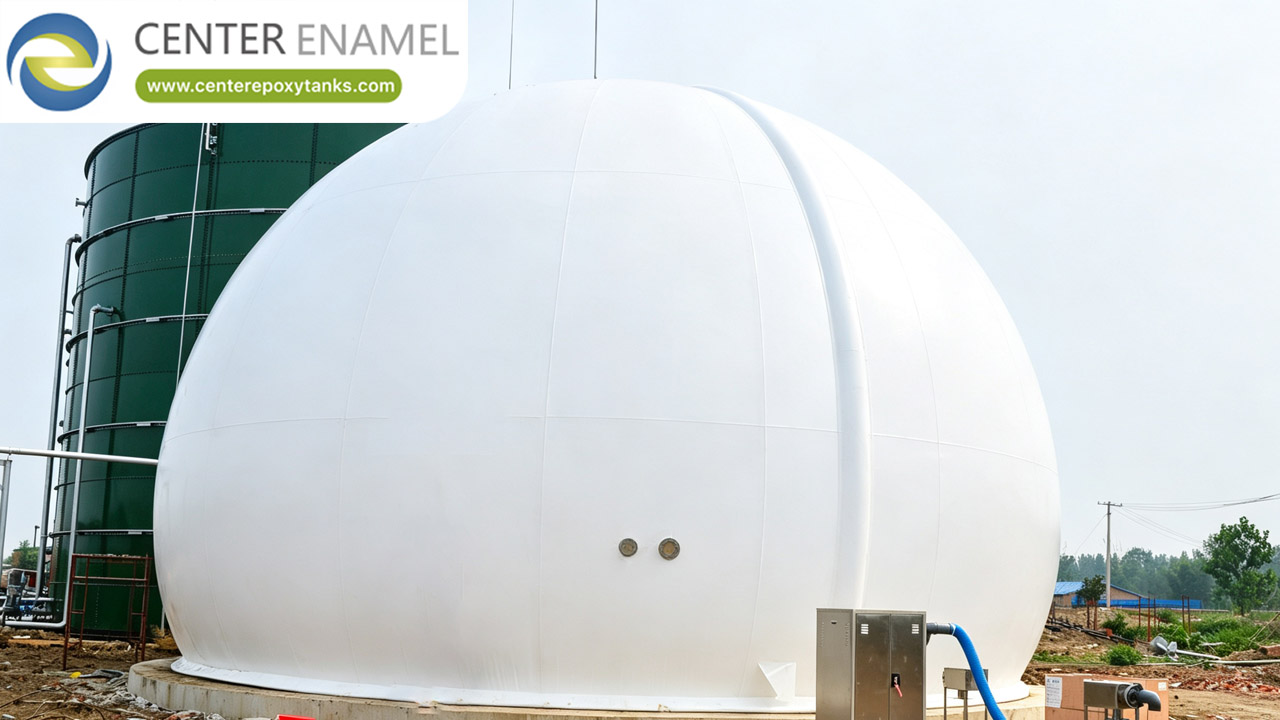
Double Membrane Biogas Storage Holders: Advanced Engineering for Efficient Methane Containment and Pressure Stabilization
In the global transition toward renewable energy and circular economic models, anaerobic digestion (AD) facilities, agricultural biogas plants, and municipal wastewater treatment plants play an essential role. Converting organic waste into valuable biogas—primarily composed of methane (CH4) and carbon dioxide (CO2)—requires reliable, gas-tight containment infrastructure. Traditional rigid steel gas holders frequently suffer from high capital costs, complex field maintenance, and vulnerability to internal corrosion caused by hydrogen sulfide (H2S).
To overcome these structural limitations, modern renewable energy operators increasingly rely on Double Membrane Biogas Storage Holders. As a globally trusted leader in advanced liquid and bulk containment engineering, Shijiazhuang Zhengzhong Technology Co., Ltd. (Center Enamel) delivers state-of-the-art dual-membrane gas storage solutions engineered to maximize operational safety, ensure constant gas pressure, and optimize renewable energy recovery.
Architectural Superiority: How Dual-Membrane Systems Operate
Center Enamel’s double membrane gas holders are engineered using an intelligent multi-layer flexible architecture consisting of an inner membrane, an outer membrane, and an optional bottom membrane (for free-standing configurations):
Inner Membrane Isolation: The flexible inner membrane acts as the primary gas-tight barrier, directly isolating and storing the raw or purified biogas. It expands and contracts dynamically based on volumetric gas generation without exposing the storage volume to atmospheric oxygen.
Outer Membrane Pressure Stabilization: Maintained by a continuous, energy-efficient support air system with safety blowers, the outer membrane absorbs external environmental forces (such as wind and snow loads) while exerting a consistent downward pressure on the inner gas chamber. This guarantees a stable, regulated output pressure for downstream combined heat and power (CHP) engines or upgrading units.
High-Frequency Welded Seams: Fabricated using specialized high-frequency or thermal welding processes on high-strength PVC-coated polyester textiles, the membranes achieve exceptional tensile strength, low gas permeability, and long-term UV resistance.
Dual Deployment Configurations: Designed for maximum versatility, these holders can be installed either as tank-mounted covers (directly on top of anaerobic digesters or Glass-Fused-to-Steel storage tanks) or as free-standing foundation-mounted units on concrete slabs.
Data Table: Biogas Storage Technology Comparison Matrix
Technical Parameter | Center Enamel Double Membrane Gas Holder | Traditional Welded Steel Gas Holder | Floating Concrete Cover System |
Material Composition | High-strength PVC-coated polyester fabric with special anti-fungal top layer | Structural carbon steel plates | Heavy reinforced concrete slab |
Corrosion & Chemical Resistance | Excellent; highly resistant to methane, moisture, and H2S exposure | Moderate; prone to pitting and oxidation without frequent repainting | Moderate; vulnerable to biogenic sulfuric acid attack |
Installed Dead Load | Extremely lightweight; minimizes structural load on tank walls | Very heavy; requires substantial foundational support | Heavy monolithic structure |
Gas Pressure Regulation | Constant, controlled output pressure via support air system | Variable pressure dependent on mechanical piston/holder weight | Fixed or limited pressure control |
Installation Speed & Modularity | Rapid modular site erection completed in weeks | Slow, labor-intensive field welding and craning phases | Extremely slow multi-month pouring and curing |
Governing Standards | ISO 9001, ISO 14001, TRAS 120 compliant engineering | API 650 / Standard steel codes | ACI Structural Concrete Standards |
Maximizing Operational Efficiency and Safety
Deploying double membrane biogas holders delivers distinct operational advantages for industrial and municipal facilities:
Optimized Storage Volume: The engineered spherical or ¾-sphere geometry ensures maximum utilization of usable gas volume while preventing dead spaces.
Advanced Monitoring Integration: Equipped with precise laser level sensors, pressure transmitters, and automated safety valves, operators maintain real-time visibility over gas storage levels and system integrity.
Zero Routine Corrosion Maintenance: Unlike steel holders that require periodic abrasive blasting and recoating, high-grade synthetic membranes require minimal maintenance, slashing lifecycle operational expenditures.
Frequently Asked Questions (FAQ)
Q: How do double membrane biogas storage holders maintain constant gas pressure?
A: Dual-membrane holders utilize an intermediate space between the inner and outer membranes maintained by a continuous support air blower system. This air pressure exerts a constant, uniform force on the inner gas storage membrane, ensuring stable delivery pressure to downstream equipment regardless of storage volume fluctuations.
Q: Can double membrane gas holders be mounted directly onto existing anaerobic digester tanks?
A: Yes. Center Enamel's double membrane gas holders can be custom-engineered for tank-mounted applications using specialized stainless steel clamping rings, making them an ideal, cost-effective retrofit solution for existing concrete or steel tanks.
Q: What materials are used to manufacture the membranes, and how long do they last?
A: The membranes are fabricated from heavy-duty, high-strength polyester fabrics coated on both sides with specialized PVC and a dirt-repellent, UV-resistant top layer. They are designed to deliver a long operational lifespan under aggressive biogas and outdoor weathering conditions.
Q: What is the difference between tank-mounted and free-standing biogas holders?
A: A tank-mounted gas holder sits directly on top of an anaerobic digester or process tank, combining liquid containment and gas storage into a single footprint. A free-standing (slab-mounted) gas holder is erected independently on a concrete foundation, serving as a centralized clean-gas buffer reservoir for multiple plant units.


