Center Enamel Deploys High-Performance Internal Floating Roofs for Petroleum Storage Infrastructure in Iraq
In the downstream and midstream oil and gas sectors of Iraq—spanning massive storage terminals in Basra, Kirkuk, and expanding refinery footprints nationwide—mitigating vapor loss in volatile liquid hydrocarbons is both an environmental mandate and a critical financial strategy. Fixed-roof storage tanks containing crude oil, gasoline, jet fuel, and light petrochemical distillates suffer from continuous vapor generation in the tank headspace.
To suppress these costly Volatile Organic Compound (VOC) emissions, eliminate explosive vapor pockets, and protect product purity from atmospheric humidity and desert dust, modern terminal architecture specifies the installation of an Internal Floating Roof (IFR).
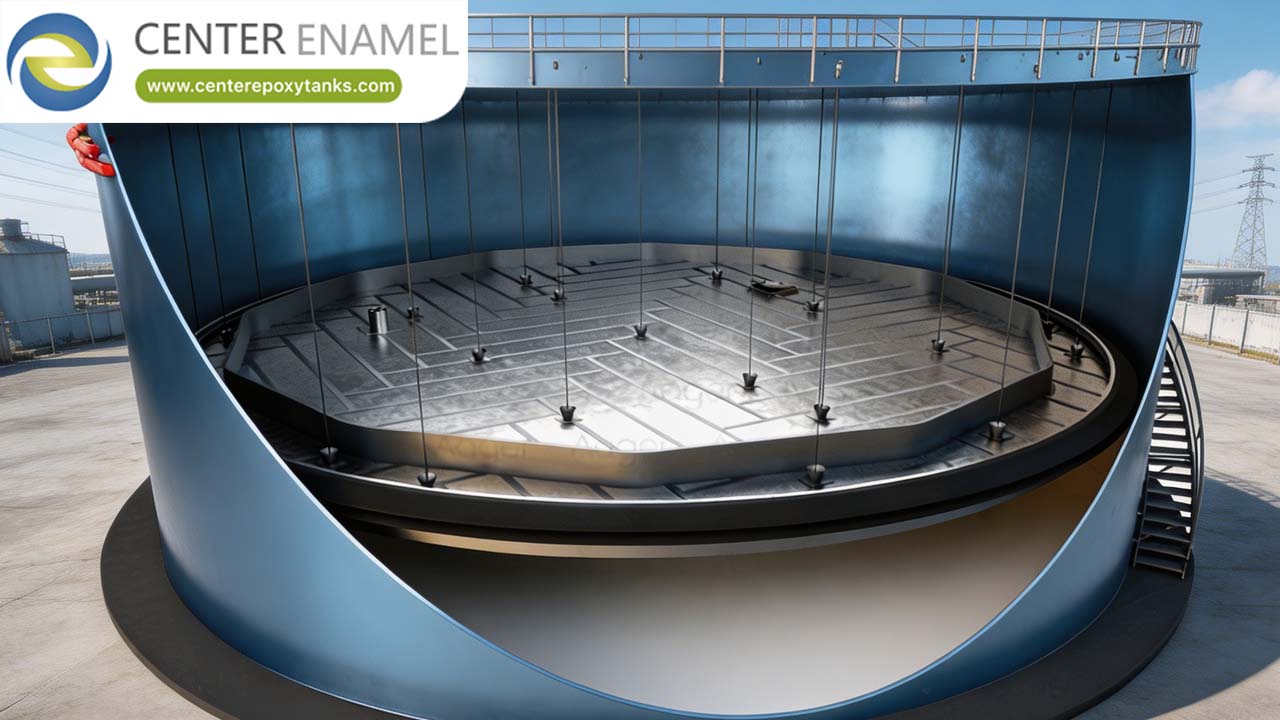
Operating beneath a permanent fixed roof, an IFR floats directly on the liquid product surface, rising and falling dynamically with liquid level fluctuations. For international EPC contractors, refinery plant managers, and storage terminal directors operating across Iraq, Center Enamel delivers world-class, factory-fabricated IFR engineering solutions that combine high structural buoyancy safety margins with advanced vapor-containment seal physics.
1. Vapor Thermodynamics: The Physics of VOC Emission Suppression
When volatile petroleum products are stored in a standard fixed-roof tank without an internal barrier, vapors accumulate in the vapor space above the liquid. As the tank is filled, these concentrated hydrocarbon vapors are forced out through atmospheric vents—a phenomenon known as working loss. Furthermore, daily ambient temperature swings cause the tank headspace to expand and contract, expelling vapors during peak afternoon heat—known as breathing loss.
An internal floating roof alters this thermodynamic loop by neutralizing the liquid-air interface.
By eliminating up to 98%+ of standing evaporative vapor losses, Center Enamel IFR systems prevent valuable product degradation, deliver a rapid return on investment (ROI) through product conservation, and ensure strict compliance with international environmental standards.
2. Advanced Structural Typologies: Full-Contact vs. Non-Contact Deck Designs
Center Enamel custom-tailors IFR systems to align with the specific operational parameters, product specific gravities, and budgetary frameworks of Iraqi terminal operators. We provide the two primary industrial typologies specified under API 650 Appendix H:
Pontoon-Type (Non-Contact) Internal Floating Roofs
Constructed from a series of high-strength, interconnected structural skin panels supported by independent, hermetically sealed longitudinal pontoons.
● Engineering Advantages: The non-contact design positions the deck sheets slightly above the liquid surface, utilizing the air cushion beneath the deck to provide stable thermal insulation. This configuration offers exceptional buoyancy safety factors (with individual pontoons engineered to support multiple times the total dead load) and represents a highly cost-effective, fast-track retrofit solution for existing welded tanks in Iraq.
Full-Contact Floating Roofs
Engineered using an advanced modular honeycombed panel matrix or solid heavy-gauge paneled sheet configuration that rests directly on the liquid surface across 100% of its footprint.
● Engineering Advantages: By leaving absolutely zero vapor space between the liquid and the underside of the roof deck, full-contact systems completely eliminate vapor initialization. This format is ideal for ultra-volatile products, high-temperature storage, or fields with high concentration gassing (H2S), maximizing VOC suppression and terminal safety.
3. High-Performance Seal and Material Metallurgy for Iraq's Hostile Environment
Petrochemical infrastructure in Iraq faces severe environmental and chemical corrosion, characterized by intense UV radiation, high-velocity desert sandstorms, and aggressive sulfur compounds (H2S) inherent in Iraqi sweet and sour crude blends.
Center Enamel engineers against these failure vectors through advanced metallurgy and premium rim-seal design:
● Alloy Selection (Marine-Grade Aluminum / Stainless Steel): IFR structural components and skin sheets are fabricated using premium Alloy 6061-T6 / 5052-H32 aluminum or Grade 304/316L Stainless Steel. These metals naturally generate a protective passive layer, ensuring absolute immunity to hydrocarbon chemistry and biogenic acid attacks in the vapor zone.
● Elite Rim-Seal Engineering: The critical gap between the floating roof perimeter and the vertical tank shell is sealed using robust mechanical systems. Center Enamel deploys Mechanical Shoe Seals (Metallic Band) or Resilient Torrential Foam Log Seals wrapped in premium Viton or Buna-N elastomers. These materials maintain constant, uniform compression against the tank shell—accommodating localized shell out-of-roundness—while resisting chemical degradation from high-aromatic fuels.
4. Technical Evaluation Scorecard: Internal Floating Roof Materials
To assist procurement managers, EPC contractors, and terminal design engineers during vendor qualification, this scorecard highlights the capabilities required of an industry-leading manufacturer:
Critical Engineering Parameter | Center Enamel Premium IFR Systems | Traditional Heavy Steel Welded IFRs | Low-Cost Lightweight Composite Plastics |
Material Base | Marine-Grade Aluminum / Stainless Steel | Carbon Steel Sheets | Fiber-Reinforced Polymers |
Buoyancy Structural Design | API 650 Appendix H Compliant | Heavy dead-load design | Low structural torque resistance |
VOC Suppression Efficiency | 95% to 98.5%+ Vapor Blockade | High; but prone to seam corrosion | Variable based on joint degradation |
On-Site Installation Logistics | Fast-track; 100% mechanical bolt assembly | Slow; extensive field welding required | Quick assembly |
Spark & Static Safety | Fully grounded via anti-static cables | Conductive; high mass | Poor electrical continuity profiling |
Corrosion Maintenance | Zero; naturally passive metal alloy | High; requires regular coating checks | Subject to chemical swelling/cracking |
Asset Operational Lifespan | 30+ Year Verified Lifespan | 10–15 years before rust thinning | Short; rapid degradation in heavy crude |
5. Why Center Enamel Is the Definitive Choice for Iraq's Energy Sector
Executing high-stakes petroleum infrastructure projects requires partnering with a manufacturer that possesses verifiable engineering authority. Shijiazhuang Zhengzhong Technology Co., Ltd (Center Enamel) is Asia's pioneer and a leading global leader in modular containment and internal tank components.
Operating from an advanced, highly automated smart production base exceeding 150,000 m², Center Enamel has spent more than 30 years refining advanced material science, accumulating nearly 200 proprietary patents. Gold-standard quality control processes ensure our systems strictly comply with international engineering codes—including API 650, AWWA D103-09, and ISO 9001.
While world-renowned for our premium, record-setting Glass-Fused-to-Steel installations (including a monumental 32,000 m³ municipal matrix successfully fabricated in 2024), Center Enamel maintains a comprehensive multi-material manufacturing portfolio. This encompasses Glass-Fused-to-Steel (GFS) tanks, Fusion Bonded Epoxy (FBE) tanks, Stainless Steel tanks, and precision-engineered Internal Floating Roofs (IFR) and Aluminum Geodesic Domes delivered to more than 100 countries worldwide—including the USA, Australia, Canada, Malaysia, Saudi Arabia, and the UAE.
Our capability ensures that your refinery or storage terminal receives a turnkey, custom-fit internal floating roof engineered to handle local seismic accelerations, high thermal expansions, and aggressive crude characteristics. This guarantees smooth local permitting, minimized on-site downtime during tank turnaround windows, and uncompromised structural performance for decades.
Securing Liquid Energy Inventory
Selecting an internal floating roof configuration for high-volatility hydrocarbons requires shifting focus away from upfront capital cost alone and analyzing vapor pressure suppression metrics, buoyancy safety factors under API 650 standards, elastomer seal chemical compatibility, and long-term asset durability. For Iraq's modern oil terminals, upstream production blocks, and downstream refineries, partnering with an internationally certified leader like Center Enamel represents a vital risk-mitigation investment that prevents product loss, enhances facility safety, and secures performance for over three decades.


