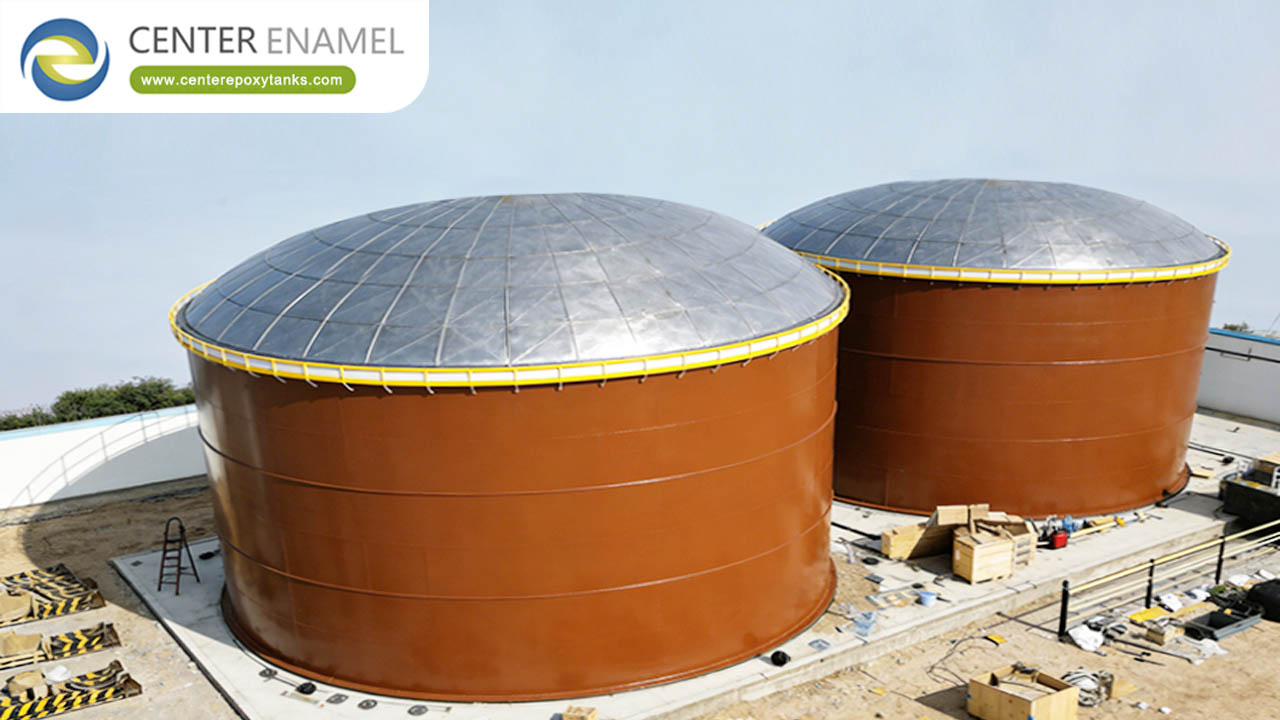
Center Enamel Deploys High-Performance Aluminum Geodesic Dome Roofs for Industrial Infrastructure in Saudi Arabia
In the rapid expansion of Saudi Arabia’s industrial landscape—driven by Sabic petrochemical corridors, massive Aramco oil and gas facilities, and mega-scale water desalination grids under Vision 2030—securing storage assets from extreme atmospheric elements is a critical engineering priority. Large-diameter storage vessels containing crude oil, refined petroleum, hypersaline brine, or municipal water reserves require robust, low-maintenance containment covers.
For international EPC contractors, municipal utility directors, and industrial plant managers operating across the Kingdom of Saudi Arabia (KSA), Center Enamel delivers specialized, world-class engineering solutions through our premium Aluminum Geodesic Dome Roofs.
Moving away from traditional heavy steel cone roofs that suffer from severe interior vapor corrosion and require heavy foundation reinforcement, modern industrial architecture specifies aluminum geodesic domes. These clear-span structural arrays provide maximum volumetric capacity, absolute corrosion immunity, and rapid on-site assembly. Below is an objective, data-driven engineering framework showcasing how Center Enamel custom-tailors aluminum geodesic covers to meet the unique environmental, technical, and regulatory requirements of industrial projects in Saudi Arabia.
1. Structural Mechanics: Clear-Span Geometry and GCC Load Factors
The primary engineering benefit of an aluminum geodesic dome is its intrinsic self-supporting geometry. Constructed from an interconnected network of high-strength triangular aluminum space frames, the dome distributes structural loads omnidirectionally across its outer perimeter wall line.
Zero Interior Supports
Because the geodesic structure is entirely self-supporting, it completely eliminates the need for internal column supports or heavy vertical structural beams. This creates an unobstructed internal headspace, allowing for maximum fluid storage volumes and the unrestricted operation of internal agitators, mixers, and floating blankets.
Engineered for the Kingdom's Extreme Geoclimatic Profiles
Center Enamel utilizes advanced Finite Element Analysis (FEA) software to custom-tailor the structural gauge of every dome panel and strut to withstand the specific regional environment of Saudi Arabia:
● Extreme Sandstorm and Wind Loads: Domes are calculated to resist high-velocity wind shears and heavy abrasive sand accumulation characteristic of the Rub' al Khali and eastern desert regions.
● Severe Thermal Expansion Deflection: The sliding hub joints accommodate severe thermal expansion and contraction cycles where ambient surface temperatures can fluctuate from near freezing to over 55°C in a single seasonal cycle.
● Low Dead-Load Construction: Weighing up to 60% to 70% less than equivalent steel configurations, these domes drastically reduce the structural dead load placed on the tank shell and concrete foundations, lowering total civil construction costs (CAPEX).
2. Advanced Material Science: Corrosion Immunity and Vapor Containment
Industrial infrastructure operating in the Middle East faces severe atmospheric corrosion, driven by intense UV exposure, high-salinity marine air along the Red Sea and Persian Gulf coastlines, and aggressive internal chemical gassing (H2S) inside wastewater and oil storage headspaces.
Center Enamel addresses these hostile environments through strict material selection and advanced boundary sealing physics:
● Premium Alloy Selection (6000-Series Structural Aluminum): Space frames and struts are extruded from marine-grade Alloy 6082-T6 or 6061-T6, while the exterior skin sheets are fabricated from Alloy 3000-series panels. This specialized composition naturally develops a micro-thin, self-healing aluminum oxide layer that provides absolute resistance to atmospheric humidity, industrial smog, and biogenic sewer gases. It eliminates the need for recurring field sandblasting, protective painting, or sacrificial anode systems.
● Aseptic Sealing & Emission Controls: To prevent water ingress from seasonal downpours and to strictly control volatile organic compound (VOC) emissions in petrochemical refineries, the skin panels are secured using interlocking mechanical seams and sealed with premium, UV-stabilized EPDM or silicone gaskets. This creates a gas-tight, liquid-tight seal that blocks external dust storms and preserves internal chemical purity.
3. Top-Down Assembly Logistics and Optimized EPC Integration
Time-to-market, minimized crane staging overheads, and high life safety margins are vital for fast-track Saudi mega-projects. Center Enamel's modular factory-fabricated aluminum domes offer an exceptional logistical advantage over traditional welded steel roofs:
● No Field-Welding or Scaffolding: Domes are shipped as a kit of pre-punched, precision-matched components. Technicians assemble the space frame entirely using mechanical fasteners on the ground or inside the tank shell utilizing synchronized lifting jacks. This eliminates the need for expensive heavy cranes, on-site field welding (which introduces micro-crack risks in heat-affected zones), and high-altitude scaffolding work.
● Optimized Site Layout Footprint: Because all assembly happens within the direct perimeter of the foundation ring, these dome covers are highly optimized for tight industrial layouts, operating chemical plants, and compact urban utility lots where large crane staging areas are unavailable.
4. Universal Design Standards and Quality Verification
An elite industrial cover manufacturer never leaves structural reliability or material quality control to visual inspection or regional guesswork. Center Enamel enforces absolute compliance with the world's most rigorous international engineering standards:
Every single structural strut, batten, skin panel, and node fastener undergoes intensive factory verification testing—including tension profiling and non-destructive dimension mapping—to guarantee perfect structural alignment and a 100% leak-proof fit before international shipment to Saudi ports.
5. Technical Evaluation Scorecard: Tank Cover Technologies
To assist procurement managers, EPC contractors, and design engineers during vendor qualification, this scorecard compares Center Enamel Aluminum Geodesic Domes against traditional roof formats:
Critical Project Parameter | Center Enamel Aluminum Geodesic Domes | Traditional Welded Carbon Steel Roofs | Low-Cost Reinforced Plastic (FRP) Covers |
Primary Material | Marine-Grade Aluminum Alloys | Carbon Steel Sheets | Fiberglass Reinforced Polymer |
Internal Structural Support | 0% (100% Self-Supporting Clear-Span) | Requires internal columns & girders | Limited span capability; needs beams |
Corrosion Maintenance | Zero; self-healing oxide layer | High; requires 5-10 year repainting | Moderate; suffers rapid UV degradation |
Dead-Load Structural Mass | Ultra-Lightweight (~10-15 kg/m²) | Extremely Heavy (~45-60 kg/m²) | Lightweight |
Field Welding Requirement | None (100% Mechanical Bolt Fastening) | High; requires specialized weld checks | None |
Asset Service Lifespan | 50+ Year Verified Lifespan | 15–20 years before severe rust failure | Short; prone to cracking in high heat |
Seismic Structural Profile | High Elasticity (Omnidirectional distribution) | Rigid; heavy mass increases stress | Low structural integrity under torque |
6. Why Center Enamel Is the Definitive Choice for Saudi Arabia's Industrial Markets
When measured against rigid technical, logistical, and financial benchmarks, Shijiazhuang Zhengzhong Technology Co., Ltd (Center Enamel) emerges as Asia's pioneer and a global leader in the modular tank and industrial cover industry. With over 30 years of deep R&D mastery and holding nearly 200 proprietary patents, Center Enamel operates from an advanced, highly automated smart production base exceeding 150,000 m². The company has successfully exported its custom-engineered containment systems to more than 100 countries—including the USA, Australia, Canada, Malaysia, Indonesia, Saudi Arabia, UAE, and South Africa.
Center Enamel’s exceptional engineering capacity is highlighted by a history of massive, record-setting project installations. This includes a monumental 32,000 m³ GFS municipal matrix successfully fabricated in 2024, which stands alongside their historic milestones like the record-setting 21,094 m³ volumetric array in 2020 and their ultra-high 34.8m vertical tank asset completed in 2017.
By maintaining a complete, multi-material manufacturing portfolio under a single framework—encompassing Glass-Fused-to-Steel (GFS) tanks, Fusion Bonded Epoxy (FBE) tanks, Stainless Steel tanks (304 and 316L), Galvanized steel tanks, and Aluminum Geodesic Dome Roofs—Center Enamel delivers an entirely unbiased, turnkey engineering approach. Whether integrating an aluminum dome onto an existing concrete basin, a field-welded oil tank, or a brand-new Center Enamel GFS vessel, our technical team ensures that your project complies perfectly with universal design codes, secures rapid local permitting, and minimizes long-term operational costs (OPEX).
The Operational Verdict
Selecting a tank cover configuration for challenging environments requires shifting focus away from initial purchase cost alone and analyzing material corrosion kinetics, clear-span structural safety margins, regional seismic and wind calculations, and long-term asset durability. For Saudi Arabia's modern petrochemical hubs, coastal desalination plants, and centralized municipal districts, partnering with an internationally certified leader like Center Enamel represents a vital risk-mitigation investment that protects valuable liquid inventories and secures infrastructure performance for over five decades.


