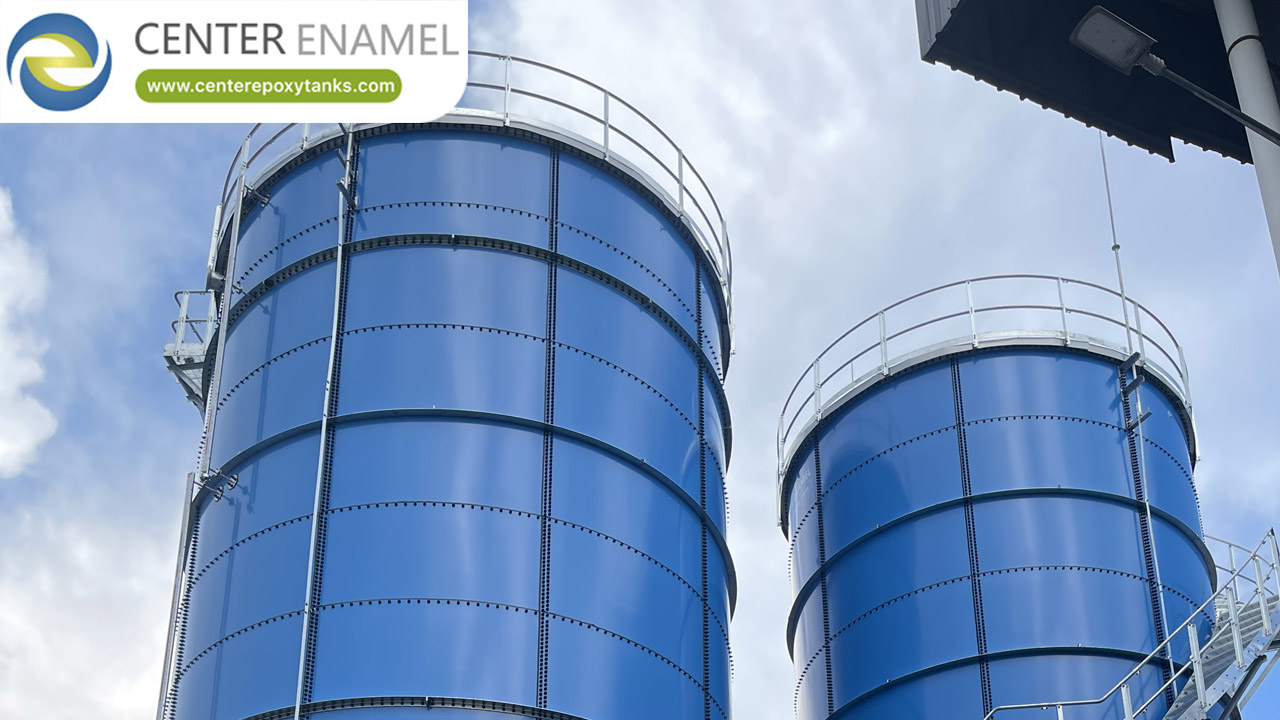
Center Enamel Deploys Fusion Bonded Epoxy Tanks for Malaysia Drinking Water Project
In June 2026, Shijiazhuang Zhengzhong Technology Co., Ltd. (Center Enamel) completed the construction and commissioning of specialized Fusion Bonded Epoxy (FBE) bolted steel tanks for a landmark municipal drinking water project in Malaysia. Serving as critical aerobic tanks within the water purification process, these custom-engineered vessels optimize pre-treatment oxidation and biological organic removal. The infrastructure deployment includes two distinct configurations: one set measuring Diameter 6.11m × 15.6m (H) and a second set measuring Diameter 6.88m × 16.2m (H). Both tanks are fully operational, adhering to stringent international standards such as AWWA D103-09 and NSF/ANSI 61 to ensure hygienic, corrosion-free, and seismically stable operation in Malaysia’s tropical climate.
Project Specifications Overview
The successful execution of this drinking water infrastructure update provides long-term operational security for the local municipal supply. The technical parameters of the installed assets include:
Application: Aerobic Treatment Tank (Drinking Water Pre-Treatment Phase)
Project Location: Malaysia
Coating Technology: Advanced Fusion Bonded Epoxy (FBE)
Configuration Set 1: Diameter 6.11m × 15.6m (Height) — 1 Set
Configuration Set 2: Diameter 6.88m × 16.2m (Height) — 1 Set
Project Completion: June 2026 (Construction finalized, system fully operational)
The Strategic Role of FBE Tanks in Aerobic Pre-Treatment
In modern drinking water generation, raw source water often contains organic compounds, ammonia, or heavy metals like iron and manganese. An aerobic tank system introduces continuous aeration to oxidize these elements and degrade organic impurities before final filtration and disinfection.
This highly oxygenated, turbulent environment creates specific structural demands that Center Enamel's FBE tanks are designed to meet.
1. High-Oxygen Corrosion Shielding
Constant aeration introduces high concentrations of dissolved oxygen, accelerating the oxidation of unprotected steel. Center Enamel utilizes an advanced electrostatic powder coating process. The epoxy powder is thermally fused to the grit-blasted steel plates at high temperatures, creating a smooth, uniform, and non-porous barrier. This ensures complete chemical isolation, shielding the underlying steel from rust and chemical attacks.
2. Structural Performance in Slim, High-Profile Form Factors
The dimensions chosen for this project—reaching heights of 15.6 meters and 16.2 meters—create high hydrostatic pressures along the lower rings of the tank shell. Center Enamel’s modular design utilizes high-tensile carbon steel plate configurations calculated to safely handle these loads. The bolted assembly maximizes vertical storage volume while maintaining a compact physical footprint, ideal for optimizing space within the water treatment plant layout.
3. NSF/ANSI 61 Potable Water Compliance
Because these aerobic tanks operate within a drinking water treatment chain, zero chemical leaching is permissible. Center Enamel’s Fusion Bonded Epoxy coatings are completely inert and certified to meet NSF/ANSI 61 standards. The smooth interior finish actively prevents biological scaling and biofilm accumulation, ensuring the water remains uncontaminated as it advances through subsequent filtration stages.
Comparative Advantage: FBE Bolted Tanks vs. Traditional Alternatives
Performance Indicator | Center Enamel FBE Tanks | Field-Welded Carbon Steel | Cast-In-Place Concrete |
Corrosion Resistance | Excellent (Factory-applied thermal bond) | Moderate (Requires frequent on-site painting) | Poor (Subject to micro-cracks and leaching) |
Installation Efficiency | High (Modular bolted assembly) | Moderate (Requires extensive on-site welding) | Low (Extended concrete curing timelines) |
Hygienic Profile | Non-porous, resists biofilm | Dependent on quality of internal paint | High porosity promotes bacterial growth |
Environmental Footprint | Low (Minimal on-site waste/emissions) | High (On-site VOC painting emissions) | High (Heavy resource consumption) |
Frequently Asked Questions (FAQ)
Q: Why was Fusion Bonded Epoxy selected over Glass-Fused-to-Steel (GFS) for this Malaysian project?
A: While Center Enamel is a world leader in GFS technology, FBE tanks offer an exceptionally cost-effective solution for specific municipal water applications where the chemical composition requires a tough, impact-resistant coating that meets NSF/ANSI 61 standards without the premium cost profile of glass-lining, providing optimal capital expenditure balance for the municipality.
Q: How does the humid Malaysian climate impact the lifecycle of an FBE bolted tank?
A: Industrial-grade FBE coatings are highly stable in tropical environments. Because the coating is applied under strict quality control conditions in a climate-controlled factory, there is no risk of ambient humidity causing blistering or poor adhesion during application, unlike traditional field-welded tanks painted on-site.
Q: What maintenance is required for these specific aerobic tanks?
A: Thanks to the smooth, low-friction surface of the epoxy coating, sediment accumulation is minimized. Routine maintenance primarily consists of periodic visual inspections of the exterior structural components and checking the torque configuration of the high-strength connection bolts during scheduled plant shutdowns.
Are you drafting the engineering designs or procurement requirements for an infrastructure expansion in Southeast Asia? Contact the technical engineering desk at Center Enamel to request detailed structural calculations, drawings, or commercial estimates tailored to your local site parameters.


