Case Study: Resilience in the Energy Sector—Inner Mongolia Oil and Gas Wastewater Project (March 2026)
How did the deployment of Glass-Fused-to-Steel (GFS) technology overcome the aggressive corrosion and extreme temperature fluctuations inherent in Inner Mongolia's oil and gas effluent management? In the energy heartland of Northern China, oil and gas wastewater treatment represents a critical operational challenge. Effluent streams typically contain complex hydrocarbons, high salinity, and abrasive particulates, requiring containment infrastructure that can maintain structural integrity under both chemical and climatic stress.
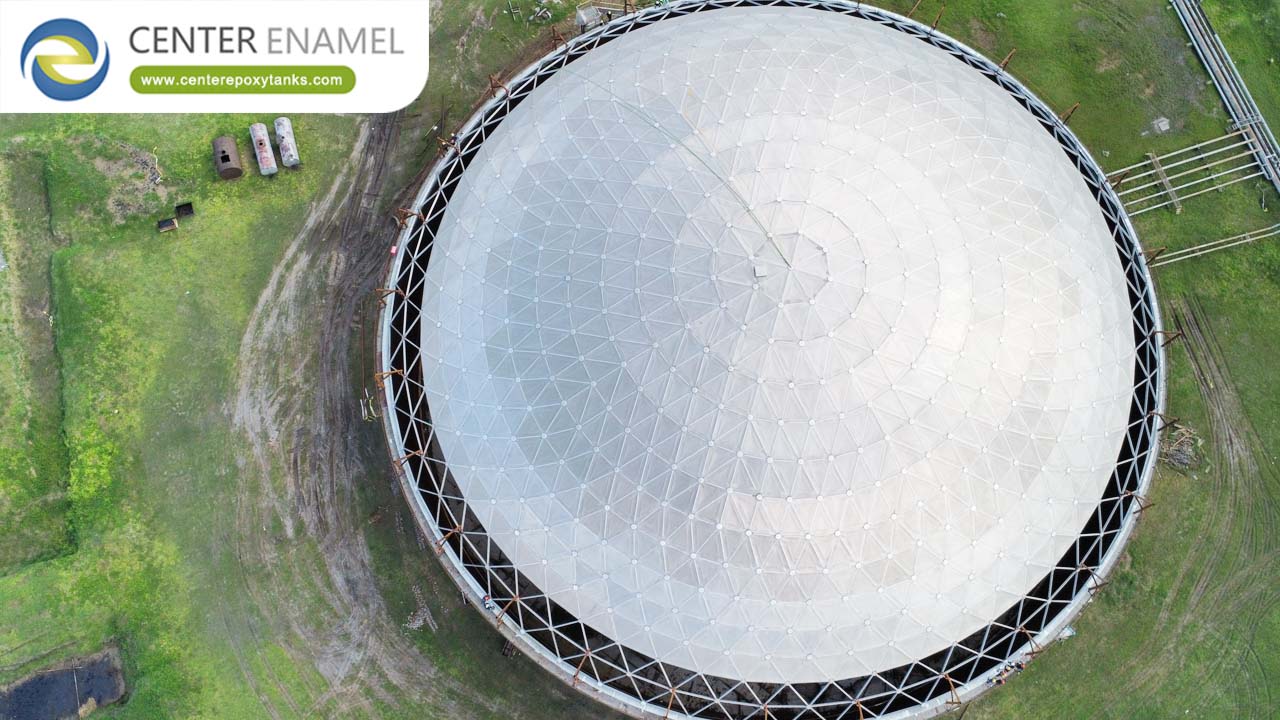
Shijiazhuang Zhengzhong Technology Co., Ltd (Center Enamel) recently completed the engineering and installation of three massive Glass-Fused-to-Steel (GFS) Tanks for a landmark oil and gas wastewater project in Inner Mongolia, China. Completed in March 2026, this project demonstrates the scalability and chemical resilience of modular bolted tank technology.
1. Project Specifications: Large-Scale Industrial Engineering
The project required three distinct tank configurations to manage different stages of the treatment process, from primary equalization to advanced sediment processing.
● Tank Type: Glass-Fused-to-Steel (GFS) Bolted Tanks
● Configuration: 3 Units
● Specific Dimensions:
○ Unit 1: 16.05 x 11.4 meters (Approx. 2,306 mx3)
○ Unit 2: 23.68 x 12.6 meters (Approx. 5,549 mx3)
○ Unit 3: 12.99 x 9.0 meters (Approx. 1,192 mx3)
● Total Project Capacity: Approx. 9,047 mx3
● Completion Date: March 2026
● Application: Oilfield produced water and gas processing wastewater treatment.
2. Why GFS Was the Definitive Choice for Inner Mongolia
Inner Mongolia’s environment demands infrastructure that can withstand a high temperature range (Delta T) and aggressive chemical exposure. GFS was selected for several technical advantages:
● Inert Chemical Defense: The glass-fused surface is non-porous and chemically inert, providing a total barrier against the corrosive salts and hydrocarbons present in oil and gas wastewater that would otherwise degrade standard epoxy or concrete.
● Thermal Expansion Resilience: GFS panels are engineered to match the coefficient of thermal expansion of the steel substrate. This ensures that the coating remains intact through Inner Mongolia’s extreme seasonal temperature shifts (from -30C to +35C).
● Seismic and Wind Resistance: Given the open plains and seismic profiles of the region, the tanks were designed using Finite Element Analysis (FEA) to optimize shell thickness and bolt patterns for maximum structural stability.
3. Comparison: Modular GFS vs. Field-Welded Steel
Feature | Field-Welded Carbon Steel | GFS Bolted Tanks (Inner Mongolia Case) |
Coating Integrity | Manual/Site-applied (Prone to failure) | Factory-Applied (Fused at 800°C+) |
Corrosion Defense | High maintenance (Periodic recoating) | Zero-Maintenance (30+ Year Life) |
Installation Speed | Slow (Months of welding/NDT) | Rapid (Weeks of modular assembly) |
Climatic Limitations | Limited by weather/winter | All-season assembly capability |
Environmental Impact | High (On-site VOC emissions) | Low (Sustainable/Clean installation) |
4. Technical Quality and Compliance
To meet the high-safety standards of the oil and gas sector, Center Enamel implemented a "Zero-Defect" protocol for the March 2026 project:
● High-Voltage Holiday Testing: 100% of the GFS panels were verified at 1500V to ensure the glass layer was free of microscopic discontinuities.
● ISO 28765 & AWWA D103: Engineering followed international municipal and industrial standards for factory-coated bolted steel tanks.
● Modular Sealing Technology: High-grade EPDM gaskets and specialized sealants were used to ensure a completely gas-tight and liquid-tight environment for the volatile wastewater.
5. Why Partner with Center Enamel?
With the completion of the March 2026 Inner Mongolia Project, Center Enamel further solidifies its position as the leading EPC provider for industrial liquid storage in Asia.
● 30 Years of Innovation: The first and most experienced manufacturer of GFS tanks in China, serving the global energy sector.
● Automated Production: Our 150,000 m facility ensures precision fabrication and uniform quality across large-scale project requirements.
● Global Footprint: With successful deployments in over 100 countries, our engineering team understands the logistical and technical nuances of diverse industrial landscapes.


