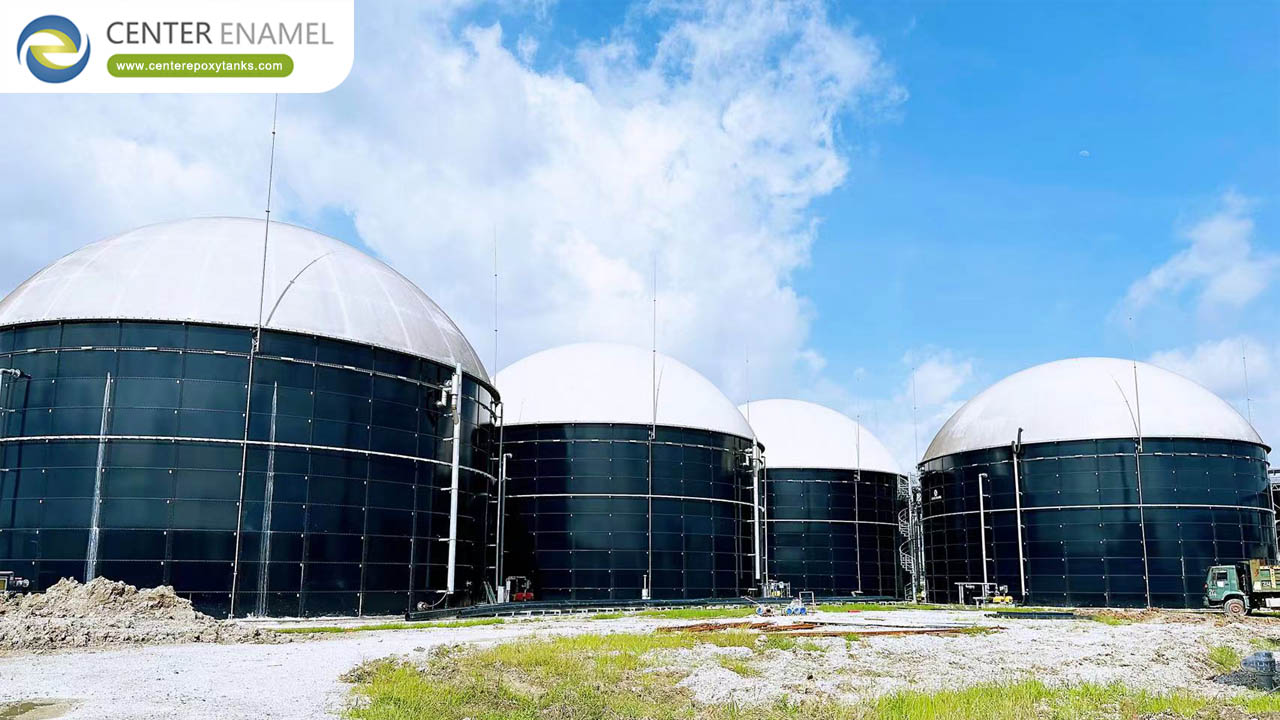
Bolted Steel Tanks as Biogas Fermentation Tanks: Engineering & Design Guide
For anaerobic digestion (AD) facilities, the fermentation tank is the heart of the operation. It must maintain a precise, airtight environment for microbial activity while withstanding the highly corrosive byproduct gases of the methane-generation process. Bolted Steel Tanks—specifically those utilizing Glass-Fused-to-Steel (GFS) or advanced Fusion-Bonded Epoxy (FBE) coatings—have become the global industry standard for biogas fermentation, offering superior structural longevity, chemical resilience, and rapid commissioning compared to traditional poured-concrete vessels.
1. Why Bolted Steel for Anaerobic Digestion?
Biogas fermentation involves a hostile environment where hydrogen sulfide (H2S) and moisture interact to create sulfuric acid, which is lethal to standard carbon steel and detrimental to concrete.
A. The "Airtight" Engineering Standard
Biogas fermentation requires an absolute anaerobic (oxygen-free) environment. Bolted steel tanks are engineered with precision-matched panels and industrial-grade elastomeric sealing gaskets.
● Gas Containment: Modern bolting systems ensure the vessel remains gas-tight, preventing methane leakage and protecting the efficiency of the biogas collection system.
● Roof Integration: These tanks are designed to support various biogas-specific roof types, including double-membrane gas holders, which expand and contract to store produced gas at low pressure.
B. Corrosion Resistance in the "Vapor Zone"
The most critical area of a fermentation tank is the "headspace"—the area above the liquid level where biogas collects. This zone is highly corrosive.
● Inert Barrier: Factory-applied coatings (GFS/FBE) provide a smooth, inorganic, non-porous glass-like barrier that is immune to H2S attack.
● Zero Pinhole Quality: Every panel is factory-tested via high-voltage spark (holiday) testing, ensuring the internal surface remains completely protected against microbial-induced corrosion.
2. Decision Matrix: Fermentation Tank Technologies
Feature | Bolted Steel (GFS/FBE) | Concrete Tanks | Site-Welded Steel |
Airtightness | Excellent (Engineered Gaskets) | Moderate (Prone to cracking) | Good (Dependent on weld quality) |
H2S Resistance | Superior (Inert Barrier) | Low (Requires expensive liners) | Moderate (Requires periodic coating) |
Installation Speed | Fast (Modular assembly) | Very Slow (Curing required) | Moderate |
Scaling Potential | High (Modular/Extendable) | None | Low |
Maintenance | Low (Inspections only) | High (Joint/Cracking repair) | High (Recoating needed) |
3. Critical Design Considerations for Biogas Plants
Structural Integrity for Mixing
Anaerobic digesters require continuous mixing to prevent solids accumulation and maintain temperature uniformity. Bolted steel tanks are engineered to accommodate:
● Submerged Mixers: Mounting hardware for various propeller-based mixing systems.
● Hydraulic Mixing: Piping penetrations for external pump-and-nozzle mixing loops.
● Structural Load Factors: Engineered plate thickness to withstand the dynamic loads and vibrations induced by large-scale agitators.
Thermal Regulation
Efficiency in a biogas plant is tied to consistent thermophilic or mesophilic temperatures. Bolted tanks are frequently paired with:
● Insulation Systems: External insulation blankets or cladding to minimize heat loss.
● Heat Exchangers: Internal or external pipe-coil heating systems to maintain the precise thermal environment required for maximum biogas yield.
4. Frequently Asked Questions (FAQ)
Q: Why are bolted tanks preferred over concrete for fermentation?
A: Concrete is inherently porous and prone to cracking under thermal cycles. In a biogas environment, these cracks allow H2S to enter the structure, corroding the rebar and compromising the tank’s structural integrity. Bolted steel tanks provide a flexible, non-porous barrier that does not crack under thermal expansion or contraction.
Q: Can bolted tanks be reused for different feedstocks?
A: Yes. Because the interior coating is inert and non-stick, transitioning from agricultural feedstock to food-waste slurry is significantly easier. The smooth, glass-fused surface prevents the buildup of residue, making the tank much easier to clean and repurpose.
Q: How do you ensure the roof stays airtight during gas generation?
A: We utilize specialized sealing channels and high-durability gaskets at the tank-to-roof interface. Combined with double-membrane roof systems, the entire structure is engineered as a single, gas-tight vessel that captures biogas safely and efficiently.
Engineering Certainty for Your Biogas Plant
Your fermentation tank is the largest single investment in your biogas facility. Choosing a bolted steel system ensures that your infrastructure is built to a predictable, factory-verified quality, minimizing the risk of gas leakage or structural degradation over the long-term project lifecycle.
Are you currently in the design or feasibility stage of a new biogas project, or are you looking to retrofit an existing fermentation facility with more reliable containment?


