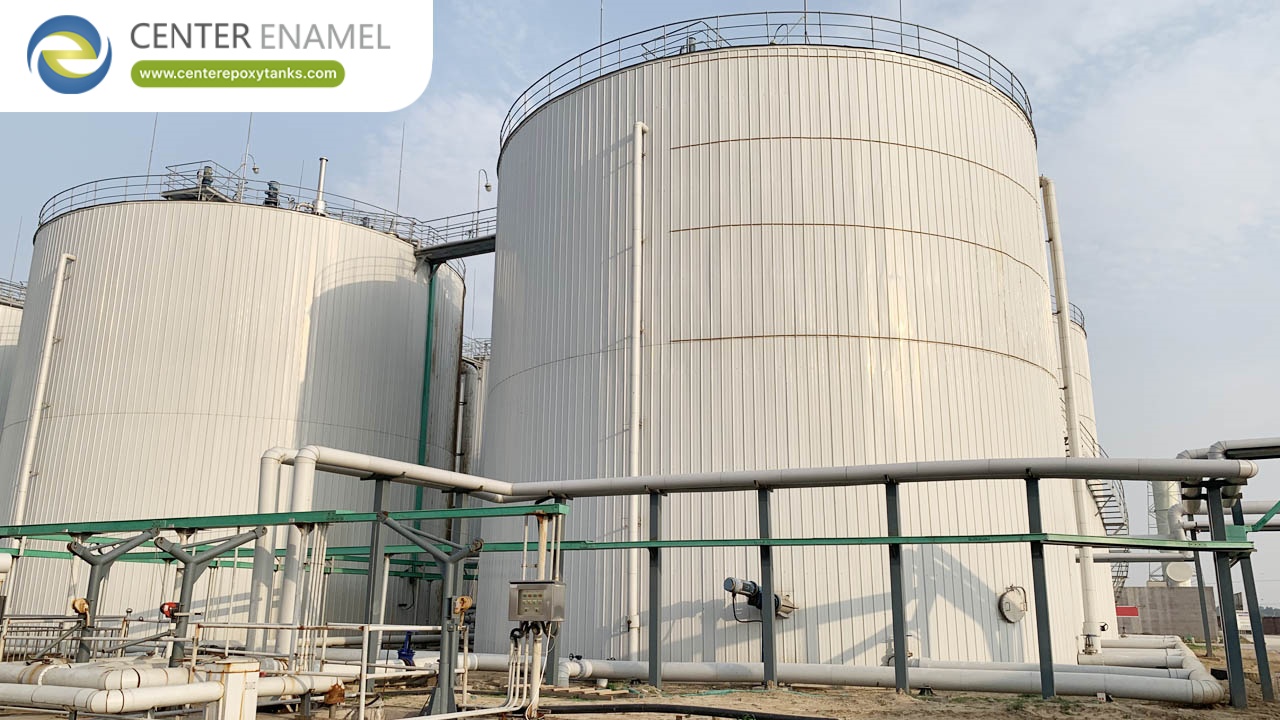
Livestock Waste Management: Utilizing Bolted Steel Tank as Animal Waste Biogas Digester
Intensive livestock operations—including dairy farms, swine production facilities, and poultry complexes—generate vast volumes of high-strength organic manure. Managing these animal waste streams traditionally relied on open storage lagoons or cast-in-place concrete basins, methods that contribute to fugitive greenhouse gas emissions, severe odor liabilities, and potential groundwater contamination.
To turn this environmental challenge into a profitable green energy asset, modern agricultural engineering has standardized on bolted steel tanks configured as animal waste biogas digesters. By combining high-tensile structural steel with advanced Glass-Fused-to-Steel (GFS) or Fusion Bonded Epoxy (FBE) coatings, these sealed anaerobic reactors provide exceptional chemical resistance, rapid deployment, and maximum methane recovery.
The Biological and Chemical Realities of Livestock Manure Digestion
Animal slurry is an aggressive substrate. The breakdown of high-nitrogen organic matter releases high concentrations of ammonia, volatile fatty acids, and hydrogen sulfide (H2S) gas. When moisture interacts with sulfur compounds inside a closed headspace, it creates a highly corrosive environment that rapidly pits and destroys traditional unlined concrete or unprotected carbon steel.
To survive these punishing conditions while containing liquid pressure and explosive biogas safely, bolted steel digesters utilize specialized engineering features:
Glass-Fused-to-Steel (GFS) and FBE Protection: Premium agricultural digesters utilize factory-applied coatings fused to steel plates at high temperatures (approx. 800°C to 900°C). This creates an ultra-smooth, chemically inert glass or thermoset polymer barrier that is completely impervious to manure acids and microbial corrosion.
Modular Bolted Precision and Leak-Proof Sealing: Prefabricated panels are bolted together on-site using high-grade structural hardware and specialized elastomeric mastic sealants. This modular approach ensures absolute gas-tight and liquid-tight containment, preventing fugitive emissions and safeguarding local water tables.
Integrated Thermal and Agitation Systems: To optimize methanogenic bacteria activity, digesters must maintain stable mesophilic (35°C) or thermophilic (55°C) temperatures. Bolted steel tanks seamlessly integrate internal heating coils, insulation layers, and heavy-duty mechanical mixers (or gas-injection agitation systems) to prevent crusting and dead zones.
Data Table: Comprehensive Comparison of Animal Waste Digestion Infrastructure
Technical Parameter | Bolted Steel Digester (GFS / Epoxy) | Cast-in-Place Concrete Basins | Traditional Open Manure Lagoons |
Corrosion & H2S Resistance | Superior; inert glass or epoxy matrix completely resists manure acids and sulfide attack | Moderate; vulnerable to concrete carbonation, acid spalling, and seepage | Poor; unlined earth erodes, degrades, and leaches nitrates into groundwater |
Methane Capture & Gas Safety | Absolute; closed-loop modular design captures 100% of biogas with ultra-low leakage (le 0.02%) | Difficult to seal effectively; prone to joint venting and gas loss | Zero capture; fugitive methane and greenhouse gases vent directly into the atmosphere |
Installation Speed & Rigging | Rapid modular bolted panel assembly completed in weeks with minimal heavy civil equipment | Slow civil construction requiring weeks of framing, pouring, and curing | Fast excavation, but large footprint and lengthy site preparation |
Volumetric Scalability | High; modular bolted design allows easy capacity expansion or future relocation | Permanent monolithic structure; impossible to scale without total reconstruction | Restricted by available land space and environmental setback limits |
Frequently Asked Questions (FAQ)
Q: Why are bolted steel tanks preferred over concrete for livestock waste biogas digesters?
A: Bolted steel tanks—particularly those featuring Glass-Fused-to-Steel (GFS) or heavy-duty epoxy coatings—offer superior corrosion resistance against aggressive manure acids, much faster modular installation timelines, and lower lifecycle maintenance costs compared to concrete.
Q: How do bolted steel digesters prevent gas leaks and ensure safety?
A: They utilize high-grade, chemically compatible elastomeric sealants at every panel overlap and incorporate secure gas-tight roofs (such as double membrane holders or GFS domes) equipped with Pressure/Vacuum Relief Valves (PVRVs) to regulate internal headspace pressure.
Q: Can a bolted steel animal waste digester be expanded if a farm increases its livestock population?
A: Yes. One of the core advantages of a modular bolted design is scalability. If waste volume increases, additional ring panels can be added to increase tank height or capacity, provided the foundation was engineered to support the load.
Q: What happens to the animal waste after the anaerobic digestion process is complete?
A: The processed byproduct, known as digestate, is a stabilized, pathogen-reduced bio-fertilizer rich in plant-available nutrients. It can be safely applied to farm fields to replace synthetic fertilizers, completing a sustainable circular agricultural economy.


