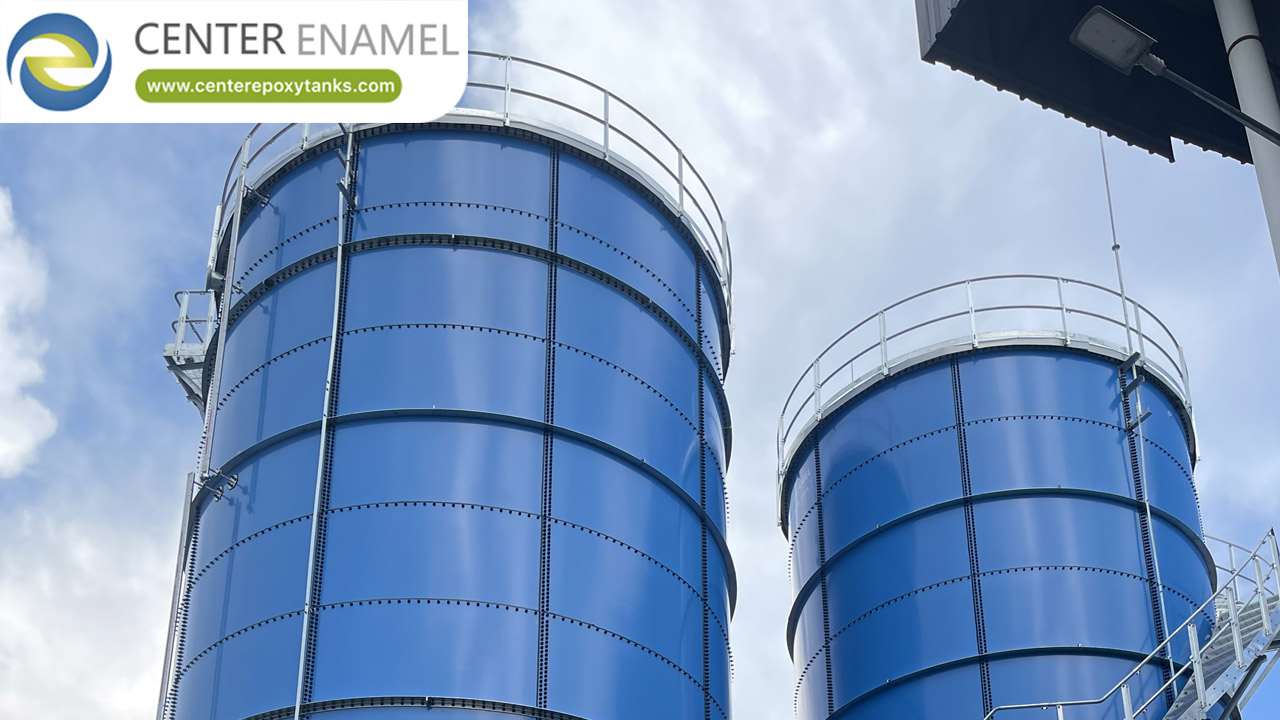
Bolted Steel Tanks as Anaerobic Reactor Tanks: The Future of Biogas Infrastructure
For modern biogas facilities, the choice of reactor tank is the single most critical decision for operational success. While traditional cast-in-place concrete has been the historical standard, bolted steel tanks—specifically those utilizing Glass-Fused-to-Steel (GFS) or Fusion Bonded Epoxy (FBE) coatings—are rapidly becoming the preferred solution for anaerobic digestion. These systems combine the structural strength of steel with the chemical inertness required to manage aggressive organic waste.
Why Bolted Steel Outperforms Concrete in Anaerobic Digestion
Anaerobic digestion is a chemically harsh process that produces biogas (CH4, CO2) and corrosive byproducts (like H2S) that can aggressively degrade standard infrastructure. Bolted steel tanks provide a superior alternative for several key reasons:
1. Superior Corrosion Resistance
The internal environment of an anaerobic reactor is hostile. Glass-Fused-to-Steel (GFS) technology, in particular, creates a porcelain-like, chemically inert barrier that is impervious to the acidity of organic sludge. This prevents the structural degradation often seen in concrete tanks, which can crack and expose rebar to corrosive gases.
2. Modular Construction & Scalability
Biogas plants often require operational flexibility. Bolted steel tanks are prefabricated in a controlled factory environment and assembled on-site. This modularity allows for:
Rapid Deployment: Assembly can be completed in a fraction of the time required to pour and cure concrete.
Future-Proofing: If a plant needs to expand its capacity, bolted panels allow for straightforward height or diameter increases, a feat that is effectively impossible with monolithic concrete structures.
3. Precision Engineering
Factory fabrication ensures that every panel meets strict quality control standards. This eliminates the "human error" factor common in on-site concrete pouring, ensuring that every bolt, gasket, and seal is engineered for the high-pressure, airtight requirements of a biogas reactor.
Comparative Performance Matrix: Bolted Steel vs. Concrete
Feature | Bolted Steel (GFS/FBE) | Cast-in-Place Concrete |
Corrosion Resistance | Excellent (Inert) | Low (Requires Liners) |
Installation Speed | Fast (Weeks) | Slow (Months) |
Maintenance Needs | Very Low | Moderate (Crack Repair) |
Expansion Capability | High (Modular) | None |
Initial Cost | Moderate/Competitive | High (High Labor) |
Critical Engineering Considerations for Biogas Reactors
A successful anaerobic reactor is more than just a storage vessel; it is a complex process machine. When specifying a bolted steel tank, engineers must integrate the following:
Note: Proper digester design must prioritize gas-tight integrity. Bolted connections must utilize high-grade, chemically compatible mastic sealants and protective bolt caps to ensure the tank remains leak-proof against both liquid and methane gas.
Thermal Regulation: Biogas bacteria are temperature-sensitive. Bolted steel tanks easily accommodate external insulation systems to maintain mesophilic (35C) or thermophilic (55C) conditions.
Mixing Efficiency: Uniform concentration is vital to prevent "dead zones." The smooth interior of GFS/FBE panels allows for efficient mixing via submersible propellers or gas injection systems, maximizing methane yield.
Gas Safety: The reactor roof—often a double-membrane system or GFS dome—must be equipped with Pressure/Vacuum Relief Valves (PVRVs) to prevent structural damage from internal pressure fluctuations.
Frequently Asked Questions (FAQ)
Q: Can bolted steel digesters handle heavy industrial organic waste?
A: Yes. GFS-coated bolted steel is exceptionally resistant to aggressive industrial effluents, including high-salt, high-acid, and high-grease wastes that would rapidly degrade concrete walls.
Q: How do you ensure bolted connections remain gas-tight?
A: Bolted digesters use high-grade, chemically compatible mastic sealants applied between panel overlaps. These sealants are engineered to maintain elasticity for decades, ensuring the tank remains leak-proof against biogas leakage.
Q: Is it possible to expand a bolted steel digester after it is built?
A: Yes. This is one of the primary benefits of bolted steel technology. If your plant requires increased capacity, additional panels can be added to the existing structure to increase tank height, provided the foundation was initially designed with sufficient load-bearing capacity.
Q: Which coating is better: GFS or FBE?
A: Both are excellent. GFS (Glass-Fused-to-Steel) is generally considered the premium, maintenance-free choice for highly corrosive environments due to its hardness and inertness. FBE (Fusion Bonded Epoxy) is a cost-effective, durable solution that is also widely used for fire water and general wastewater, often offering a slightly lower initial investment.
Q: What is the expected design life of a bolted steel anaerobic reactor?
A: With proper maintenance and correct material specification, these tanks typically offer a design life of 30 to 50+ years, often outperforming the lifecycle of more labor-intensive concrete structures.


