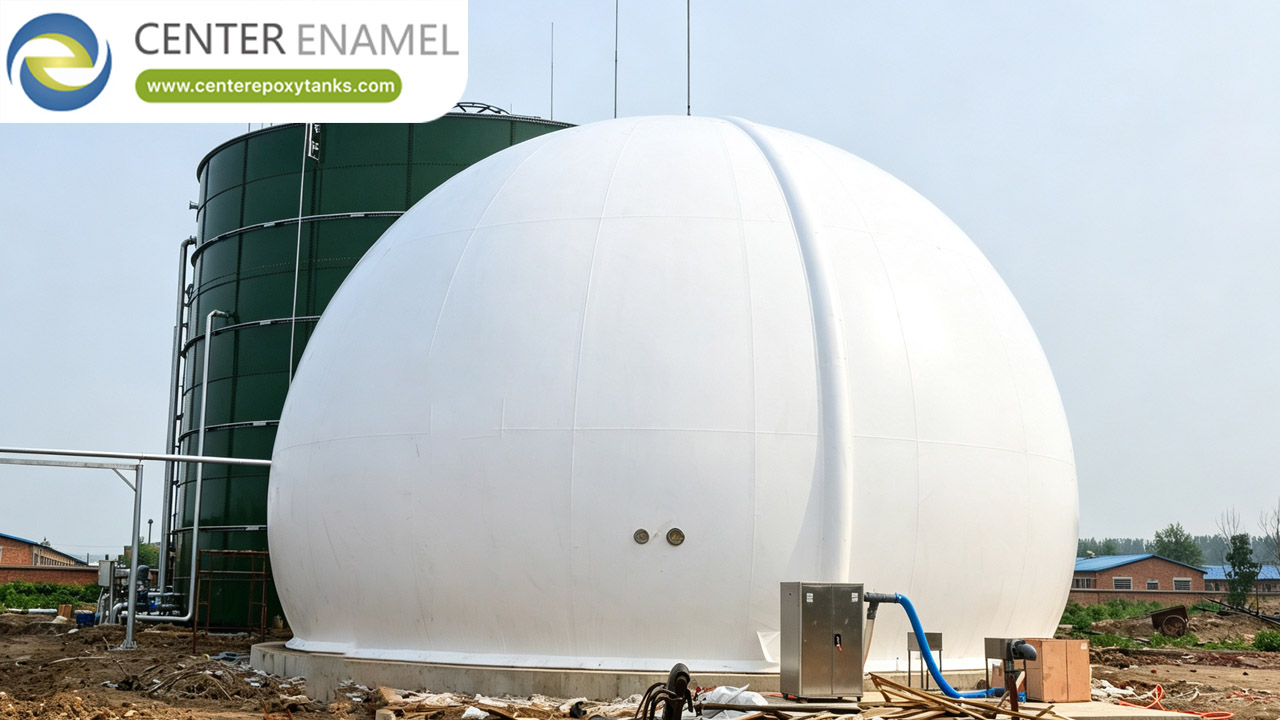
Biogas Holders for Industrial-Scale Renewable Energy Projects: Engineering High-Capacity Containment and Stability for Utility-Scale Biogas Plants
As global industries and utilities accelerate their transition toward net-zero carbon targets, multi-megawatt renewable energy projects powered by commercial anaerobic digestion (AD) have become critical pillars of the clean energy economy. Processing thousands of tons of organic municipal solid waste, agricultural sludges, and industrial wastewater streams daily, these mega-scale facilities generate immense volumes of raw biogas.
However, because biological digestion is a continuous process while electrical grid demands and biomethane upgrading schedules fluctuate dynamically, bridging the gap requires robust intermediate containment. Industrial-scale biogas holders serve as the essential buffering core of utility-scale renewable energy facilities, guaranteeing system stability, protecting downstream power assets, and maximizing overall energy capture efficiency.
The Operational Imperatives of Mega-Scale Gas Storage
In utility-scale renewable projects, managing massive throughputs introduces unique engineering challenges that standard agricultural storage solutions cannot handle:
Demand-Driven Power Generation: Large-scale combined heat and power (CHP) plants or biomethane upgrading units require a steady, uninterrupted fuel supply. Industrial gasholders decouple biological production peaks from high-tariff grid demand periods, allowing facilities to dispatch power when it holds maximum economic value.
Pressure Stabilization Across Extensive Piping Networks: Sprawling industrial plants feature long gas distribution lines. High-capacity gasholders act as primary accumulators that eliminate pressure drops and damp out surges, protecting sensitive compressors, scrubbers, and gas engines from operational failure.
Emergency Buffer and Flaring Mitigation: During scheduled maintenance or sudden shutdowns of downstream upgrading skids, industrial storage holders provide critical temporary volume retention, preventing the wasteful and environmentally hazardous flaring of millions of cubic meters of gas.
Technical Performance Matrix: Utility-Scale Storage Solutions
Technical Parameter | Industrial Double-Membrane Gasholders | High-Pressure Steel Bullet Tanks | Large Concrete Storage Basins |
Volumetric Capacity Range | Massive custom scales (ranging from 5,000 to over 50,000+ cubic meters) | Limited individual volume; requires multiple interconnected vessels for large scales | Variable, but restricted by massive structural footprint limitations |
Capital Expenditure & Footprint | Highly economical; lightweight modular design requires minimal civil foundation work | Extremely high capital cost; heavy-walled steel fabrication demands massive foundations | Moderate cost, but highly permanent and inflexible to future volume expansion |
Operational Pressure Behavior | Constant, stable low pressure maintained dynamically by an automated air-support blower | High pressure (15 to 20+ bar) requiring high-energy multi-stage gas compression | Low, variable pressure reliant on liquid displacement within masonry structures |
Corrosion Resistance & Durability | Zero structural corrosion risk due to chemically inert PVC/PVDF polymer membranes | High susceptibility to internal oxidation from moisture and H2S without constant upkeep | Vulnerable to concrete carbonation and sulfate attack from wet industrial substrates |
Advanced Engineering and Safety Features for Industrial Projects
Industrial-scale renewable energy projects demand uncompromising safety protocols and robust material science:
Heavy-Duty Multi-Layer Membranes: Constructed from high-tenacity polyester base fabrics coated with specialized, low-permeability polymers, these membranes prevent methane diffusion and withstand extreme mechanical tear loads.
Redundant Air-Blower Systems: Automated, explosion-proof dual blower configurations ensure continuous pressure is maintained in the interstitial space between the inner gas bladder and outer weather shell, even during primary power interruptions.
Comprehensive Safety Instrumentation: Integrated with automated pressure/vacuum relief valves, emergency flare interlocks, continuous gas leak detection arrays, and lightning protection bonding systems compliant with NFPA 820.
Frequently Asked Questions (FAQ)
Q: Why are industrial-scale biogas holders critical for utility-scale renewable energy projects?
A: Industrial biogas holders act as high-capacity energy buffers that decouple continuous biological gas generation from fluctuating industrial power consumption or grid injection schedules, ensuring stable, reliable plant operations.
Q: What is the storage capacity range of commercial double-membrane biogas holders?
A: Industrial double-membrane gasholders are engineered for massive scales, frequently offering storage capacities ranging from 5,000 cubic meters to well over 50,000 cubic meters in single standalone installations.
Q: How do industrial-scale gasholders maintain stable operating pressures under fluctuating loads?
A: They utilize a double-membrane design where an automated air-support blower continuously maintains positive pressure in the outer shell. This exerts uniform downward pressure on the inner gas bladder, guaranteeing a consistent, stable gas delivery pressure to downstream equipment.
Q: What international engineering and safety standards govern industrial biogas storage systems?
A: Large-scale biogas holders are designed and fabricated in strict accordance with major global standards, including ISO 23590, ISO 20675, and fire safety codes such as NFPA 820, ensuring structural integrity and regulatory compliance.


