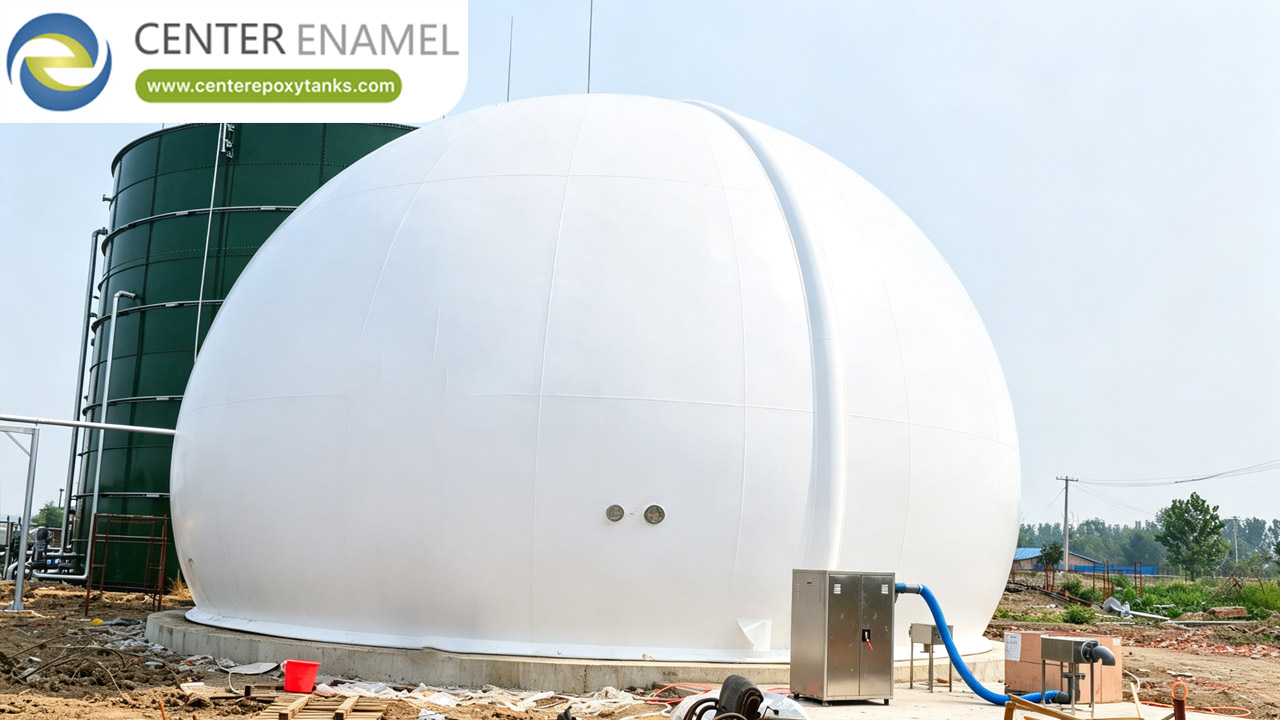
Biogas Holders for Dairy Farm Plant: Engineering Renewable Energy and Sustainable Manure Management
Modern dairy farming enterprises face a dual challenge: managing high-volume livestock manure streams efficiently while minimizing environmental footprints and carbon emissions. High-strength dairy manure, combined with milk parlor washdown wastewater, generates massive amounts of organic waste that release potent methane emissions if left unmanaged.
To turn this environmental liability into an operational asset, commercial dairy farms increasingly implement anaerobic digestion (AD) plants. These systems convert raw manure into renewable biogas and nutrient-rich organic fertilizer. However, biological gas generation on dairy farms fluctuates based on feeding schedules, milking cycles, and seasonal variations. To safely store, buffer, and regulate this volatile energy source, facilities rely on advanced biogas holders for dairy farm plant operations—predominantly featuring state-of-the-art double-membrane gas storage architecture.
The Critical Role of Biogas Containment in Dairy Operations
Anaerobic digestion transforms complex organic solids into a clean energy gas mix consisting primarily of methane (CH4) and carbon dioxide (CO2). For a dairy farm plant to successfully utilize this biogas for combined heat and power (CHP) generation, boiler heating, or biomethane upgrading, reliable storage is mandatory:
Volumetric Buffering Against Production Spikes: Manure digestion rates can surge unexpectedly. A flexible gas holder absorbs these peaks, preventing dangerous over-pressurization in the digester tank.
Absolute Odor and Emission Control: Uncapped manure storage emits severe odors and greenhouse gases. Enclosing the system with specialized membranes traps fugitive gases, significantly improving neighbor relations and environmental compliance.
Constant Operating Pressure Delivery: Downstream equipment like generators or flares require a steady, regulated gas feed pressure. Modern gas holders utilize automated air-side pressure maintenance to ensure consistent delivery flow regardless of storage volume.
Architecture of Double-Membrane Biogas Holders
The industry standard for agricultural biogas containment is the Double Membrane Gas Holder (DMGH), which consists of three core structural layers engineered from high-strength, PVC-coated polyester fabrics:
Bottom Membrane: Seals the lower boundary, anchoring the system securely to a concrete slab foundation or directly onto the top rim of a bolted steel digester tank.
Inner Membrane: Directly confines the stored biogas, expanding and contracting dynamically within the protective shell based on daily gas production volumes.
Outer Membrane: Maintained under constant pneumatic pressure by a dedicated, spark-resistant air blower system, this outer shell provides continuous shape, weather protection against wind and snow, and steady counter-pressure on the inner gas chamber.
Specialized high-frequency (RF) welding ensures absolute gas-tight integrity across all seams, while advanced fabric treatments provide superior resistance to ultraviolet (UV) radiation, fungal growth, and aggressive hydrogen sulfide (H2S) exposure up to 8000 ppm.
Technical Performance Matrix: Dairy Biogas Storage Systems
Technical Parameter | Double-Membrane Gas Holder (DMGH) | Fixed-Roof Steel Gas Tank | Open Lagoon with Geomembrane Cap |
Volumetric Buffer Flexibility | High; dynamic inner membrane expands and contracts freely based on gas output | Rigid volume limit; highly vulnerable to pressure spikes if production surges | Moderate; flexible cap but prone to rainwater pooling and shifting volume constraints |
Pressure Stability | Constant, regulated operating pressure managed via automated air-side control blowers | Variable pressure depending on fill levels and structural gas displacement | Low stability; relies entirely on natural gas uplift or complex active vacuum systems |
Chemical & H2S Defense | Superior; specialized PVC-polyester fabrics resist moisture, UV rays, and high H2S | Vulnerable to internal acid condensation and sulfuric pitting without expensive alloy linings | Moderate; geomembrane liners can degrade over time under continuous organic exposure |
Installation Velocity & Cost | Rapid modular assembly completed in days to weeks with minimal civil investment | Slow, capital-intensive field construction requiring extensive welding and heavy rigging | Moderate installation time, but requires extensive earthwork and anchor trenching |
Frequently Asked Questions (FAQ)
Q: Why are double-membrane gas holders preferred for dairy farm anaerobic digestion plants?
A: They offer a cost-effective, high-capacity, and flexible storage solution that adapts dynamically to fluctuating manure digestion rates. Their modular design allows them to be mounted directly on top of digester tanks or on independent concrete slabs.
Q: How does the double-membrane system maintain a constant gas delivery pressure?
A: A dedicated, spark-resistant air blower continuously maintains a controlled air pressure in the space between the outer and inner membranes. This outer air pressure exerts a steady, uniform downward force on the inner gas storage membrane, ensuring consistent delivery pressure to downstream generators or boilers.
Q: Can dairy biogas holder membranes withstand corrosive hydrogen sulfide (H2S)?
A: Yes. High-performance agricultural gas holders are manufactured using multi-layered, PVC-coated polyester fabrics specifically treated to resist chemical permeation and high concentrations of hydrogen sulfide (tested up to 8000 ppm) typical of livestock manure digestion.
Q: How do biogas holders help dairy farms reduce environmental emissions and odor?
A: By completely enclosing the manure digestion and storage process, the system prevents fugitive methane emissions and volatile odor compounds from escaping into the atmosphere. The captured methane is safely directed to a combined heat and power (CHP) unit or an enclosed flare, converting potent methane into lower-impact carbon dioxide.


