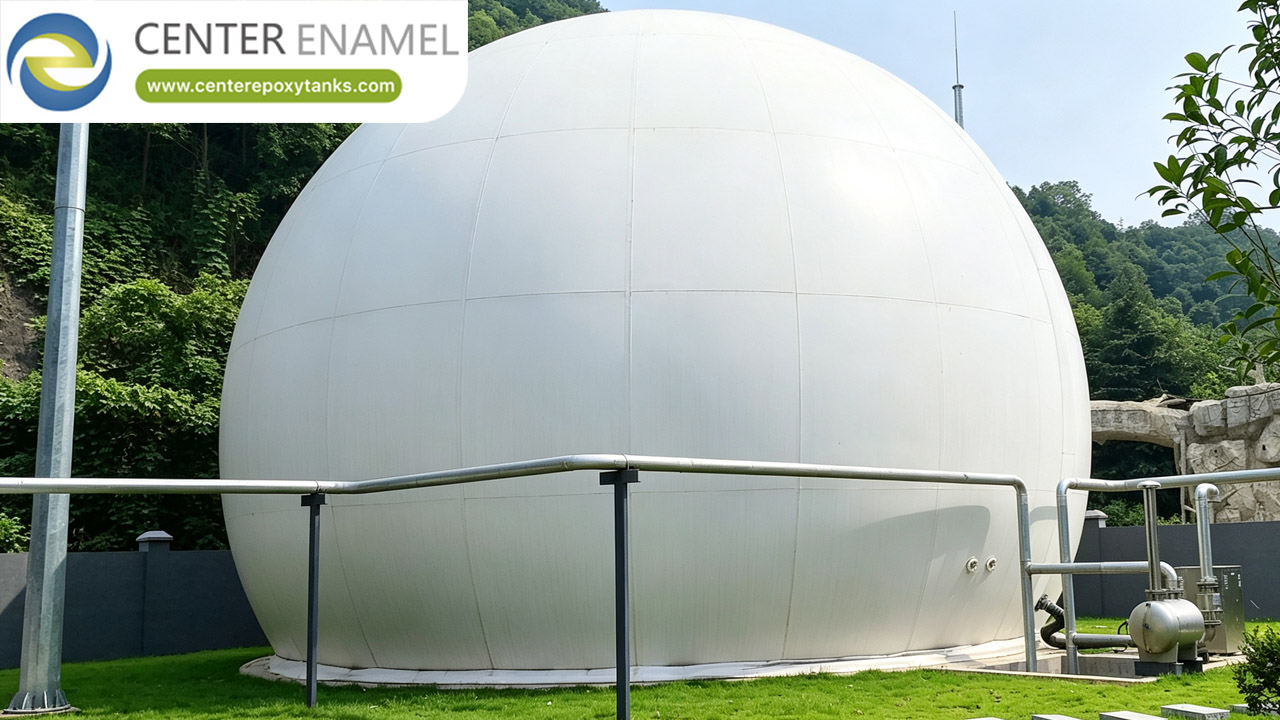
Biogas Holder Advanced Storage Solutions: Supporting High-Volume Biogas Production from Biomass Digestion
As the global transition toward decarbonization and circular energy gains momentum, large-scale anaerobic digestion (AD) plants processing agricultural waste, industrial effluents, and municipal biomass are scaling up production capacities. High-volume biomass digestion generates immense volumes of raw biogas continuously. However, because anaerobic biological activity operates around the clock while downstream cogeneration (CHP) engines or Bio-CNG upgrading units experience variable duty cycles, plants face significant gas buffering challenges.
To bridge this operational gap, facility designers rely on biogas holder advanced storage solutions. Engineered to provide flexible, high-volume, and corrosion-resistant containment, these advanced gasholders ensure stable pressure regulation, prevent hazardous gas flaring, and maximize energy recovery efficiency.
The Engineering Demands of High-Volume Biogas Buffering
Handling high-volume biogas output from large biomass digestion plants requires specialized containment systems capable of addressing three primary operational variables:
Volumetric Fluctuations: Biological gas generation rates fluctuate based on feedstock consistency, temperature, and feeding frequency. Advanced storage holders must dynamically expand and contract without compromising structural integrity.
Aggressive Chemical Exposure: Raw biogas is saturated with moisture and high concentrations of hydrogen sulfide (H2S) and carbon dioxide (CO2), which rapidly corrode standard metals and degrade unreinforced plastics.
Constant Pressure Delivery: Downstream purification compressors and gas engines require a steady, predictable inlet pressure. Unregulated gas pressure leads to equipment cavitation, inefficient combustion, or compressor trip-offs.
Technical Architecture of Advanced Double-Membrane Gas Holders
To meet these demanding industrial requirements, modern high-volume facilities utilize multi-layer pneumatic membrane structures:
High-Tenacity Polymer Fabrics: The membranes are fabricated from heavy-duty polyester (PES) base fabrics coated with specialized PVC or PVDF polymers. These materials incorporate anti-microbial, UV-resistant, and high-strength anti-static additives.
Triple-Layer Pneumatic Design: Consisting of a bottom membrane, an inner gas-tight containment membrane, and an outer weather protective shell, the system creates an isolated storage volume shielded from external environmental forces.
Automated Interstitial Air Regulation: An explosion-proof blower system continuously maintains positive air pressure in the outer chamber, applying uniform downward pressure on the inner gas bag to ensure a steady output delivery pressure regardless of stored gas volume.
Data Table: Comprehensive Comparison of Biogas Storage Technologies
Technical Parameter | Advanced Double-Membrane Biogas Holders | Traditional Welded Steel Gasholders | Fixed Concrete Gas Domes |
Volumetric Scalability | Excellent; highly flexible design accommodates massive high-volume footprints | Rigid structure; expanding capacity requires building entirely new tanks | Fixed permanent volume; impossible to expand without major reconstruction |
Corrosion Resistance ($H_2S$) | Superior; inert polymer fabrics resist high $H_2S$ concentrations without degradation | Moderate to High; requires continuous internal epoxy recoating and weld monitoring | Moderate; vulnerable to microbial-induced concrete corrosion (MIC) |
On-Site Installation Speed | Rapid modular deployment completed within days | Slow, labor-intensive field welding and structural rigging taking weeks | Extremely slow civil pouring and multi-week concrete curing schedule |
Safety & Overpressure Relief | Integrated emergency pressure relief valves and automatic air-space venting | Requires heavy mechanical piston seals or complex water-seal configurations | High risk of structural cracking if gas pressure exceeds relief thresholds |
Frequently Asked Questions (FAQ)
Q: Why are advanced storage solutions necessary for high-volume biomass digestion plants?
A: High-volume digestion plants produce gas continuously, whereas gas engines and upgrading units operate on specific schedules. Advanced storage holders act as critical buffer vessels that absorb production spikes, stabilize pressure, and prevent gas flaring.
Q: How do double-membrane biogas holders resist corrosive hydrogen sulfide (H2S)?
A: They are manufactured from high-tenacity polyester fabrics coated with chemically inert PVC or PVDF polymers that do not react with hydrogen sulfide or moisture, avoiding the oxidation and rust issues common in metal tanks.
Q: How is constant gas output pressure maintained in large-scale storage units?
A: An automated air blower continuously injects air into the space between the outer and inner membranes, maintaining precise positive pressure that presses down on the inner gas storage bag to guarantee a steady flow of gas to downstream equipment.
Q: Can advanced biogas holders be integrated directly onto large anaerobic digesters?
A: Yes. They can be engineered either as tank-mounted roofs installed directly on top of CSTR anaerobic digesters or as large standalone biogas holders positioned on dedicated concrete foundation slabs.


