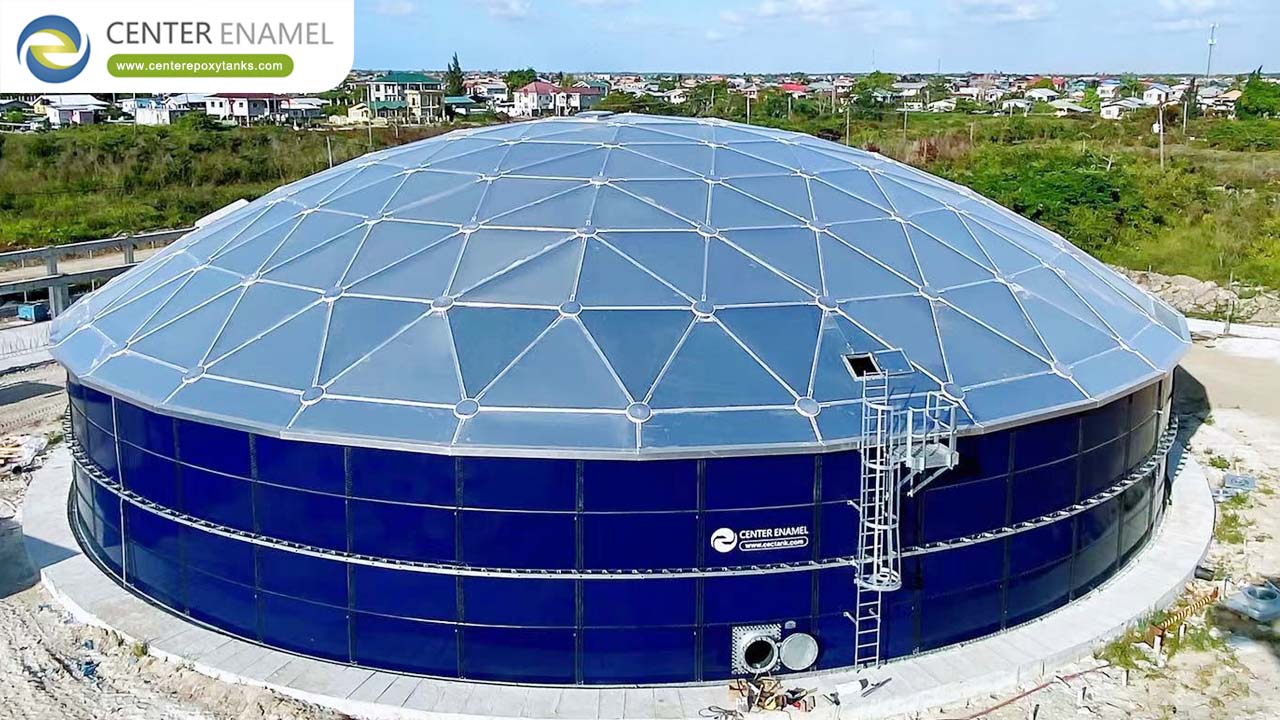
API 650 Epoxy Coated Steel Tanks: Engineering Petrochemical Reliability
API 650 epoxy coated steel tanks are high-integrity atmospheric storage vessels engineered for the containment of crude oil, hydrocarbons, and chemicals. By combining the structural requirements of API 650 with factory-applied Fusion Bonded Epoxy (FBE) or high-build liquid epoxy systems, these tanks provide a dual-layer defense against internal chemical aggression and external atmospheric corrosion. Center Enamel (Shijiazhuang Zhengzhong Technology Co., Ltd) manufactures these tanks to exceed ISO 12944 C5-I corrosion standards, offering a modular, bolt-together solution that eliminates on-site welding and significantly reduces facility downtime in 100+ countries.
1. Technical Specification & Structural Matrix
This matrix establishes the mechanical benchmarks for Center Enamel’s epoxy technology.
Feature | Technical Specification (2026 Standard) | Strategic Utility Value |
Design Standard | API 650 / AWWA D103-09 | Global benchmark for oil and chemical storage safety. |
Coating Technology | Fusion Bonded Epoxy (FBE) / High-Build Liquid | Dielectric barrier; resists $H_2S$ and chloride attack. |
Adhesion Strength | 12 MPa (per ASTM D4541) | Ensures coating remains intact under thermal expansion. |
Holiday Testing | 100% High-Voltage Spark Test | Zero-leak assurance for hazardous liquid containment. |
Corrosion Class | ISO 12944 C5-M / C5-I | Optimized for coastal and heavy industrial zones. |
Shell Material | ASTM A36 / A516 Gr. 70 Carbon Steel | High-tensile strength for seismic and pressure resilience. |
2. Structural Dynamics: The Epoxy-Steel Synergy
Neutralizing Electrochemical Corrosion
In petrochemical environments, steel is subject to rapid oxidation from moisture, sulfur compounds ($H_2S$), and salt. Center Enamel solves this through:
● The Dielectric Barrier: Epoxy coatings act as a high-resistance electrical insulator. By preventing the flow of ions between the steel (anode) and the environment (cathode), the coating halts the electrochemical process of corrosion at the molecular level.
● Factory-Controlled Application: Unlike field-painted tanks, Center Enamel’s epoxy is applied in a climate-controlled facility. This ensures optimal surface profile ($Rz 60text{--}100mu m$) and uniform Dry Film Thickness (DFT), eliminating the "pinholes" and "holidays" common in manual on-site painting.
● Thermal Expansion Compatibility: Our advanced epoxy formulations are engineered with a coefficient of thermal expansion similar to carbon steel. This prevents delamination or cracking during the rapid temperature fluctuations common in fuel and feedstock processing.
3. High-Stakes Applications in Petrochemical Infrastructure
● Refined Product Storage: Safeguarding high-value gasoline, diesel, and jet fuel from contamination and preventing tank wall thinning from moisture accumulation.
● Intermediate Chemical Processing: Containing corrosive feedstock, alcohols, and solvents that require a chemically inert internal surface to maintain product purity.
● Produced Water & Brine: Handling the aggressive, high-salinity wastewater generated during oil and gas extraction, where traditional carbon steel would fail within months.
● Strategic Fuel Reserves: Providing long-term, low-maintenance storage for national energy security initiatives.
4. Why Partner with Center Enamel?
As a global leader with over 30 years of R&D, Shijiazhuang Zhengzhong Technology Co., Ltd (Center Enamel) offers a unique technological advantage:
● Pioneering Coating Mastery: We utilize automated electrostatic spraying and high-temperature curing lines to ensure a consistent, non-porous finish that meets NSF/ANSI 61 and ISO 9001 standards.
● Modular Bolted Resilience: Our API 650 tanks are manufactured as precision-drilled panels. This modularity allows for rapid on-site assembly without hot work (welding), reducing safety risks in explosive "Class 1, Division 1" environments.
● Advanced FEA Engineering: Every tank is custom-modeled using Finite Element Analysis (FEA) to calculate specific gravity loads, wind speeds (up to 300 km/h), and seismic acceleration values.
● Turnkey Global Delivery: From initial design to international logistics and on-site technical supervision, we provide a single point of accountability for your containment strategy.
5. Technical FAQ: API 650 Epoxy Tank Implementation
Q: How does the "Bolted" API 650 tank compare to a "Welded" tank?
A: Bolted tanks provide a 40-60% faster installation time and eliminate the need for on-site sandblasting and painting. Because the coating is factory-applied, it is of higher quality and significantly more durable than field-applied coatings on welded tanks.
Q: Can these tanks handle "Sour" crude or high-sulfur products?
A: Yes. We utilize specialized chemical-resistant epoxy linings that are specifically tested for resistance to $H_2S$, $CO_2$, and organic acids common in sour service applications.
Q: What is the maintenance requirement for an epoxy-coated tank?
A: Due to the high adhesion and durability of the coating, maintenance is minimal. We recommend a visual inspection of the exterior every 5 years and a holiday test/ultrasonic thickness (UT) check of the shell every 10-15 years, per API 653 guidelines.


