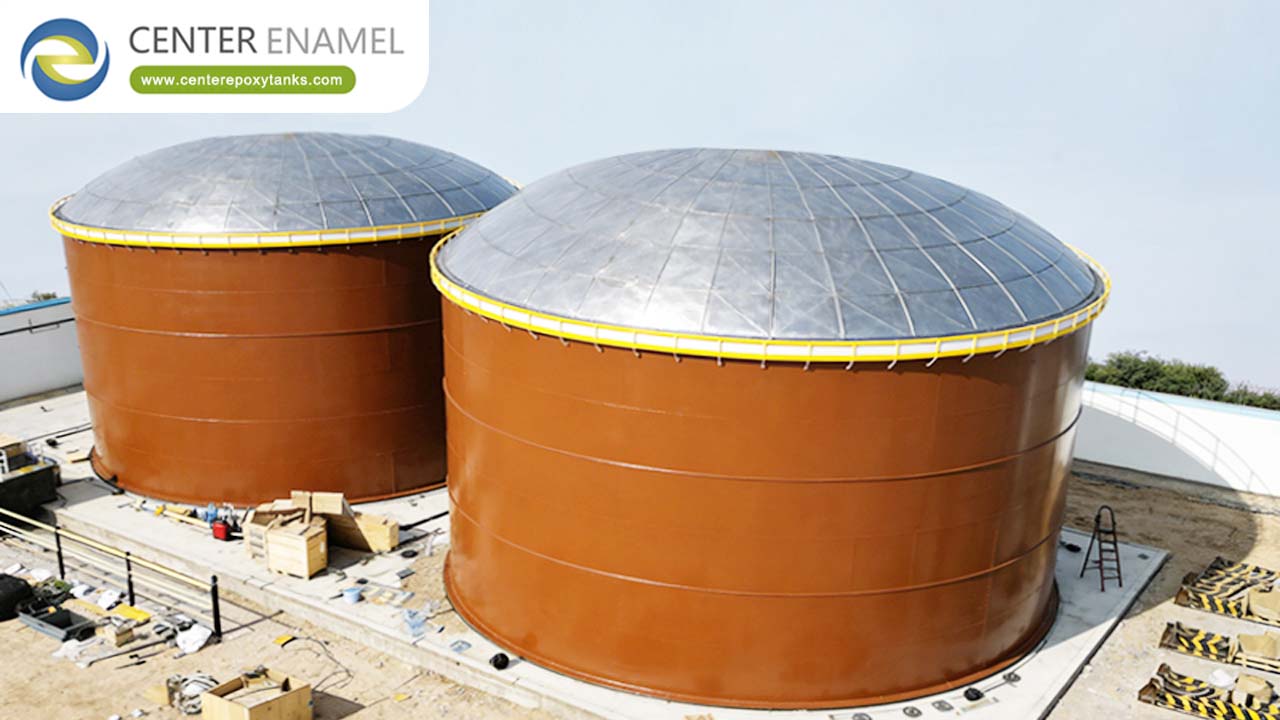
API 650 Compliant Aluminum Geodesic Dome Roofs for Fuel Oil Storage
In the modern petrochemical landscape, the roof of a storage tank is its first line of defense against environmental degradation and vapor loss. For fuel oil storage facilities, transitioning to Aluminum Geodesic Dome Roofs designed to API 650 Appendix G standards is the industry-standard choice for reliability. By leveraging high-strength, marine-grade aluminum, these clear-span structures eliminate the maintenance bottlenecks associated with traditional carbon steel roofs, ensuring long-term operational integrity and regulatory compliance.
1. Technical Compliance: API 650 Appendix G
While API 650 primarily governs tank shell and floor design, its Appendix G provides the rigorous structural framework for aluminum dome roofs. Compliance is critical for guaranteeing that the roof can withstand environmental loads while maintaining seal integrity.
Design Standards: Engineered to meet API 650 Appendix G, ensuring compatibility with existing or new fuel oil tank shells.
Material Specifications: Construction utilizes high-strength alloys like 6061-T6 (structural members) and 3003-H14 (roof panels), which provide exceptional strength-to-weight ratios.
Structural Efficiency: The geodesic geometry allows for a clear-span design, removing the need for internal support columns. This eliminates "hot spots" for internal corrosion and simplifies the installation of internal floating roofs (IFR).
2. Performance Comparison: Aluminum Dome vs. Fixed Steel Roof
For fuel oil storage, the operational advantages of aluminum domes significantly outweigh the initial material investment:
Feature | Aluminum Geodesic Dome Roof | Traditional Fixed Steel Cone Roof |
Maintenance | Negligible (Self-passivating oxide layer) | High (Requires periodic repainting) |
Internal Supports | None (Clear Span) | Required (Risk of column corrosion) |
Corrosion Resistance | Excellent (Naturally resistant) | Low (Prone to rust/pitting) |
Weight | Lightweight (Lower foundation load) | Heavy (Requires structural reinforcing) |
Installation | Rapid (Bolted modular components) | Slow (Site welding and hot work) |
Emission Control | Highly effective (Tight vapor seal) | Variable (Potential for leakage at seams) |
3. Why Fuel Oil Terminals Prefer Aluminum Domes
VOC & Emission Mitigation: The geodesic dome acts as a protective barrier over the product, significantly reducing wind-driven evaporation and helping facilities meet stringent environmental regulations (EPA 40 CFR 60/63).
Rainwater & Contaminant Exclusion: By sealing the tank against external elements, these domes prevent the water ingress that causes fuel contamination and accelerates internal tank degradation.
Reduced Lifecycle Costs: Unlike steel, which requires constant external and internal coating remediation, aluminum domes offer a service life exceeding 25+ years with minimal intervention, dramatically reducing facility downtime.
Seismic Resilience: The geodesic structure naturally distributes seismic loads throughout the framework, providing superior stability in regions prone to tectonic activity compared to rigid steel structures.
4. Frequently Asked Questions (FAQ)
Q: Can aluminum dome roofs be retrofitted onto existing API 650 tanks?
A: Yes. Aluminum domes are modular and lightweight, allowing them to be installed on existing tank shells, often without requiring major structural modifications to the foundation.
Q: Do these roofs handle heavy snow and high-wind loads?
A: Absolutely. Every dome is engineered based on site-specific weather data, including snow loads, wind shear, and seismic risk, ensuring full compliance with local building codes and API 650 standards.
Q: Does aluminum pose a fire risk in fuel storage?
A: No. Aluminum has a lower fire load than steel and excellent thermal dissipation properties. When combined with proper venting and safety equipment, these roofs are fully compliant with NFPA and international fire safety standards for hydrocarbon storage.
Engineering Your Storage Future
As global standards for fuel storage move toward greater efficiency and environmental safety, Center Enamel provides the engineering expertise to support your infrastructure upgrades. From initial design and stress analysis to precision fabrication and on-site assembly guidance, we ensure your storage assets are future-proof.
Are you planning a project for a new fuel oil terminal or a structural retrofit for an existing aging tank roof, and would you like to review our technical design templates?


