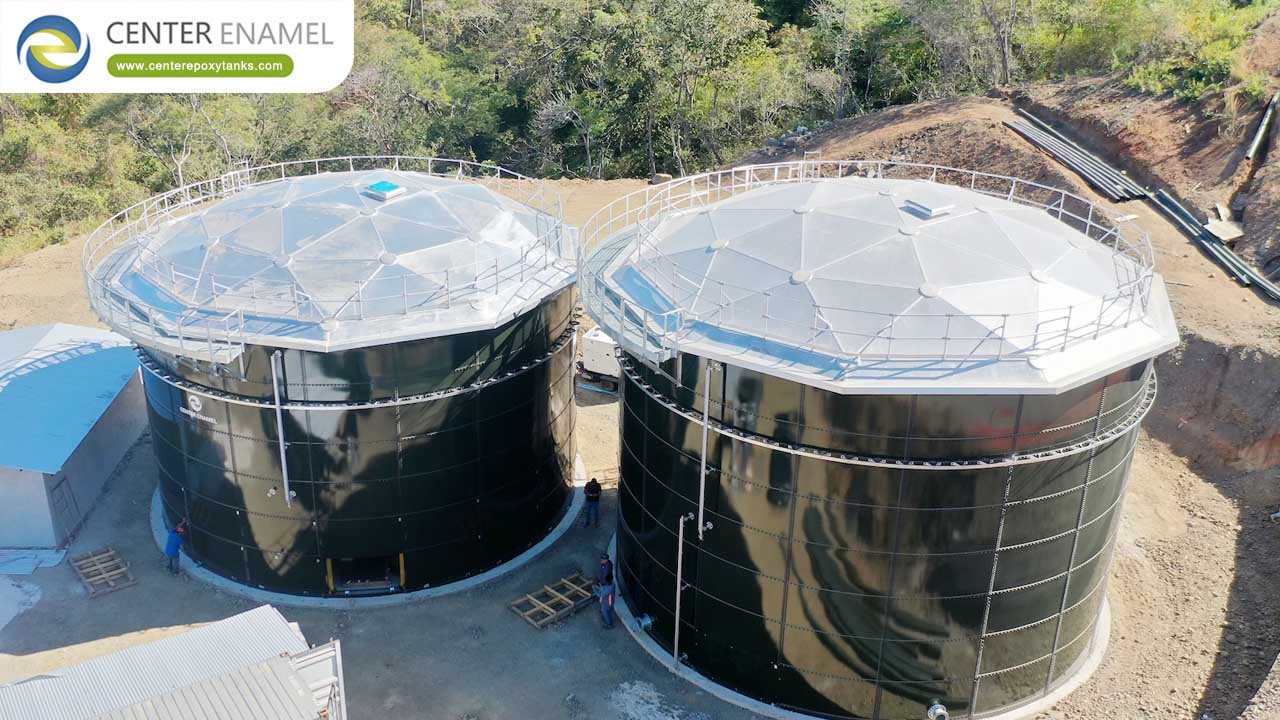
Aluminum Geodesic Dome Roofs: The Standard for Landfill Leachate Storage
Landfill leachate is one of the most chemically aggressive substances in waste management. Containing it requires infrastructure that is not only leak-proof but also chemically inert to protect against the high concentrations of ammonia, volatile organic compounds (VOCs), and hydrogen sulfide ($H_2S$). Aluminum Geodesic Dome Roofs are the industry-leading solution for leachate storage tanks, offering a lightweight, maintenance-free, and highly corrosion-resistant cover that outlasts traditional steel or concrete alternatives.
1. Why Aluminum for Leachate?
The atmospheric environment inside a leachate tank is often more corrosive than the liquid itself. Vapor-phase corrosion rapidly attacks painted steel, eventually causing structural failure.
● Natural Corrosion Resistance: Aluminum naturally forms a protective oxide layer that is highly resistant to the humid, acidic, and chemical-laden environment of a leachate storage tank.
● Maintenance-Free Lifespan: Unlike steel roofs, aluminum domes do not require painting, sandblasting, or re-coating. This drastically reduces the Total Cost of Ownership (TCO) and eliminates the need for hazardous work inside confined, toxic spaces.
● Weight Advantage: Because aluminum has a superior strength-to-weight ratio, it places minimal load on the tank walls, making it the ideal choice for retrofitting existing, aging storage tanks.
2. Engineering Advantages: The "Clear-Span" Design
Leachate storage often requires large-diameter tanks to manage peak flow volumes. Aluminum geodesic domes utilize a triangular, space-frame geometry that provides unique engineering benefits:
● Self-Supporting/Clear-Span: The dome structure is self-supporting, meaning it does not require internal columns or supports. This provides an unobstructed interior, allowing for the installation of mixers, aerators, or level-monitoring equipment without interference.
● High Structural Integrity: Designed to meet rigorous standards (such as ASCE 7 and Aluminum Association guidelines), these domes handle heavy snow loads, high wind uplift, and seismic activity with ease.
● Airtight Odor Containment: For landfill sites, odor control is a regulatory requirement. Geodesic domes provide a superior seal, which, when paired with odor control/scrubber systems, prevents hazardous vapors from escaping into the surrounding community.
3. Comparison Matrix: Leachate Tank Roofs
Feature | Aluminum Geodesic Dome | Fixed Steel Roof | Concrete Roof |
Corrosion Resistance | Excellent (Natural) | Low (Requires coating) | Moderate (Requires liner) |
Maintenance | Near-Zero | High (Periodic painting) | Moderate |
Weight | Lightweight | Heavy | Very Heavy |
Span Capability | Clear-Span (No columns) | Limited | Limited |
Ease of Installation | Fast (Bolt-together) | Slow | Slow (Formwork) |
4. Key Considerations for Landfill Specifications
When specifying a dome for a leachate project, the following parameters are critical:
1. Vapor Containment: The dome must be equipped with high-quality gasketing at the tank-to-roof interface to ensure no fugitive emissions escape.
2. Structural Load Calculation: Leachate tanks are often located in open areas exposed to severe weather. The dome must be engineered specifically for the site’s wind, snow, and seismic coefficients.
3. Chemical Sensitivity: Ensure the aluminum alloy used is compatible with the specific VOC concentrations of the leachate. While aluminum is generally excellent, specific anodizing treatments may be recommended for extremely high concentrations of certain acids.
5. Frequently Asked Questions (FAQ)
Q: Can aluminum domes be installed on older concrete tanks?
A: Yes. Because aluminum domes are lightweight, they are the preferred solution for replacing failing, corroded, or structurally compromised steel or concrete roofs on existing leachate tanks.
Q: Does the geodesic structure trap gas?
A: Yes, which is exactly why they are used. The dome serves as a primary containment vessel. Combined with a negative pressure ventilation system, it ensures that all odors and hazardous gases are routed directly to your treatment/scrubber system.
Q: What is the lead time for an aluminum dome compared to a steel roof?
A: Aluminum domes are often faster. Because they are modular and manufactured to precise specifications off-site, the "site time" is significantly reduced. This allows for rapid facility upgrades without lengthy site disruptions.
Engineering Certainty for Leachate Management
Leachate containment requires a solution that is as resilient as the waste it stores. An Aluminum Geodesic Dome is not just a roof—it is an engineering asset that provides odor control, structural longevity, and operational safety for the life of your landfill facility.
Are you currently retrofitting an existing leachate tank, or are you in the planning phase for a new storage facility that requires robust odor and vapor control?


