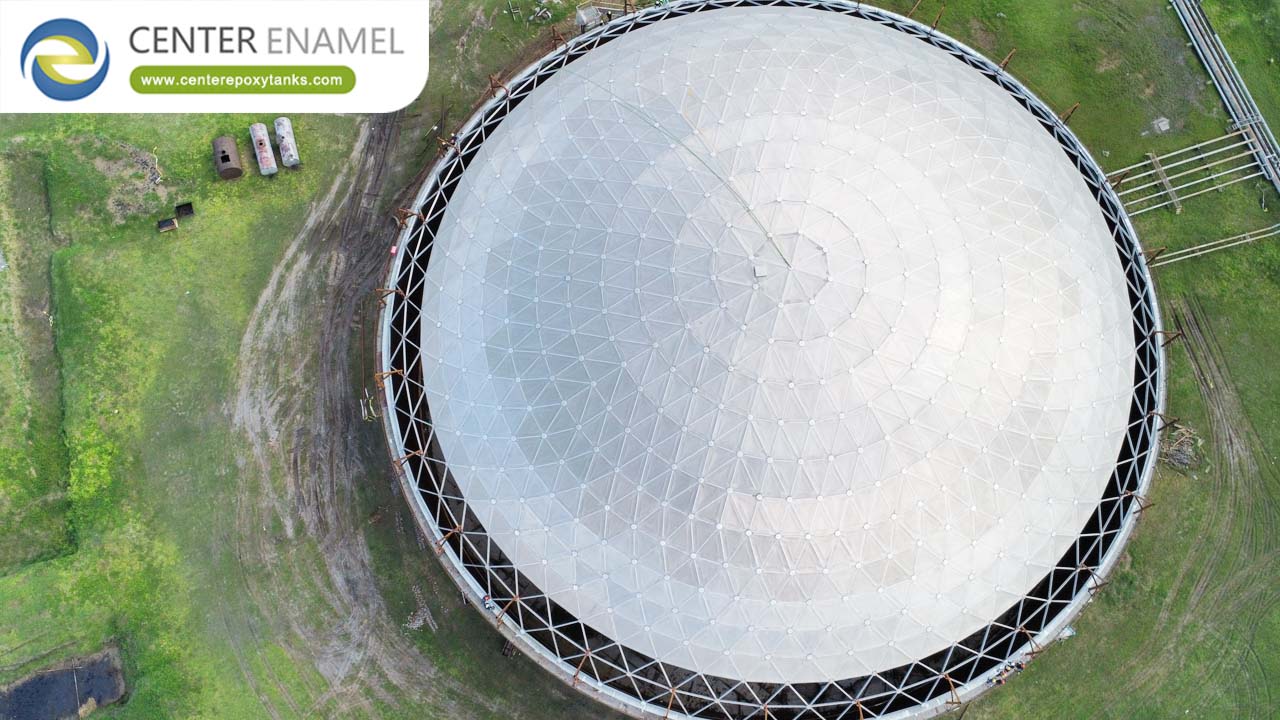
Aluminum Geodesic Dome Roof Installation: Comprehensive Engineering and Assembly Guide
In modern bulk liquid storage—spanning municipal water reservoirs, wastewater treatment plants, industrial chemical silos, and petroleum terminals—protecting internal contents from environmental contamination while minimizing structural maintenance is paramount. Aluminum geodesic domes have become the industry standard for covering aboveground tanks due to their exceptional corrosion resistance and self-supporting, clear-span geometry.
However, realizing the full structural potential of these advanced systems requires meticulous planning, precise geometric assembly, and rigorous adherence to installation protocols. As a globally trusted leader in advanced liquid storage and containment manufacturing, Shijiazhuang Zhengzhong Technology Co., Ltd. (Center Enamel) delivers precision-engineered aluminum dome solutions backed by comprehensive installation methodologies.
Pre-Installation Planning and Engineering Compliance
Before a single aluminum strut or panel is unboxed, a rigorous preparation phase must take place to ensure structural safety and regulatory compliance:
Engineering & Wind/Seismic Verification: Installation plans must adhere to strict structural frameworks such as API 650 Appendix G and AWWA D108, factoring in local wind velocity, seismic zone coefficients, and dead-load distributions.
Site Logistics and Material Staging: Components must be organized in clean, designated staging areas near the installation footprint. Framework tubes, marked numerically by item codes, nodes, and closure panels must be inspected for transit damage.
Harness and Safety Protocol Establishment: Because dome installation frequently occurs at height, mandatory safety measures include daily tailgate meetings, 100% tie-off fall protection policies, and wind speed monitoring (prohibiting lifting operations when sustained winds exceed safe thresholds, typically 12 mph).
Step-by-Step Installation Process
While specific erection techniques vary based on site constraints and tank geometry, the standard installation sequence follows a structured path:
1. Tension Ring and Perimeter Base Attachment
The foundation of any geodesic dome is its integral tension ring, which contains primary horizontal thrust to prevent outward radial loads on the supporting tank wall.
The tension ring segments are aligned and anchored onto the top wind girder or concrete tank rim.
Precise leveling and alignment ensure that subsequent three-dimensional space-frame geometry remains uniform and stress-free.
2. Space-Frame Node and Strut Assembly
Aluminum domes utilize a fully triangulated space truss structure.
Crews assemble the central nodes and interlocking struts progressively, working outward and upward from the tension ring or downward from a central compression ring depending on the erection technique.
High-strength stainless steel fasteners (such as ASTM F593 bolts) are torqued to exact engineering specifications to maintain structural rigidity without stripping the lightweight aluminum components.
3. Panel Installation and Weatherproofing Sealing
Once the structural skeletal framework is secure, aluminum closure panels are installed across the triangular grid:
Batten Method: Raw edges of roof panels are clamped securely using aluminum batten bars, supplemented by high-grade silicone or elastomeric gaskets to guarantee an absolute weather-tight seal.
Lapped Method: Panels overlap downward in a shingle-like configuration and are fastened with specialized screws, offering robust environmental protection.
Data Table: Comparison of Aluminum Dome Installation Methodologies
Installation Parameter | Crane Hoisting Method | Internal Tank-Floor Assembly | External Davit / Tripod System |
Site Footprint Requirements | Requires wide, stable ground space adjacent to the tank for crane staging | Minimal external space required; ideal for tight or confined plant footprints | Limited exterior space needed; relies on the tank perimeter or shell |
Tank Operational Status | Typically used for new tank construction prior to fluid filling | Excellent for retrofitting existing in-service tanks where external access is restricted | Frequently utilized for retrofitting existing tanks while internal floating roofs remain active |
Equipment & Rigging Demand | High dependency on heavy mobile cranes and certified rigging crews | Low machinery dependency; manual labor with basic staging platforms | Moderate equipment needs utilizing specialized perimeter davits or quad-pods |
Safety & Wind Sensitivity | High weather sensitivity; lift operations must halt during high wind events | Controlled interior environment protects workers from severe external wind loads | Moderate exposure during the final positioning and anchoring phases |
Frequently Asked Questions (FAQ)
Q: What are the primary standards governing aluminum geodesic dome installation?
A: Installations typically comply with international engineering benchmarks including AWWA D108 (for water storage covers), API 650 Appendix G (for petroleum and industrial storage), and the Aluminum Design Manual.
Q: Can an aluminum dome be installed on an existing steel or concrete tank while it is in service?
A: Yes. Aluminum dome roofs are frequently retrofitted onto existing operational tanks (such as external floating roof tanks) using internal floor assembly or specialized davit lifting systems without requiring prolonged plant shutdowns.
Q: What weather conditions can halt an aluminum dome installation or lifting procedure?
A: High winds (typically sustained over 12 mph), heavy rain, or lightning storms will immediately halt lifting and overhead assembly operations to prevent structural sway and safeguard personnel.
Q: How do installation teams ensure the dome remains watertight?
A: Watertight integrity is achieved through precision-engineered batten bar clamping systems, high-performance elastomeric gaskets (such as ASTM C509 rubber seals), and specialized overlapping panel configurations designed to shed precipitation efficiently.


