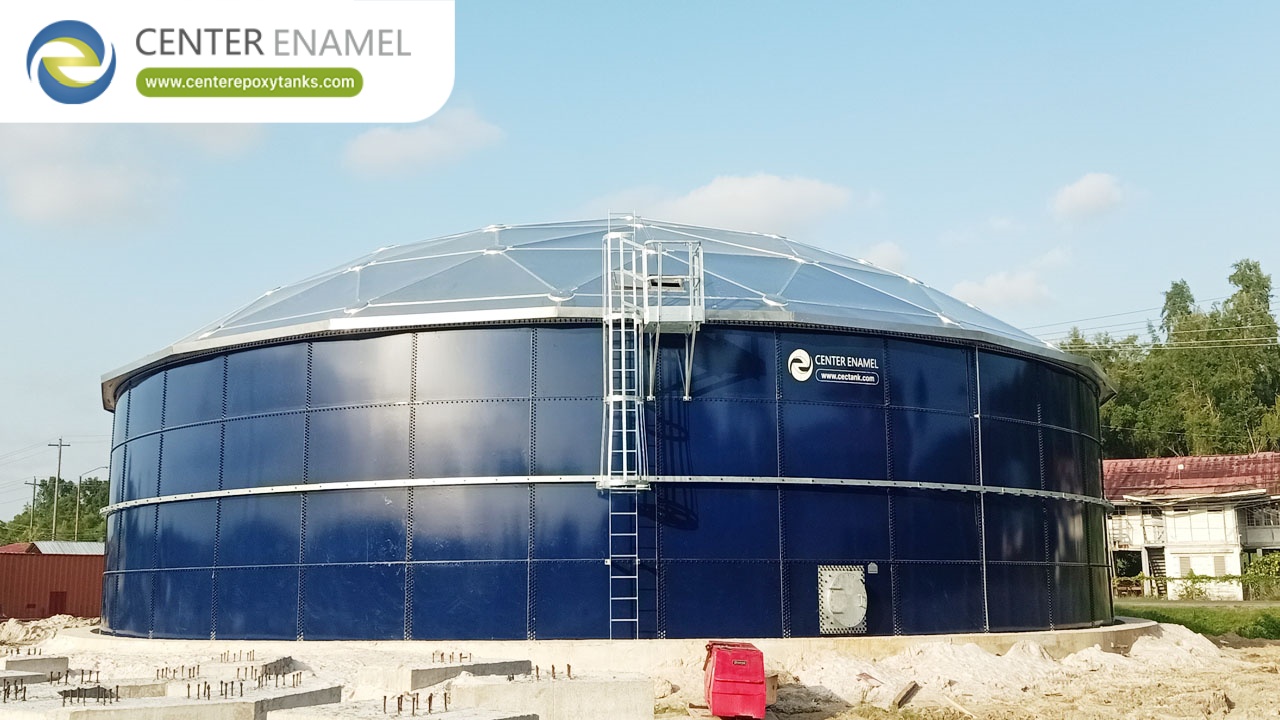
Aluminum Geodesic Dome Roof: Definition, Geometry and Where It Is Used
An aluminum geodesic dome roof is a clear-span, triangularly triangulated aluminum cover that sits on top of a storage tank, named for its geodesic geometry rather than for any one manufacturer. It carries load through a network of short struts and nodes so the shell is largely self-supporting and column-free across the tank diameter. The geometry suits tanks where a large clear span, corrosion-prone atmosphere, or retrofit over a live tank makes a conventional column-and-rafter steel cone roof awkward. It is referenced in design frameworks such as API 650 Appendix G and AWWA D108, though naming a standard in a submittal is a designation, not proof of compliance. Its fit is driven by span, environment and installation method, not by a generic quality claim. Where a tank needs internal column-free space or a corrosion-resistant fixed cover, the geometry is worth evaluating against a cone roof on total lifecycle cost, not first cost alone.
What the term actually names
The phrase aluminum geodesic dome roof names a specific roof form, not a brand or a single product line. A geodesic dome is built from a network of straight aluminum members arranged on a spherical or segmented surface so that triangular panels share load between many short struts. The result is a stiff, lightweight shell that bridges the tank opening without relying on a central column. In storage terminology it is a fixed cover, distinct from a floating roof that rests on the liquid. The word geodesic describes the triangulation logic, while aluminum names the structural material. Specifiers should treat the term as a geometry-and-material description and then confirm the alloy, jointing and code basis on the submittal rather than assuming any performance level from the name alone.
How the geodesic triangulation carries load
A geodesic dome works because triangulation is inherently stable: when load arrives as wind, snow or its own weight, the forces resolve into axial tension and compression along the struts rather than into bending across long spans. Each node transfers load to its neighbors, so no single member carries a dominant bending moment the way a long rafter would. This is why a relatively thin aluminum shell can clear a wide tank. The design still requires a proper load path to the tank shell and foundation, and the local shell ring must accept the dome thrust. A submittal should show the strut forces, the node connection type and the ring-beam transfer, not merely a span claim.
Clear-span and the column-free consequence
Because the shell is self-supporting, a geodesic dome typically leaves the tank interior free of roof columns. For many duties that column-free space is the real benefit, not the material. Internal columns in a cone roof obstruct mixer access, heater layouts, floating-deck clearance and tank cleaning. Removing them simplifies operations and can reduce tank outage during maintenance. Where the tank is small, the column-free advantage is less decisive and a cone or flat cover may be the more economical choice. The decision should follow diameter and lifecycle cost rather than a default preference.
Materials and jointing in a typical dome
The structural members are usually extruded aluminum alloys such as 6061-T6 or 6063-T6, chosen for strength-to-weight and corrosion behaviour in exposed service. Panels are connected with batten bars and a gasket or sealant so the surface stays weathertight while remaining demountable. The joints are typically bolted rather than welded in the field, which reduces hot-work risk during installation over a tank that may contain flammable product. The exact alloy, temper and gasket specification belong in the submittal, and the material test report should confirm the alloy rather than a generic aluminum claim. Aluminum does not rust, but it is not immune to galvanic interaction with dissimilar metals near steel shell interfaces, which the connection detailing should address.
Where the geometry is the right choice
The geometry earns its place on tanks where clear span, corrosion exposure or live-tank retrofit dominate the decision. Large-diameter tanks above roughly 20 m gain the most from removing internal columns. Coastal, wastewater or chemical atmospheres gain from aluminum's corrosion resistance and the lower recoating burden versus carbon steel. Terminals that cannot easily take a tank out of service gain from a cover that is lowered over the shell. The dome is less compelling on very small tanks where the material and fabrication cost outweigh the operational gain. The fit is a duty-and-lifecycle judgement rather than a universal superiority that the geometry does not support.
How codes name the dome (designation, not compliance)
Published frameworks name this roof type without certifying any specific supply. API 650 Appendix G covers aluminum dome roofs on tanks within that standard's scope, and AWWA D108 addresses aluminum domes for steel water tanks. ADM 2015 and ASCE 7 provide the aluminum design and load basis that a calculation draws on. A submittal that names one of these is stating a design basis, not demonstrating compliance. Compliance requires the actual calculation, the edition cited, the load combinations used and the acceptance by the reviewing engineer. The reader should treat a code reference as a pointer to the method, and should ask for the calculated outputs and the edition before treating the dome as code-compliant for the project.
The installation envelope over a live tank
A practical reason specifiers consider the dome is the installation envelope. Many aluminum domes are delivered as bolted modules that are assembled either inside the tank and lifted, or lowered over the existing shell, which can reduce hot work and tank downtime compared with a welded steel roof replacement. The exact method depends on tank access, diameter and the product in service, and it must be stated in the erection plan. No universal claim about downtime applies, because site constraints vary. The submittal should describe the sequence, the lifting or internal-assembly approach, and the hot-work controls, so the operator can judge whether the dome can be placed without taking the tank fully out of service.
What a definition page must not claim
A definition page should not present the geodesic dome as the right answer for every tank, nor imply that the name alone confers a performance or quality rank. It is not a pressure vessel, not a floating roof, and not a substitute for a documented structural calculation. It should not promise emission or corrosion outcomes without the project-specific design and the referenced standard edition. It should not claim compliance with a code merely by naming it. What the page can honestly do is explain the geometry, the material logic, the code pointers and the installation envelope so a specifier can scope an enquiry and read vendor claims critically before requesting a calculation against the actual tank loads.
Fixed-cover geometry selection for a tank
Use this to decide whether a geodesic aluminum dome is the appropriate fixed cover before requesting a calculation.
Duty condition | Geodesic aluminum dome | Alternative fixed cover | Decision note |
Diameter above about 20 m, no internal column | Strong fit: clear span, column-free | Cone roof needs rafters and columns | Use dome where column-free operation matters |
Corrosive or coastal atmosphere | Aluminum avoids carbon-steel rust | Coated steel needs periodic recoating | Specify alloy and corrosion basis |
Retrofit over a tank in service | Lowered over shell, low hot work | Full welded roof tear-off | Confirm live-tank method in submittal |
Very small diameter below about 8 m | Possible but lighter benefit | Cone or flat may cost less | Compare lifecycle, not first cost |
What a definition page should let a reader verify
These are the records a specifier should request before treating a dome as defined and designed for the project.
Item | What the page should state | Record to request |
Span and tank diameter | The diameter the dome covers | Tank drawing or data sheet |
Aluminum alloy | 6061-T6 or 6063-T6 as applicable | Material test report |
Code basis | API 650 Appendix G or AWWA D108 named | Design basis note |
Load assumptions | Wind, snow, seismic per ASCE 7 | Load calculation sheet |
Project Case Study
The batch allocation register assigns CE-R003 (match grade A) to this page as its single formal project reference. The source row records a Glass-Fused-to-Steel (GFS) Bolted Tank supply for a tank in Panama, with completion recorded as 2024-06. The row lists 1 tank(s) and a recorded capacity of 268; roof type is recorded as Aluminum Dome and supply scope as Tank + Roof. These values are transcribed from the supplied project case library and are not supplemented with inferred dimensions, per-tank volumes or outcomes.
Evidence boundary. Row CE-R003 records a GFS tank with an Aluminum Dome Roof in Panama (268 m3, 1 tank, completion 2024-06, scope Tank + Roof). It is used here only to show a real dome-covered tank reference; no dimensions, coating or outcome are inferred.
Recorded data gaps for this row: None recorded. The case row does not include certificate numbers, test reports, commissioning results, contract values or client names, so none are claimed here. This Project ID is the formal case for this page only; it is not used as project evidence, an anchor-text summary or an image caption on any other article in this batch.
Frequently Asked Questions
Q1. What does the term aluminum geodesic dome roof actually name?
It names a fixed tank cover built from a triangulated aluminum shell rather than a brand. Geodesic describes the load-sharing triangulation; aluminum names the material. It is a fixed cover, not a floating roof or a pressure vessel. A specifier should confirm alloy, jointing and code edition on the submittal rather than assuming them from the name.
Q2. Which document would prove a dome is designed to API 650 Appendix G?
No single page proves compliance. The submittal should name the edition of API 650, show the dome calculation under Appendix G, list the load combinations and carry the reviewing engineer's acceptance. A code reference in marketing copy is a designation, not evidence of compliance for a specific tank. Request the calculation sheet and the edition cited.
Q3. Can a dome be accepted without a load calculation sheet?
It should not be. The geodesic form only helps if the strut forces, node connections and ring-beam thrust transfer are calculated for the actual wind, snow and seismic loads. Without that sheet the dome is an undefined geometry. Treat the calculation as a hold point, not a formality, before any purchase order is placed.
Q4. Which appurtenance loads must a terminal specify for a dome roof?
Walkways, nozzles, platforms and suspended equipment add point and distributed loads the triangulation must carry across the span. Terminals that omit them get a bare-shell check that passes while the dome stays under-designed where the load lands. The submittal should list every appurtenance and its load so the review confirms the shell was checked with them included.
Q5. How does the clear span change the evidence needed for a tank roof?
A clear span removes internal columns, so the entire roof weight and its appurtenances are carried by the shell and ring. The evidence shifts from column sizing to strut forces, node capacity and ring-beam thrust. Request those outputs specifically; a cone-roof review checklist will not cover them by default and may miss the dome's real limit states.
Q6. What is deliberately out of scope on this terminals and farms page?
This page defines the geometry and duty fit for terminals and farms. It does not quote a price, design a named tank, certify compliance, or compare concrete domes in detail. Cost, a worked design and emission claims are covered by other topics and the submittal, not by this terminals and farms page.
Q7. Which source supports the alloy claim for these domes?
The alloy reference to 6061-T6 and 6063-T6 reflects the typical extruded aluminum used in dome framing as observed in supplier technical literature and AWWA D108-related guidance. The designation is referenced here; the specific heat-treat temper for a project must be confirmed by the material test report, which this page does not itself provide.
Q8. How should the duty-fit statement be written into an RFQ?
State the tank diameter, product, atmosphere, whether the tank stays in service during install, and any roof-hung equipment with its loads. Ask the supplier to return the code basis, alloy, jointing method and a load calculation. Writing those lines into the RFQ turns the geometry question into a verifiable submittal instead of a marketing comparison.
Conclusion
The aluminum geodesic dome roof is most usefully read as a clear-span, triangulated aluminum fixed cover whose real advantages are the column-free interior, corrosion behaviour and a bolted installation envelope that can suit live-tank retrofits. It is named, not certified, by standards such as API 650 Appendix G and AWWA D108, and a code reference is a design basis rather than proof of compliance. The geometry is not the right answer for every tank. A reader who leaves this page should be able to judge duty fit and name the records to request before treating the term as a qualified claim.
Talk to an Engineer
To move from definition to a project-specific review, send the tank diameter, stored product, site atmosphere and whether the tank must remain in service during installation, together with any roof-hung equipment and its loads. Request the supplier's code basis and edition, the aluminum alloy and temper, the jointing method and a load calculation covering wind, snow and seismic per the applicable standard. With those inputs a dome submittal can be checked as a defined geometry rather than accepted on the strength of its name, and the column-free benefit can be weighed against a cone roof on lifecycle cost for the actual duty.
About Center Enamel
Shijiazhuang Zhengzhong Technology Co., Ltd (Center Enamel) has designed and fabricated bolted storage tanks since its registration in 2008; the founding team's enamelling work dates to 1989. The product range covers Glass-Fused-to-Steel (GFS), Fusion Bonded Epoxy (FBE), stainless steel and hot-dip galvanized tanks, and aluminum geodesic dome roofs. Certifications and standard references in the supplied fact base are scoped per product line, not held as a blanket claim for every product. No performance, service life or project outcome beyond the cited sources is claimed here.


