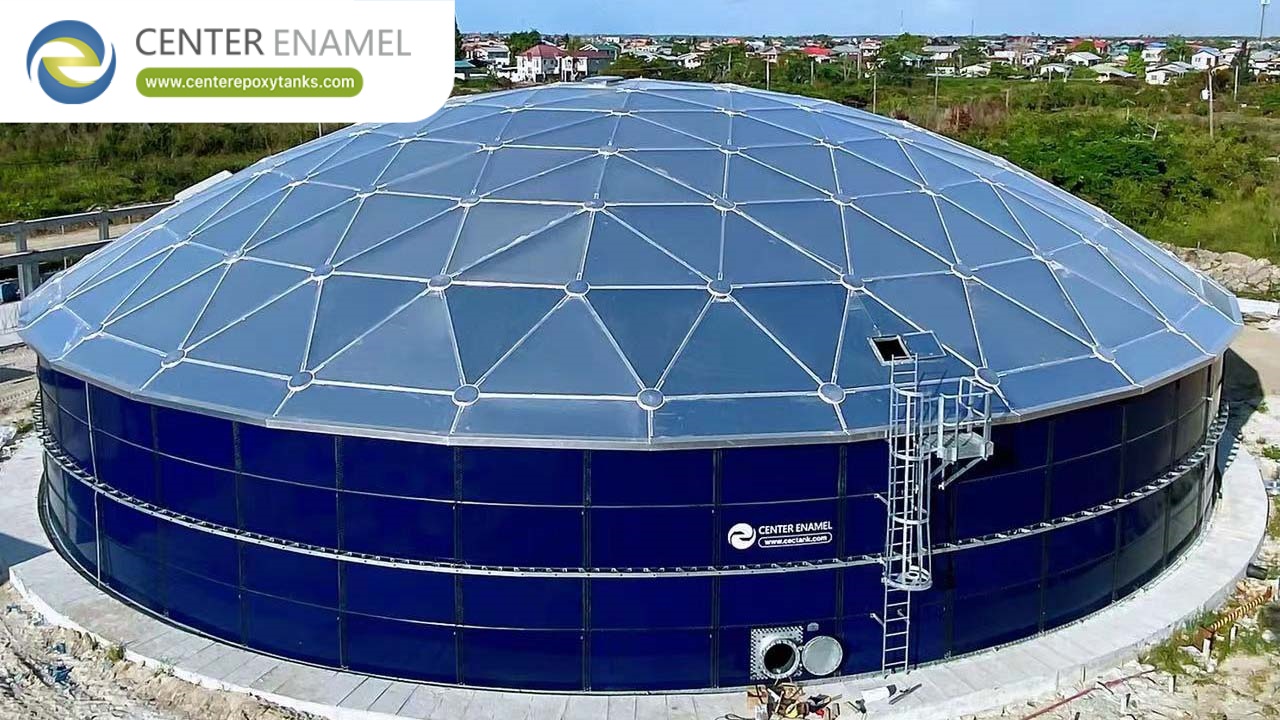
Aluminum Geodesic Covers – Lightweight and Durable Protection for Storage Tanks
In industrial, municipal, and petroleum storage applications, protecting stored liquids from environmental contamination, evaporation losses, and structural degradation is critical. Traditional steel and concrete fixed roofs often suffer from high dead weights, complex internal column requirements, and high susceptibility to atmospheric corrosion. To overcome these operational hurdles, modern storage asset managers increasingly specify aluminum geodesic covers as the industry standard for aboveground containment structures.
Engineered on the geometry of triangulation, aluminum geodesic dome roofs provide an exceptional strength-to-weight ratio, complete self-supporting clear spans, and lifelong resistance to environmental corrosion. As a global leader in advanced containment engineering, Shijiazhuang Zhengzhong Technology Co., Ltd. (Center Enamel) delivers custom-engineered aluminum dome solutions that maximize structural integrity and long-term asset value.
1. The Engineering Principle: Triangulation and Clear-Span Integrity
The defining characteristic of an aluminum geodesic cover is its spherical, triangulated structural framework:
Uniform Load Distribution: By breaking the dome's curved surface into an interconnected network of rigid triangular elements, environmental loads (such as heavy wind, torrential rain, and snow accumulations) are distributed evenly across the entire frame and transferred directly to the tank shell.
Clear-Span Architecture: Because geodesic domes are completely self-supporting, they require no internal support columns. This eliminates internal obstruction, prevents internal corrosion points, and allows interference-free operation for internal floating roofs, mixers, and liquid level gauges.
API 650 and AWWA Compliance: Advanced geodesic structures are designed in strict accordance with API 650 Appendix G and AWWA D108 standards, utilizing non-linear structural analysis to ensure safety under rigorous operational parameters.
Data Table: Storage Tank Roof Technology Comparison Matrix
Technical Parameter | Aluminum Geodesic Dome Cover | Traditional Welded Steel Cone Roof | Poured-in-Place Concrete Roof |
Structural Framing | Self-supporting triangular clear-span frame | Rafters and support columns requiring internal pillars | Heavy concrete beams and central support pillars |
Corrosion Resistance | Inherent, lifelong passivation without painting | Moderate to Low (Requires periodic sandblasting and recoating) | Variable (Prone to cracking, spalling, and rebar oxidation) |
Dead Weight Load | Extremely Lightweight (Minimizes foundation stress) | Heavy (Imposes high structural stress on tank walls) | Extremely Heavy (Requires deep foundation piling) |
Installation Speed | Rapid: Modular pre-fabricated assembly in days/weeks | Slow: Requires extensive on-site welding and crane lifting | Very Slow: Formwork, pouring, and multi-week curing |
Governing Standards | API 650 Appendix G, AWWA D108 | API 650 / AWWA D100 | ACI Structural Code Standards |
2. Inherent Material Benefits: Durability, Low Maintenance, and Emission Control
Aluminum alloys provide unique physical properties that make them superior for industrial tank protection:
Natural Corrosion Resistance: Aluminum forms a self-healing, protective oxide film upon atmospheric exposure. It does not rust, making it entirely impervious to humid tank headspaces, marine air, and aggressive chemical vapors without requiring protective paint.
Drastic Emission Reduction: For petroleum and chemical storage, geodesic domes paired with internal floating roofs provide a gas-tight seal that minimizes volatile organic compound (VOC) emissions and prevents product evaporation losses.
Rapid Retrofit Capability: Aluminum geodesic covers can be erected over existing operational tanks—often while the tank remains in service—saving facility operators costly downtime.
Frequently Asked Questions (FAQ)
Q: Why choose an aluminum geodesic cover over a traditional steel roof?
A: Aluminum geodesic covers offer a self-supporting clear-span design that eliminates internal support columns, provides a much higher strength-to-weight ratio, and features natural, maintenance-free corrosion resistance without requiring periodic repainting.
Q: Do aluminum geodesic dome roofs comply with international engineering standards?
A: Yes. High-performance aluminum domes are engineered and fabricated in strict compliance with global standards, including API 650 Appendix G and AWWA D108 specifications.
Q: Can an aluminum geodesic dome be retrofitted onto an existing operational storage tank?
A: Yes. Due to their lightweight modular construction, aluminum geodesic covers can be easily assembled adjacent to tanks and lifted into place or built directly over existing structures while tanks remain in service.
Q: How do aluminum geodesic covers help control emissions in fuel storage?
A: By providing a rigid, completely sealed upper barrier that limits solar heat absorption and stops wind-induced breathing losses, geodesic domes significantly reduce VOC evaporation and malodorous gas emissions.


