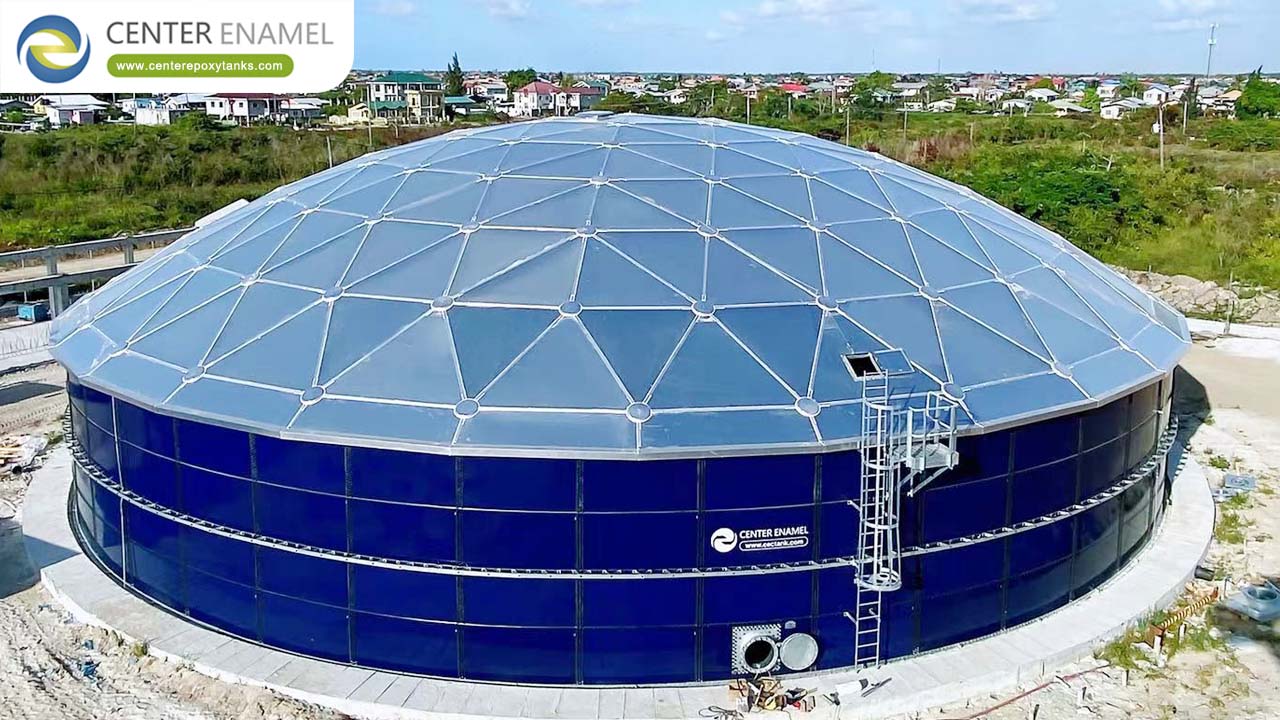
Aluminum Domes for Petroleum Tanks: Optimizing Storage with Clear-Span Engineering
Aluminum geodesic domes are the industry-standard roofing solution for petroleum storage tanks, engineered to comply with API 650 Appendix G. These clear-span structures eliminate the need for internal support columns, significantly increasing effective storage volume while reducing Volatile Organic Compound (VOC) emissions by up to 90%. As a global leader, Center Enamel (Shijiazhuang Zhengzhong Technology Co., Ltd) utilizes high-strength 6000-series aluminum alloys to provide maintenance-free, corrosion-resistant covers that withstand extreme seismic and weather loads in the harshest industrial environments.
1. Technical Specification & Compliance Matrix
This matrix defines the engineering benchmarks for petroleum-grade aluminum domes.
Feature | Technical Specification (2026 Standard) | Strategic Utility Value |
Design Standard | API 650 Appendix G / ADM 2020 | Mandatory for petroleum tank structural safety. |
Alloy Grade | 6061-T6 / 6063-T6 Aluminum | Superior strength-to-weight; C5-M corrosion rating. |
Seal Technology | Silicone / EPDM Gaskets | UV-resistant; ensures gas-tightness and leak prevention. |
Span Capability | Up to 120m+ (Clear-Span) | Eliminates columns; reduces vapor space and sludge. |
VOC Mitigation | Reduces emissions by ~90% | Critical for ESG compliance and product loss prevention. |
Load Resistance | ASCE 7-22 / Eurocode 3 | Engineered for hurricane-force winds and heavy snow. |
2. Structural Engineering: The Geodesic Advantage
Clear-Span Integrity and Vapor Control
Traditional fixed-roof tanks require internal columns that penetrate the floating roof, creating "wicking" points for evaporation.
● Column-Free Design: Aluminum geodesic domes are self-supporting. By removing internal pillars, operators can install full-contact Internal Floating Roofs (IFR), drastically reducing the "breathing losses" of volatile hydrocarbons.
● Reflectivity and Temperature Regulation: Aluminum’s high thermal reflectivity (low emissivity) keeps the stored product cooler, reducing internal pressure buildup and further curbing evaporation losses.
Metallurgy and Corrosion Defense
● Inherent Oxide Layer: Unlike carbon steel, aluminum naturally forms a protective oxide layer that self-heals. This makes it impervious to the H2S (Hydrogen Sulfide) and moisture commonly found in crude oil and sour service environments.
● Weight-to-Strength Ratio: An aluminum dome weighs approximately 1/3 to 1/5 of a comparable steel roof. This allows for the retrofitting of older tanks whose foundations or shells can no longer support the weight of a heavy steel replacement.
3. High-Stakes Applications in the Petroleum Sector
● Crude Oil Terminal Storage: Protecting massive-scale assets from rainwater ingress and costly evaporation.
● Refined Product Tanks: Maintaining the purity of gasoline, jet fuel, and diesel by preventing external contamination.
● Aggressive Service Environments: Ideal for coastal refineries where salt spray accelerates the corrosion of traditional steel infrastructure.
● Wastewater & Equalization Tanks: Used in refinery treatment plants to contain odors and hazardous vapors.
4. Why Partner with Center Enamel?
As a Global Leading Storage Solutions Provider, Shijiazhuang Zhengzhong Technology Co., Ltd offers a unique technological advantage:
● 30-Year EPC Excellence: We provide a single point of accountability—from initial Finite Element Analysis (FEA) for load distribution to precision CNC fabrication.
● Precision Modular Fabrication: Our aluminum domes are precision-engineered for rapid "bolt-together" assembly. This minimizes "hot work" on-site, a critical safety requirement for active petroleum facilities.
● Comprehensive Integration: Center Enamel is the only manufacturer offering a seamless integration of Aluminum Domes with Glass-Fused-to-Steel (GFS), Fusion Bonded Epoxy (FBE), and Stainless Steel tanks.
● Global Compliance Mastery: Our engineering team ensures all dome designs meet API 650, AWWA D108, and local Eurocodes, facilitating insurance approvals and regulatory compliance.
5. Technical FAQ: Aluminum Geodesic Domes
Q: Can aluminum domes be installed on existing steel tanks?
A: Yes. Their lightweight nature makes them the ideal choice for retrofitting. Because they exert minimal load on the tank shell, they can often be installed without requiring foundation reinforcement.
Q: How do aluminum domes handle extreme snow or wind loads?
A: Every dome is custom-engineered using FEA software to calculate the specific triangular lattice density required to meet local ASCE or Eurocode environmental loads.
Q: What is the maintenance requirement for an aluminum dome?
A: Virtually zero. Unlike steel roofs that require sandblasting and repainting every decade, aluminum domes do not rust or peel, leading to significant lifecycle cost savings (TCO).


